
“How To Win The Long Game” is the final chapter of our series and we dig into the rules and guidelines for better investing and portfolio risk management.
Chapter 1: Think Like An Investor
Chapter 2: Investor Psychology
Chapter 3: Why Crashes, Timing & Valuations Matter
Over the first four articles, we have spent most of our time on what NOT to do.
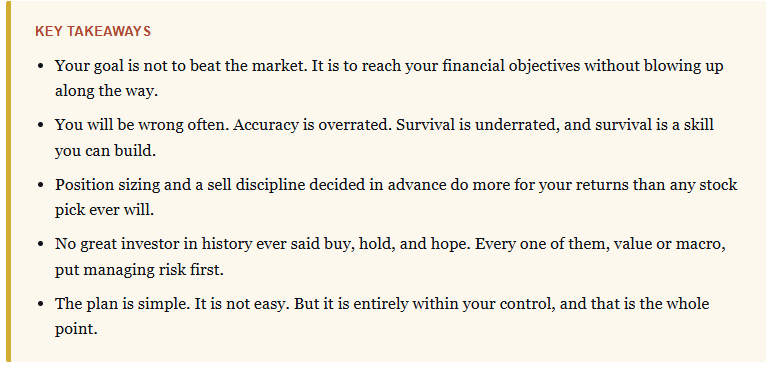
- Do not speculate when you think you are investing.
- Do not let your psychology or your conditioning run your money.
- Ignoring the math of losses, valuations, and timing can be devastating
- And, most importantly, do not swallow the comfortable myths that tell you to stop thinking.
If you have made it this far, you are probably ready for the obvious question.
“Okay, so now that you have told me everything NOT to do, what SHOULD I be doing?”
The answer comes down to a discipline almost nobody teaches beginners, and it is the foundation of everything that follows. Portfolio risk management.
In our final chapter for this series, we will dig into that exact question. Unfortunately, there is good and bad news, and it can be summed up in a single sentence.
The plan is simple, but it is not easy.
What is most important is that you don’t need a genius IQ, a Bloomberg terminal, or a secret indicator to invest for the long term. It just requires a goal, a disciplined process, and the conviction to follow your own rules when every instinct is screaming at you to abandon them.
So, let’s get started.
Start With A Goal, Not A Guess
First, stop everything you are currently doing. Before you buy a single share, you need to answer a singular question that almost nobody asks.
“What is the money actually for?”
Investing without a defined goal is just gambling with extra steps. “Retirement” isn’t a goal that is a concept. Be very specific about your dollar goals. For example:
- I need $35,000 for a new car.
- A 5% downpayment on a $300,000 house is $15,000.
- To generate $5,000 a month in retirement, I need a lump sum of $1.3 million in bonds yielding 4.5% annually.
Being specific about your goals is crucial because your plan starts with three numbers that have nothing to do with the market.
- The amount you are starting with,
- The amount you need it to grow to, and
- How much time do you have to get there?
From those, you can go back to the only benchmark that matters, which we covered in the last article. The rate of return your plan actually requires, earned at the lowest risk that gets you there.

This reframing is critical to successful outcomes because it takes a nebulous concept that may seem out of reach and turns it into a concrete objective that can be broken down into smaller, more achievable ones.
Furthermore, being specific about your goals reduces overall portfolio risk. For example, if your plan needs a 6% return to fund the life you want, then chasing a 15% return requires excess risk you do not need and, most likely, cannot afford. Trying to win a game of “beat the market” that you were never required to play often leads to disappointing outcomes.
Lastly, the foundation you build early includes the boring, unglamorous work that comes before investing at all. As we laid out in the “10 Laws Of Money,” spending less than you earn, clearing high-interest debt, and holding a cash reserve are the foundation to build successful outcomes. You cannot manage a portfolio if a single emergency forces you to sell it at the bottom. Get the base solid first, then build the rest.
Accept The Hard Truth
Here is the single most liberating fact in investing, and almost nobody tells beginners about it. You are going to be wrong. A lot. Not because you are bad at this, but because everyone is eventually wrong and more often than you think.
Steve Cohen, one of the most successful traders alive, has said his best trader is right only about 63% of the time, and most traders are right barely more than 50% of the time.
Look at baseball, where the greatest hitters in history reached base on roughly a third of their swings. The best in the world at these games fail most of the time and still win.
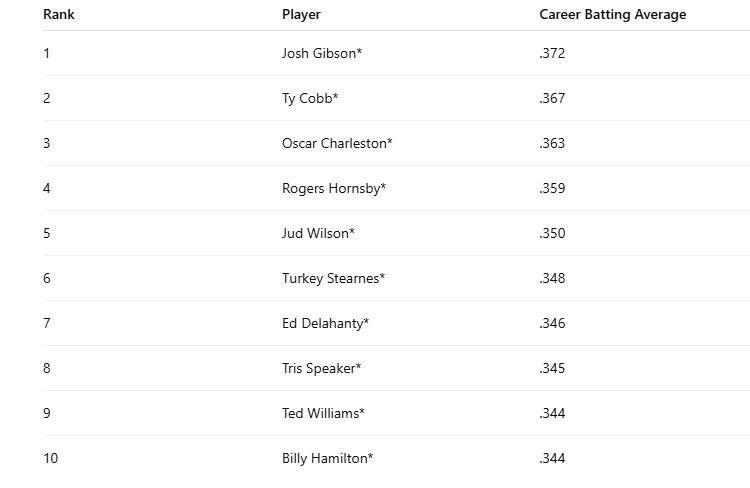
Stop and think about that for a moment, because it undercuts many of the things that we were taught, or at least believe to be true. If even the professionals are wrong nearly half the time, then obsessing over being right is a losing strategy. The edge is not accuracy. The edge is what happens when you are wrong.
In Portfolio Risk Management, Accepting The Hard Truth, we discussed how accuracy is overrated while survival is underrated. Here is the sentence I want you to focus on.
“The investors who survive the longest are not the ones who are right most often; they are the ones who make sure that being wrong never takes them out of the game.“
That’s it. That is the entire job of managing your own portfolio. Every time you invest, the only goal is to keep your losses small enough to survive, and let your winners run long enough to matter.
Manage Risk Like A Professional
So if survival is the goal, how do you actually build it into a portfolio? Professional risk managers, from hedge funds to trading desks, lean on the same three tools.
- Position sizing,
- A “sell” discipline, and
- The self-control to follow both.
None of those tools is complicated; it is just that most investors ignore them, which is exactly why most investors underperform.
Start with the most powerful and least appreciated of the three. Position sizing. How much of your money you put into any one bet matters far more than the bet itself. Research suggests that sizing drives the vast majority of a strategy’s risk-adjusted results, meaning how much you risk matters more than what you buy.
The logic behind position sizing and risk management, while brutal, is also elegantly simple. If you risk 1% of your account on a position and you are wrong, you lose 1%. That loss, while painful, is survivable and quickly recoverable. However, if you risk 5%, 10%, or more on a singular position or sector concentration, a losing streak will dig a hole for you very quickly.
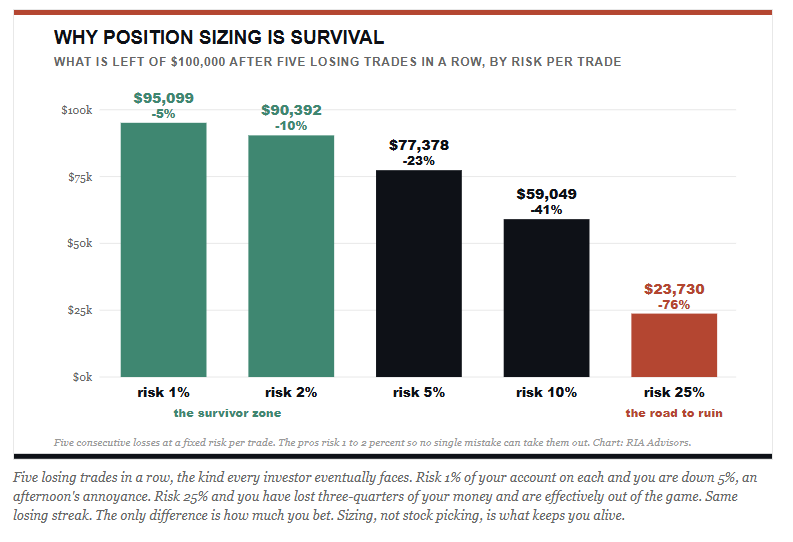
This concept is important because it turns the same math of loss from the third article into a tool. A small loss can be recovered in days or even weeks, but a large one can end your entire plan. This is why professional investors generally risk only a controllable amount of their investment capital on any single position. This is precisely so that no single mistake or unlucky streak can ever take them out.
No, this is not exciting. It also will not “make you rich” quickly; however, it is the secret to survival, engineered on purpose. And notice the quiet second benefit. When losses are small, they reduce the panic and bad decisions that the second article tries to cure. Good sizing protects both your capital and your judgment.
That is the easy part. The second tool, the most critical and difficult to use, is the “sell discipline.” Here is a simple process to follow:
“Before you ever buy a single share of anything, decide the price at which you will admit you were wrong and get out.”
Write it down and make it sacred.
Legendary investor Bill O’Neil had a rule to cut his losers at 7% or 8%. Warren Buffett’s first rule is simply do not lose money; the second rule is to remember the first.
The specific number matters less than the commitment you make, and the one unbreakable law is this.
“Never, ever move your stop farther away to avoid taking the loss”.
That is not patience or discipline. That is how a small, planned loss becomes a catastrophic one. If you want a simple version, a moving average, such as the 50- or 200-day line, gives you a rule that adjusts as prices rise.
The third tool is the one no chart can give you. Discipline.
“A rule you abandon in the heat of the moment is worse than no rule at all, because it gave you false confidence going in.
This is where the probabilistic mindset helps. The same mindset a poker player trains, as discussed in “What Poker Can Teach You About Investing.”
Professional poker players do not set out to win every hand. They are quick to fold the bad hands cheaply, and they bet big on the good ones. Above all, unless there is an odds-based certainty of a win, they never commit so much capital that a single loss ends the night. As in poker, the same goes for investing:
“If you run out of chips, you are out of the game, no matter how good your reads were.”

How The Greats Actually Do It
Here is something worth noticing about every name we have mentioned. Value investors and macro traders, quiet compounders and aggressive speculators, they could not be more different in style. Yet on one point, they are absolutely identical.
- Every single one of them obsesses over not losing money.
- They never focus on how much money they will make, and
- Not one of them, in a century of collected wisdom, ever recommended that you simply buy, hold, and hope for the best.
That advice does not come from the people who got rich investing. It comes from the people selling you the product.
Start with the man most often held up as the patron saint of buy-and-hold. It is a misreading of Warren Buffett. He buys only with a margin of safety, concentrates his bets only when the odds are overwhelming, and sits on enormous piles of cash, recently a record, whenever prices get expensive by his own favorite yardstick. His first rule of investing is not “hold forever.” It is to “never lose money.” Then, as noted above, his second rule is never to forget the first. That is a risk manager talking, not a buy-and-hoper.
Now, cross to the other end of the spectrum, the aggressive macro traders, and the message does not soften. It intensifies. George Soros and Stanley Druckenmiller built one of the greatest track records in history on a single insight.
“It does not matter how often you are right. What matters is how much you make when you are right and how little you lose when you are wrong.”
Paul Tudor Jones says the most important rule is to play great defense, not great offense, and that he spends his days thinking about losing money rather than making it. These are among the boldest risk-takers who ever lived, and they are the most obsessed with risk of anyone in the room.
The great investors that we all admire and try to emulate in some way, say it more calmly. However, they all mean exactly the same thing. For example, Howard Marks defines risk not as volatility but as the probability of permanently losing money. Marks leans defensively precisely when everyone else feels safe.
Ray Dalio built the world’s largest hedge fund on diversification and balance. He has often warned that the moment you stop worrying is the moment you should start. Seth Klarman holds cash, and sometimes a great deal of it. Why? Because he refuses to buy until the price offers real protection. He believes the first job is to avoid losses, not to chase gains.
Even the pure traders, the ones with no interest in a company’s story at all, live by the identical law. Jesse Livermore made his fortune by cutting losers instantly and sitting patiently on his winners, and he lost everything the times he broke his own rules. Bill O’Neil never let a loss run past 7 or 8 percent. Steve Cohen’s firm and Izzy Englander’s Millennium hand their traders hard loss limits, and if you breach the limit, you lose your capital allocation, no argument.
Here is the one point I want you to take away from this section:
“The entire industry that manages money for a living is built on one foundation, and it is not hope. It is controlling the loss.”

“Wait a second, Lance, Jack Bogle, the father of the index fund, told everyone to just buy and hold?”
Not quite. Bogle told you to buy low-cost index funds, automate your contributions, and stay the course through a disciplined plan. That is a world away from buying on a tip and hoping for the best. His advice was rigorous, rules-based, and relentlessly focused on costs and behavior. Even the closest thing investing has to a buy-and-hold prophet was really preaching discipline. Never hope.
“In a century of collected wisdom, not one great investor ever said: buy, hold, and hope. Every one of them managed risk first.”
That is something to think about the next time someone hands you a comforting chart and tells you the whole secret to success is to buy and hold and never look. Instead, ask yourself why not a single person who actually got rich investing agrees with them.
The “investing legends” of our time do not “hope,” they “prepare.”
- They all follow a discipline,
- Size their bets so no loss can end them,
- Decide their exits before they enter.
- Hold cash when nothing is cheap, and, most critically,
- They treat the avoidance of ruin as the first job rather than the last.
That is the thread running through all of their collective wisdom, and it is the thread running through this entire series.
Stand On The Shoulders Of Giants
Here is what is most important. Those patterns that run through all the investing greats are not a coincidence. The greatest investors and market observers of the last century left behind a body of hard-won rules, forged over market cycles. The striking thing is how completely they agree.
Bob Farrell distilled decades at Merrill Lynch into ten market rules. The legendary investors from Marks to Grantham to Livermore preached their own versions. I have collected these in several places, from Farrell’s ten rules to fifteen rules to win the long game and the ten rules from the legends themselves. However, when you strip them all down to their core, the same handful of truths keep appearing.

Print that table. Tape it somewhere you will see it when the market is testing you, because that is exactly when you will be tempted to break every rule on it. These are not my invention, but rather they are the collected scar tissue of the people who survived the cycles you have not lived through yet. When bullishness runs to excess, the same rules apply, only harder, which is why I keep a version of them for navigating excess bullishness and another for the volatile markets that inevitably follow.

Three Ways To Run A Portfolio
“Great, tell me exactly what to do.”
I wish there were just one method that everyone could follow, and I know you were probably expecting a specific style to adopt. However, there is no single right answer. There are really three legitimate ways to run a portfolio, and the best one is the one you will actually stick with. What matters is not which lane you pick; it is that you add risk management to whichever you choose. So, what are the three paths you can take:
- The disciplined indexer. You own a low-cost, broad-market fund as your core, automate your contributions, and rebalance on a regular schedule. Crucially, you have a plan to reduce risk when the evidence clearly turns. This is buy-and-hold with a seatbelt, and for most people, it is probably sufficient.
- A rules-based tactical investor. In this process, you still keep it simple, but you shift your risk exposure up or down based on objective signals, trends, valuation, and momentum. This is more work and requires strong discipline, but you lean with the odds rather than riding every cycle all the way down.
- The active investor. This approach involves purchasing individual securities with a margin of safety, as discussed in the first article. It offers the most control but demands the most work, discipline, and temperament.
Any of these three approaches can win if you are willing to follow the rules strictly.
The only approach that consistently fails is the fourth one. This is the one that nobody admits to, but is probably by and large the most followed. Does it sound familiar?
Buy on a tip, hold on hope, and manage nothing.
The Long-Game Playbook
Let’s put the whole plan in one place. This is the entire series, distilled into a sequence you can actually follow.

At the beginning of this series, we showed you a seductive chart of a dollar growing into a fortune, and the promise that you just had to buy and hold to get there. Now, five articles later, you know the truth is certainly richer and more demanding than that.
- Yes, own stocks for the long run.
- But do it as an investor, not a speculator.
- Be aware of your own psychology.
- Have respect for the math of losses, valuations, and timing.
- Avoid swallowing the comfortable myths.
- Lastly, above all, have a strict plan that manages risk.
Inevitably, the market will test you. The only question that matters,, either today or when the test comes, is whether you are still standing afterward.
The greatest investors who ever lived never once told you to buy and hope. Neither will I.
To “win the long game of investing” was never about being the smartest person in the room or calling the exact top or buying the precise bottom. It is, and always has been, about staying in the game long enough for compounding and discipline to do their slow, unglamorous work.
All of that is entirely within your control, not the market’s returns or the next headline. Just your own, personal goals, risk tolerance, and behavior. When you learn to control your emotions and master the basic rules, the “long run” finally becomes something you get to keep.
And remember, the promise on that chart was never really yours to begin with.
If you have read all five parts and want help turning this plan into a portfolio built around your goals and your risk, that is exactly what we do at RIA Advisors. Every day, for real families, with real money on the line. Schedule a complimentary consultation at RIA Advisors, and let’s build the thing that keeps you in the game.
Sources & Notes
- Lance Roberts, “Portfolio Risk Management: Accepting The Hard Truth,” RIA Advisors. realinvestmentadvice.com
- Lance Roberts, “15 Investing Rules To Win The Long-Game,” RIA Advisors. realinvestmentadvice.com
- Lance Roberts, “The Rules Of Bob Farrell: An Updated, Illustrated Guide,” RIA Advisors. realinvestmentadvice.com
- Lance Roberts, “Speculator Or Investor: 10 Rules From Legendary Investors,” RIA Advisors. realinvestmentadvice.com
- Lance Roberts, “Excess Bullishness: 10 Rules To Navigate It,” RIA Advisors. realinvestmentadvice.com
- Lance Roberts, “Investing Rules To Navigate Volatile Markets,” RIA Advisors. realinvestmentadvice.com
- Lance Roberts, “Poker & Gambling Can Teach You To Be A Better Investor,” RIA Advisors. realinvestmentadvice.com
- Position-sizing survival illustration assumes five consecutive losses at a fixed percentage of capital risked per trade. Trader and hitter success-rate figures are drawn from the risk-management article above and public baseball records.