
“Investing Myths Dismantled” is chapter 4 of a 5-part series examining the narratives around “investing for the long run.”
Chapter 1: Think Like An Investor
Chapter 2: Investor Psychology
Chapter 3: Why Crashes, Timing & Valuations Matter
Chapter 3 of this series, linked above, ended with a simple question. If the math so plainly says avoid big losses, respect valuations, and mind your timing, why does so much of the industry preach the opposite? Why are you told to stay fully invested no matter what, that you cannot beat the index, so do not try, that the great investors are magic and cannot be copied, and that the only thing worth worrying about is fees?
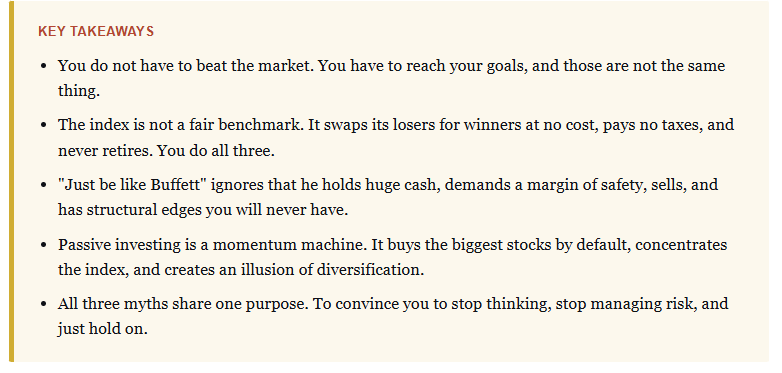
The reason is that those messages are comfortable, and comfort sells. Each one is an investing myth that sounds like wisdom and quietly talks you out of managing your own money. In this article, we take three of the biggest ones and run them through the same unforgiving logic we used on the math. These articles are not meant to scare you out of stocks, but rather to hand you back the judgment the myths are designed to take away.
Investing Myth One: You Have To Beat The Market
From your first day as an investor, you are handed a scoreboard. The S&P 500 index. If you beat it, you win; but if you trail it, for any one of a million different reasons, you lose. Wall Street loves this scoreboard because a scoreboard keeps you comparing, and comparing keeps you moving your money, chasing whichever fund topped the index last year.
Perhaps it is inevitable that, as social animals, we have an urge to compare ourselves with one another. Such is particularly the case since the rise of social media, where we are constantly bombarded by images of how well “everyone” else seems to be doing. Here is an example.
Assume your boss gave you a new Mercedes as a yearly bonus. You would be thrilled until you learned everyone in the office got two. Now you are upset because on a “relative” basis, you got less than everyone else. However, are you deprived on an absolute basis by getting a Mercedes?
Comparison-created unhappiness and insecurity are pervasive. Social media is full of images of people showing off their lavish lifestyles, giving you something to compare to. It is unsurprising that repeated studies show that social media users are terminally unhappy.
The flaw of human nature is that whatever we have is enough, until we see someone else who has more.
Therefore, it should be unsurprising that comparison in financial markets can lead to awful decisions, so investors have trouble being patient and letting whatever process they have work for them. Chasing that scoreboard does not just set you up for disappointment. It makes you behave badly. You lag the index for a year, so you fire your fund and chase last year’s winner, usually right before it reverts to the mean. You buy high and sell low on a permanent loop, all in the name of keeping up with a number.
But here is the part you may not know – the scoreboard you are comparing yourself to is rigged, and not in your favor.
“There are many reasons why you shouldn’t chase an index over time and why you see statistics such as ‘80% of all funds underperform the S&P 500’ in any given year. The impact of share buybacks, substitutions, lack of taxes, no trading costs, and replacement all contribute to the index’s outperformance over those investing real dollars who do not receive the same advantages. More importantly, any portfolio allocated differently than the benchmark to provide for lower volatility, income, or long-term financial planning and capital preservation will also underperform the index. Therefore, comparing your portfolio to the S&P 500 is inherently ‘apples to oranges’ and will always lead to disappointing outcomes.“ – Absolute vs Relative Returns
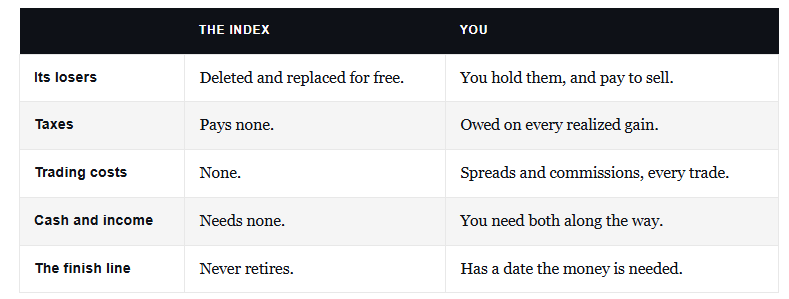
One of the most important points to consider is what “substitution” really means. The index you admire is survivorship bias sold as a product, and it quietly buries its dead. Every company that went bankrupt, got acquired, or simply fell out of favor is deleted from the record, so the smooth line climbing across the page is the winners’ bracket with all the losers erased. Your real portfolio never gets that “magic eraser.” You must live with your mistakes, and you pay to fix them, while the index just pretends its mistakes never happened.
So what should you measure against instead? The only benchmark that actually matters is your own goals. The rate of return your financial plan requires, at the lowest risk that gets you there. Your portfolio is specific to your life, so a thirty-year-old and a sixty-year-old should not own the same things, and neither should be graded against an index that has no age, no goals, and no end date.
Reaching for the index’s return means reaching for the index’s risk, and as we saw in the last article, higher returns demand an exponential increase in risk. That is a fine bargain at thirty and a potentially ruinous one at sixty. I dug into this in “Relative Returns or Absolute“ and again in “The 5 Reasons Benchmarking Works Against You“.
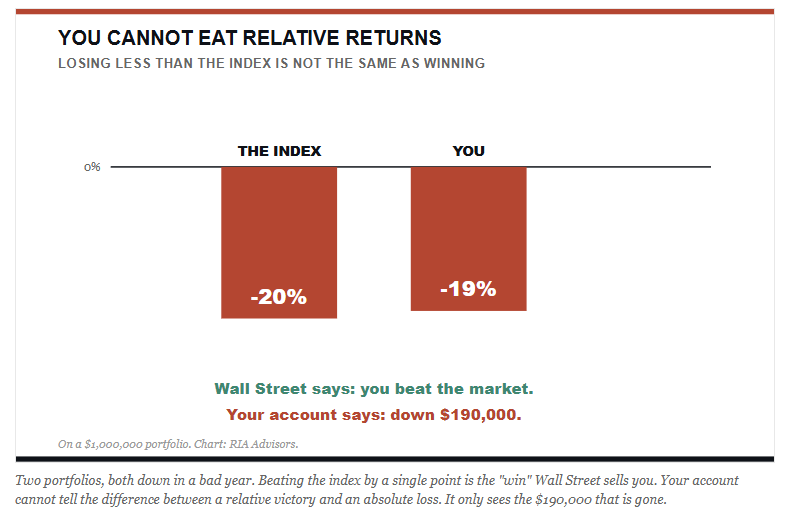
The investing myth of comparing to a benchmark index is dangerous. The reality is that you cannot eat relative returns. Say the market falls 20% in a bad year and your portfolio falls 19%. You beat the index, so you should be happy about that. But you still lost nearly 20% of your portfolio. In real life, nobody has ever felt richer for losing slightly less than an index. The relative game feels like winning right up until the moment you actually have to spend the money.
It comes down to one honest question. What matters more, matching the index in a bull market, or protecting your capital in a bear market?
You cannot have both.
Critically, since you can replace lost money but never lost time, protecting capital is almost always the trade worth making.

Investing Myth Two: Just Invest Like Warren Buffett
The second investing myth wears a friendlier face. If investing is hard, just do what the greatest investor alive does. Buy good companies and hold them forever. You will even hear that Buffett himself says to just buy an index fund and never look at it again. It sounds like permission to stop thinking. It is also a caricature of the man, and following the caricature will hurt you.
Here is what Buffett actually does, and why you can’t replicate it. He is a value investor to the bone. He estimates what a business is truly worth and then refuses to buy until the price offers a wide margin of safety, a discount deep enough that he can be wrong and still not lose. Furthermore, he buys quality businesses with durable advantages, and he is famously willing to do nothing for years; when he cannot find value, he does not force it. He can sit on an enormous pile of cash and wait, sometimes for years, for the fat pitch. Most importantly, he sells. The buy-and-hold-anything-forever story is the opposite of a man who is ruthlessly disciplined about price.
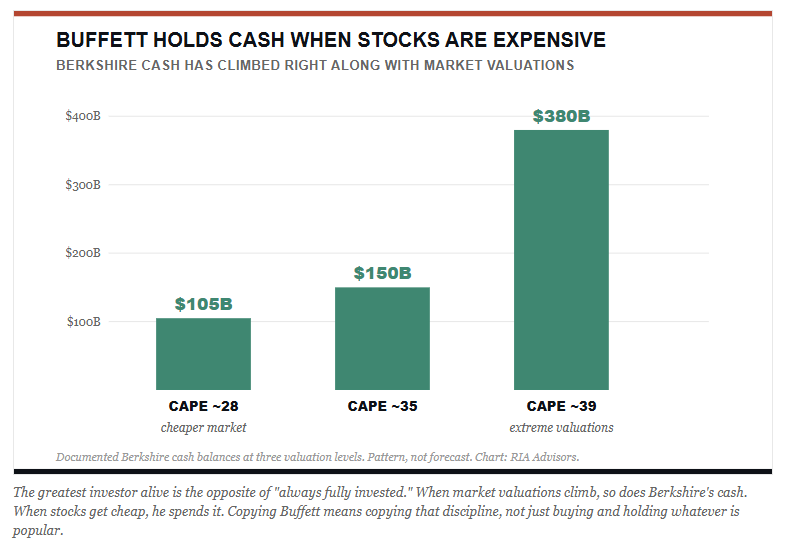
Watch what he does with that cash, and you see the entire philosophy. His cash pile is not random, and it swells when the market is expensive and shrinks when it is cheap. He even has a favorite yardstick for measuring that, the total value of the stock market compared to the size of the economy, a ratio now known as the Buffett Indicator.
When the Buffett indicator runs hot, as I covered in a piece on that very gauge, he stops buying and waits. The greatest investor alive is the living opposite of “stay fully invested no matter what.” He calls cash oxygen, cheap and unexciting, and absolutely necessary, held precisely so he can act when everyone else is forced to sell. Sitting on your hands with dry powder is not a failure of nerve for Buffett. It is the strategy.
It is also important to notice what he is not doing. He is not buying the benchmark index. When Buffett does invest, specifically in the public securities side of the portfolio, Berkshire holds around 40 names, but the vast majority of its value is concentrated in just a handful of high-conviction bets. That is the opposite of spreading your money across five hundred companies by size and hoping it all works out. Buffett’s edge was never breadth; it was judgment, patience, and the discipline to concentrate only when the odds were overwhelmingly in his favor.
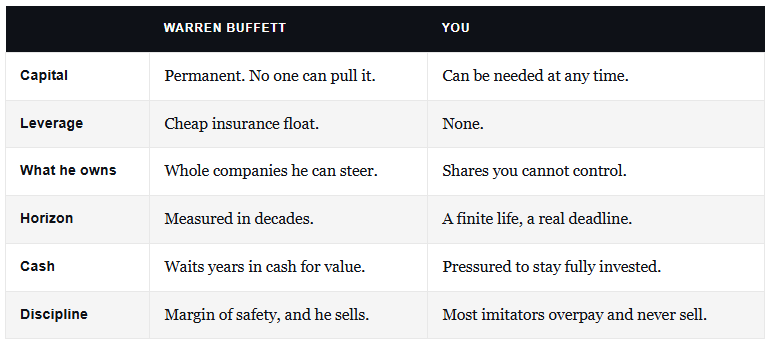
Then there is the part that the investing myth never mentions. Buffett is not even playing your game. He invests permanent capital that no client can yank at the wrong moment.
- He has spent decades using cheap insurance float as leverage.
- He buys whole companies and shapes how they are run.
- His horizon is measured in decades, and he has no retirement date and no tuition bill coming due.
However, you have a finite life, a real deadline, and money that might be needed at any time. The gap between you and Buffett is not mostly talent. It is structural.
So no, you cannot be Warren Buffett; however, there is a part worth keeping, and it is the whole reason his name is worth invoking. You can copy his discipline, even if you can never copy his position.
- Refuse to overpay.
- Demand a margin of safety.
- Hold cash when nothing is cheap and,
- Treat that patience as a strategy, not a personal failing.
- Sell when the reason you bought is gone.
Buffett himself says the most important quality in an investor is not intellect but temperament, which means the real Buffett lesson is not a stock list at all. It is everything we covered in the first two articles. The self-control to think like an owner and to do nothing when there is nothing worth doing.

Investing Myth Three: Passive Investing Always Wins
The reason this third investing myth is the most seductive is that, for a very long stretch, it has looked to be absolutely true. Just buy the index, keep costs low, and you beat almost everyone. Let’s be fair, low costs and staying out of your own way are genuinely powerful, exactly as we covered in the first two articles. But “passive always wins” hides a mechanism that quietly builds risk into the market, and understanding it changes how you think about that index fund.
The problem is that an index fund does not buy good companies; it typically just buys big ones. Because the S&P is weighted by size, every dollar that flows in gets pushed hardest into whatever is already the largest, regardless of price or quality. That creates a loop.
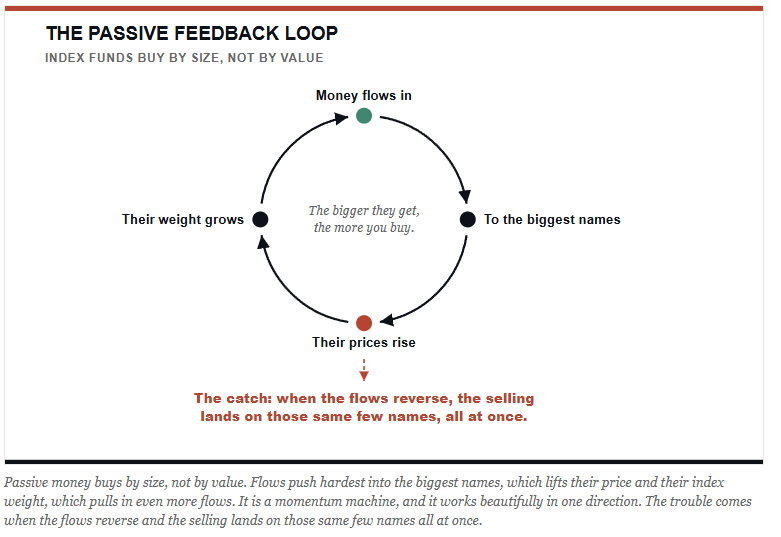
Follow the loop, and you see the problem. The biggest companies get bigger not because they earned it that year, but because they were already big and the flows had nowhere else to go. They come to dominate the index by default, not by merit. You can watch the machine at work in the numbers. The ten largest stocks have swollen to more than a third of the entire index, nearly double their share a decade ago. A tiny handful of names now sets the direction for nearly every retirement account in the country, whether the people who own them ever chose them or not.
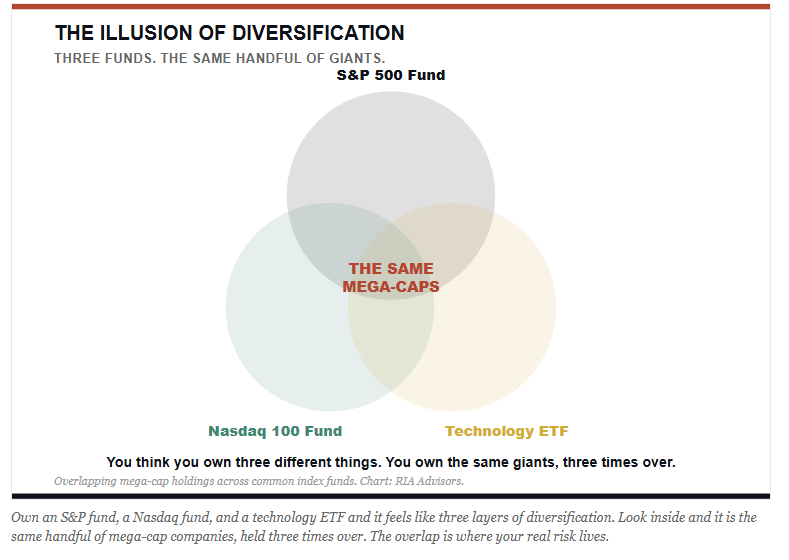
And that hollows out the one thing you thought you were buying. Diversification. If you own an S&P index fund, a Nasdaq fund, and a technology ETF, you do not own three different things. You own the same handful of giant companies three times over. I laid this out in “Why Diversification Is Failing In The Age Of Passive Investing.” Your portfolio may look diversified, but in reality, it is a concentrated bet with much higher risks than you realize. Therefore, in a real crisis, the little diversification you have left tends to vanish, because correlations rush toward one and everything falls together at once.
There is a deeper problem hiding beneath this investing myth: “Passive money never asks what anything is worth.”
Passive investors simply buy in proportion to size. As an increasing share of the market moves this way, fewer participants remain to price companies on fundamentals. The market drifts away from being a weighing machine and toward being a pure momentum machine, where prices rise because money is flowing in, not because the underlying businesses have gotten any better.
The stocks most owned by passive funds become the most sensitive to those flows. As long as the market rises, passive flows come in. Those flows are consumed by the companies with the heaviest index weightings at the top. However, when it eventually falls, and it will, those same companies are dragged down the hardest and fastest. This is because the selling is mechanical and indiscriminate, hitting the crowded names in unison. I made this case in a piece on the fragility that passive flows create. Simply, a market that goes up together tends to come down together.
None of this means that index funds are evil or that you should never own one. There are real truths to the indexing story. For example, low cost is real, and for many investors, a broad fund is a perfectly reasonable core. However, that also means an index fund is not the safety blanket of diversification that the marketing brochure says it is. Yes, own an index fund if you choose, but own it with your eyes open.
Knowing what you actually hold and how concentrated it has quietly become is crucial. Critically, that is a very different thing from buying an index as a substitute for thinking.
Passive is not a free lunch. It is a bet that the flows never stop, but they always eventually do..
What All Three Myths Have In Common
Step back and look at the three together.
- Beat the market.
- Be like Buffett.
- Just buy the index.
On the surface, they say different things. Underneath, they deliver the exact same instruction.
- Stop thinking.
- Hand your judgment to a scoreboard, a guru, or a formula, and
- Just hold on, no matter what.
That message is comfortable, and it is enormously profitable for an industry that would rather you never question it.
But notice the thread running through every rebuttal. In each case, the answer was not a better guru or a cleverer index. It was always you, doing the work.
- Measuring against your own goals instead of a scoreboard.
- Copying Buffett’s discipline instead of his ticker symbols.
- Owning an index fund with your eyes open instead of as a substitute for judgment.
Remember, it is your money. These are your goals, your risk, and your finite, unrecoverable time.
Outsourcing your judgment to a comfortable story, but it will not serve you well.
- You do not have to beat anyone.
- No one is asking you to be a legend.
- And it is okay, in fact, you have an obligation to manage your own risk rather than pretend it does not exist.
The myths want you to be passive. The math wants you awake.
The Bottom Line
We have spent four articles clearing the ground. We learned to think like an investor rather than a speculator, to beat our own psychology and conditioning, to respect the hard math of losses, valuations, and timing, and now to see through the comforting myths that tell us to stop managing our money. That is a great deal of what NOT to do. It raises the obvious question. So what do you actually do instead?
In the final chapter on investing myths, we will provide you with the rules and guidelines to win the “long game” in investing. How to actually manage risk in a portfolio, the three practical ways to run one depending on who you are, and the timeless rules the greatest investors leave behind. We have torn down the myths. In the last piece, we built the thing that replaces them.
If any of these three myths has quietly been running your portfolio, that is worth a real conversation before the next bear market tests it. We build portfolios measured against your goals, not a scoreboard, and managed with genuine discipline about price and risk. Schedule a complimentary consultation today.
Sources & Notes
- Lance Roberts, “Relative Returns Or Absolute. What’s More Important?,” RIA Advisors. realinvestmentadvice.com
- Lance Roberts, “Absolute Returns Or Relative, There Is A Difference,” RIA Advisors. realinvestmentadvice.com
- Lance Roberts, “Portfolio Benchmarking: 5 Reasons Underperformance Occurs,” RIA Advisors. realinvestmentadvice.com
- Lance Roberts, “Buffett Indicator Says Markets Are Going To Crash?,” RIA Advisors. realinvestmentadvice.com
- Lance Roberts, “Why Diversification Is Failing In The Age Of Passive Investing,” RIA Advisors. realinvestmentadvice.com
- Lance Roberts, “Passive Investing And The Most Dangerous Era,” RIA Advisors. realinvestmentadvice.com
- Warren Buffett’s investment philosophy (margin of safety, quality, long horizons, large cash balances scaled to valuation, and a concentrated equity portfolio) is drawn from his Berkshire Hathaway shareholder letters and public statements. Market-concentration figures reference the growing share of the largest stocks in the S&P 500 and are illustrative of the mechanism rather than a point-in-time forecast.