
Poker, and gambling, can teach us to be better investors. I often use “poker” when discussing risk management. Such is because the rise of online trading, free commissions, and social media “gurus” turned the stock market into a “get rich quick” casino equivalent.
Just recently, Kim Iskyan via American Consequences discussed this very idea of poker and gambling in the markets.
“Stocks and gambling involve risking, and losing, money. With both, it often feels like ‘they’ in stocks, speed-of-light algorithms, market makers, and insiders or, in casinos, ‘the house’ and pit bosses have rigged the system against us. And luck, ostensibly, plays an outsized role in determining how much we win or, more often, lose.”
Even Senator Elizabeth Warren stated on CNBC previously:
“The whole point of having a stock market is so that people across this country around the world can invest in businesses. Instead, what has happened is it’s turned into a casino so that market manipulators come in and they drive markets up or down and make a profit on the stock market. It has become the giant casino and playground for the billionaires.”
Kim explains the important link between investing, poker and gambling.
“The dopamine rush, the euphoric brain chemical, of a market win or a poker win is nearly identical. And the ease with which the Reddit-residing meme-stock kamikaze capital transitioned to stock speculating from sports betting points to casinos and stocks being twins separated at birth.“
Today, the stock market does indeed resemble a casino. Prior to 1990, before the evolution of technology, the market represented individuals investing capital on fundamentals. Today, to steal a line from Kim, the market is an equivalent of “a 3-a.m.-push-your-chips-to-the-center-of-the-table and stagger-up-to-your-room gambler.”
However, just as you can win at poker and gambling, you can win at investing.
What Is Risk?
Here is the thing. You can win the investing game by being a “smarter” player.
In Las Vegas, there are two types of gamblers. The vast majority are “pigeons” which are what keep casino coffers full. These amateurs go to Vegas and leave with empty pockets and some great stories. “Professional” gamblers, to the contrary, win regularly enough to make a “profession” of it.
The difference between the “pigeons,” and the “professionals” comes down to the understanding of the “risk” of winning or losing.
The word “RISK” is not normally associated with positive outcomes. For example:
- Walking a tightrope without a safety net.
- Wingsuit Gliding
- Hanging off the edge of skyscrapers
Yes, professionals do these things and survive. But for the average person, it could mean death.
The same idea of “risk” applies to investing.
Many individuals convince themselves that in order to make more money, they need to take on more “risk.” The correlation, over the short term, may indeed seem positive when markets are trending higher.
However, the reality is quite different. “Risk” in a portfolio can be directly correlated to the amount of loss (destruction of capital) that occurs when something inevitably goes wrong.

Understanding Risk
After a decade-long “bull market,” it is not surprising that individuals believe the market only goes higher. Therefore, the more “risk” taken in portfolios, the better the return.
Here is a good example of the current thought process.
Recently, I was visiting with a new client who just transferred from one of the “big box” financial firms. He told me he wanted to “aggressively invest” as he had a high tolerance for “risk.”
It only takes a couple of questions to derail that psychology:
- What did you do in 2001-2002, 2008, or March 2020?
- How did you feel?
- Are you willing to do that again?
Since the “dot.com” bust, when I began asking those questions, I have NEVER had anyone tell me:
- I sold near the top and bought near the bottom. (Sell High/Buy Low)
- It was a truly terrific experience watching half of my money disappear.
- Absolutely, just tell me when so I can get some popcorn.
In this particular case, he happened to be an avid “poker player” and enjoyed going to Las Vegas for a “few hands” at the tables. Poker and gambling are a straightforward comparison to investing. Such is because the general rules of risk management apply to both. The conversation was quick.
“Do you go ‘all in’ on every hand you are dealt?”
“Of course, not” he responded.
“Why not?”
“Because I will lose all my money,” he said.
“You say that with certainty. Why?”
“Well, I am not going to win every hand, so if I bet everything, I will certainly lose everything” he stated.
“Correct. So why do you invest that way?”
“………….Silence………………….”
You could actually see the “lightbulb” come on.

The Poker & Gambling Analogy
In poker, most individuals can not calculate the odds of drawing a winning hand. However, while they may not know the odds of drawing a “full house” in a 7-card poker hand is just 2.6%, they do know the odds of “winning” with such a hand are extremely high. Therefore, they are comfortable betting heavier on that particular hand.
When it comes to investing, they are comfortable betting their retirement savings on a market that, at current valuation levels, has a long history of delivering poor results. I have shown you the following chart before, and statistically speaking, the odds aren’t in your favor.
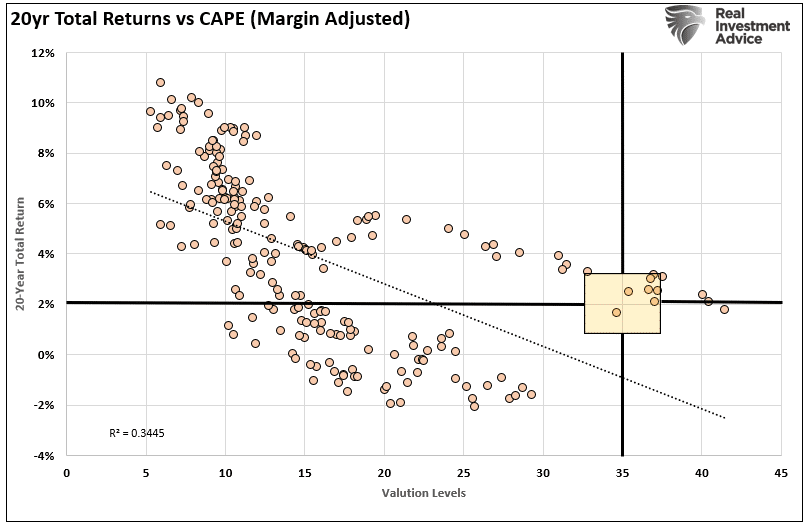
Despite this simple reality, investors continue to chase stocks as if future 10-year returns will be the same as the last decade.
To make this clearer, let’s equate market fundamentals to poker hands.
If individuals were presented with the following “hand,” rather than media rhetoric, do you think they would quickly put all their retirement savings in the markets.?
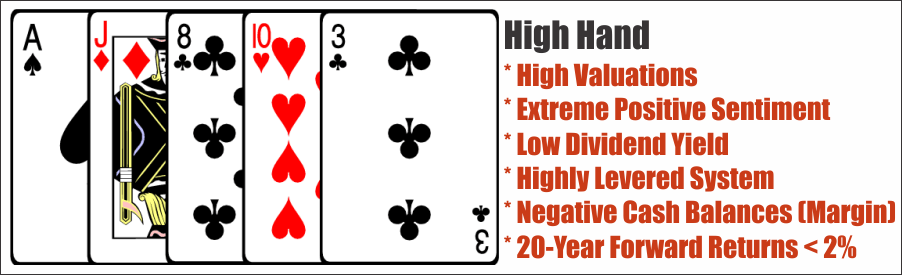
Yes, one could absolutely win with a “high card hand” assuming everyone else is in exactly the same position without an “Ace.” But what are the “odds” of that being the case?
However, this is the market as it exists today and the media is telling you to “be all in” as it is a “no-lose” proposition.
Are you all in?
I’ll bet you are and your reasoning is completely logical – “The market is going up.”
Holding Out For The Winning Hand
So, should you just sit in cash waiting for the winning hand?
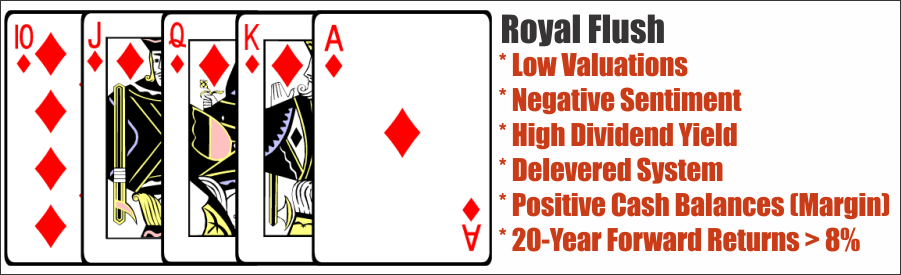
You could, but as we explained in “Being All In Cash,” at the time you get dealt this hand you will not “want” to be in the market.
Why? Because this is what markets look like after major, mean-reverting events. It is at this point individuals have learned the lesson of “risk,” and want nothing to do with the “financial markets ever again.”
If you were invested in the markets in 2003 or 2009, you will remember. However, the “lack of memory” is a major problem for a large majority of investors, and financial media commentators, who were not invested during the last two major bear markets. Experience is a brutal teacher.
The issue of understanding risk/reward is the single most valuable aspect of managing a portfolio. Chasing performance in the short-term can seem to be a profitable venture, just as if hitting a “hot streak” playing poker can seem to be a “no lose” proposition.
But in the end, the “house always wins” unless you play by the rules.

The 8-Rules Of Poker & Gambling
1) You need an edge
“Investing without research is like playing stud poker and never looking at the cards.” – Peter Lynch
The financial markets are nothing more than a very large poker table where your job is to take advantage of those who allow emotions to drive their decisions versus those who “bet recklessly” based on “hope” and “intuition.”
2) Develop expertise in more than one area
There is no one investment style that is in favor every single year – which is why those that chase last year’s “hot hands” are generally the least successful investors over 10- and 20-year periods.
“I skate where the puck is going to be, not where it has been.” – Wayne Gretzky
3) It often pays to pass, and 4) Know when to quit and cash in your chips
“You’ve got to know when to hold ’em. Know when to fold ’em.” – Kenny Rogers
All great investors develop a risk management philosophy (a sell discipline) and combine that with a set of tools to implement that strategy. Such increases the odds of success by removing the emotional biases that interfere with investment decisions. Just as a professional poker player is disciplined with his craft, a disciplined strategy allows for the successful navigation of a fluid investment landscape. A disciplined strategy not only tells you when you to “make a bet,” but also when to “walk away.”
5) Figure out why people are betting against you & Don’t assume you are the smartest person at the table.
“We know nothing for certain.”
Managing a portfolio for “what we don’t know” is the hardest part of investing. With stocks, we must always remember that there is always someone on the other side of the trade. Why are they selling? What do they know that you don’t?
Learn when to “take profits,” reduce your investment size, and when your reasons for buying have changed, be willing to “call it a day and walk away from the table.”
6) Know your strengths AND your weaknesses
Two-time World Series of Poker winner Doyle Brunson joked a bit about his book with which he had thrown around two alternative ideas for titles before going with “Super/System.” The first was “How I made over $1,000,000 Playing Poker,” and the second equally accurate idea was, ‘How I lost over $1,000,000 playing Golf.”
The larger point here is that invariably there will be things in life that you are good at, and there are things you are much better off paying someone else to do.
7) When you can’t focus 100% – take a break & 8) Be patient
Patience is hard. Most investors want immediate gratification when they make an investment. However, real investments can take years to produce their real results, sometimes, even decades. More importantly, as with playing poker, you are not going to win every hand and there are going to be times that nothing seems to be “going your way”. But that is the nature of investing; no investment discipline works ALL of the time. However, it is sticking with your discipline and remaining patient, provided it is a sound discipline to start with, that will ultimately lead to long-term success.
Those are the rules. Play by them and you have a better chance of winning. Don’t, and you will likely lose more than you can currently imagine. As the old saying goes:
“If you look around the poker table and can’t spot the pigeon, it’s probably you.”