



Value has crushed growth for four weeks, and the AI bill just came due. The risk now is assuming the defensive trade still has room to run.
🏛️ Market Brief – The AI Bill Comes Due
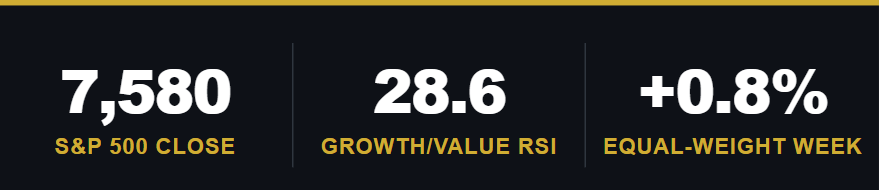
In last week’s Bull Bear Report, I warned that a “Meta-style reaction” to this week’s mega-cap earnings could push the S&P 500 below its 100-day average and back toward the September lows. Alphabet delivered that reaction on Thursday. Intel finished the job on Friday. The S&P 500 fell 1.8% on Friday to close at 7,580, its lowest close since September 16, and ended the week down 0.6%. On Friday alone, the Nasdaq Composite dropped 2.9%, and the Dow lost 1.1%.
The change in tone came from cash flow, not demand. Google Cloud revenue more than doubled, yet Alphabet reported negative free cash flow of $9.1 billion, with quarterly capital spending at $51.4 billion. The stock fell 12.6% on Thursday. Amazon’s AWS grew 39%, but earnings missed, and capital spending ran near $77 billion for the quarter. Intel collapsed 28.6% on Friday after a weak fourth-quarter outlook, and Caterpillar dropped 9.3% on Thursday. Microsoft was the exception. Azure grew 48%, and the stock gave up less than 2% over two days.
Investors aren’t questioning whether AI works. They’re questioning who pays for it, and with Treasury yields near 5%, that question has a price.
Macro didn’t help. The Fed held rates at 3.75% to 4.00% on Wednesday in a 10-2 vote, with Governor Lisa Cook and Cleveland Fed President Beth Hammack dissenting and favoring a hike. Thursday brought September PCE inflation of 3.6%, with core at 3.1%, and third-quarter GDP growth of 3.4%. Futures now price in roughly an 85% chance of a December hike. The one bright spot was wages. The employment cost index showed wage growth slowing to 3.1%, a sign that energy-driven inflation isn’t feeding into paychecks. Meanwhile, the 10-year yield slipped to 4.93% from 5.00% a week ago, while Brent crude held near $118.
Here’s the part the headlines missed. Nine of 11 sectors rose this week. The equal-weight S&P 500 gained 0.8%, outrunning the cap-weighted index by 1.4 points, and 500 of 849 actively traded stocks finished higher. Nearly all the damage was in technology and communication services, the two sectors that carry the AI capex trade.
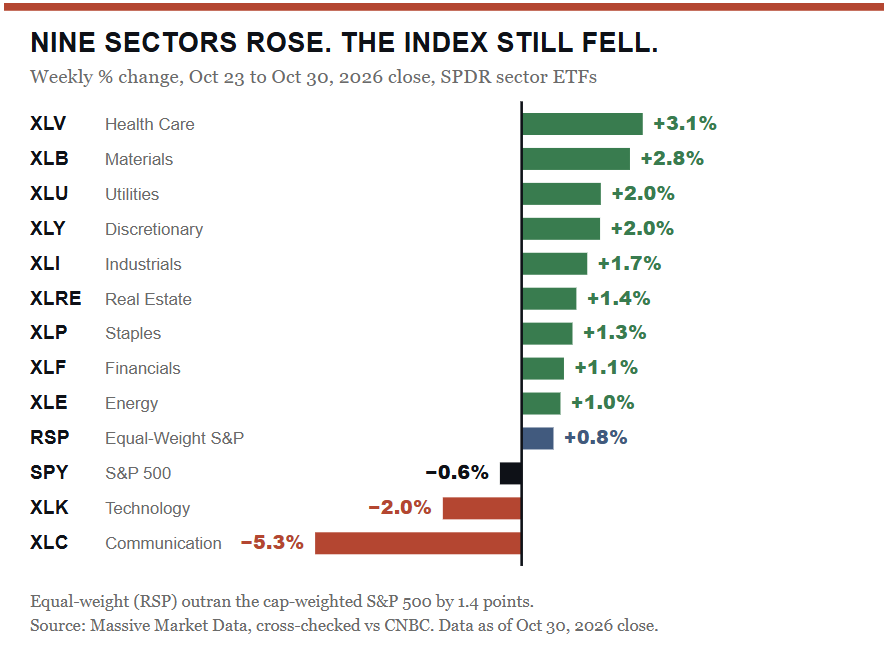
The mainstream narrative is that the “broadening” in the market is a healthy sign. Maybe that is the case. However, Howard Marks has long argued that the riskiest thing in the world is the belief that there’s no risk, and right now that belief lives in the defensive sectors everyone ran to. Watch whether the bid under the equal-weight index survives Apple’s results and next week’s October jobs report. If it does, Friday was a rotation. If it doesn’t, it was the start of something larger.
📈Technical Backdrop – MACD Turns Up Just Below The Record
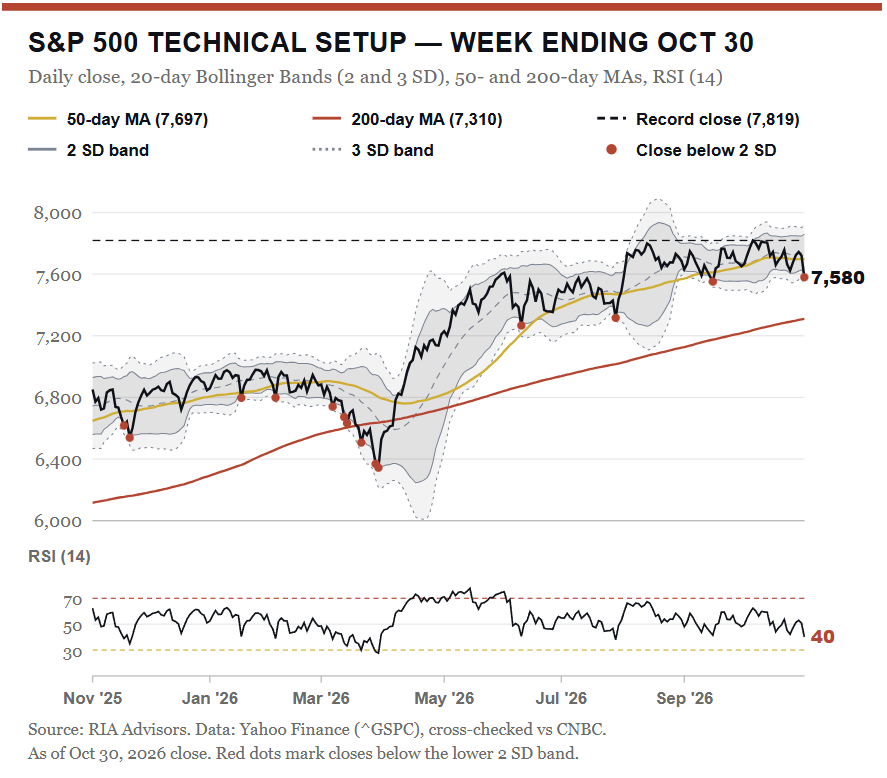
Friday’s decline did real technical damage. The S&P 500 closed at 7,580.07, its first close below the 100-day moving average since early April. It now sits 0.5% below that average at 7,615 and 1.5% below the 50-day at 7,697. From the October 6 record close of 7,819, it’s down 3.1%. Is the bull trend over? No. The index remains 3.7% above a rising 200-day average at 7,310, the line that defines the bigger trend, and while it slipped below that line for about three weeks in late March and early April, it has held above it ever since. The short-term trend is another matter.
Pay attention to momentum as it confirms the break. RSI fell from 50.8 to 40.1 in a single session. MACD had been closing in on a bullish crossover, then turned back down below zero, and its histogram widened from −3.7 to −11.5 index points. Friday’s close also landed below the lower Bollinger Band at 7,600, a move 2.3 standard deviations below the 20-day mean. Notice in the chart below that closes under that band marked short-term lows on September 16 and July 29. That isn’t a guarantee. In March, the index closed below the band six times over three and a half weeks before it finally bottomed.
As noted above, sector breadth explains why the index fell while most stocks rose. Measured against the S&P 500, eight of 11 sectors trade more than 2.5% above their 50-day relative average. Energy leads at 9.5%, with health care at 9.0% and staples at 7.3%. Only technology at −3.9% and communication services at −8.4% sit meaningfully below. The “safe” trade has become the crowded trade. In other words, the oversold groups are exactly where a rebound would have to start.
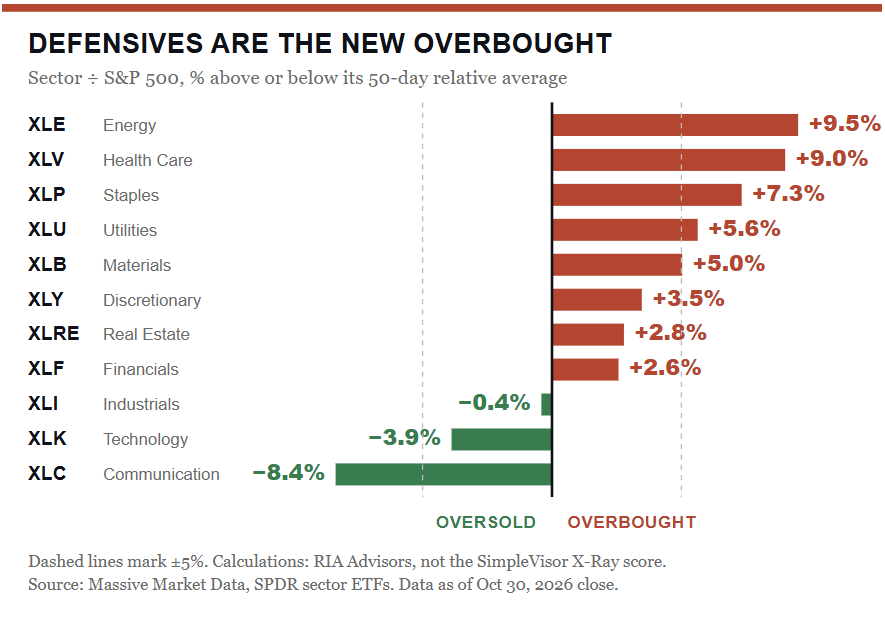
That setup also cuts both ways. Technology and communication services carry the heaviest weights in the index, and oversold can always get more oversold. With the market trading below its 50- and 100-day averages, investors tend to sell rallies until the market reclaims those levels as support. Such is the nature of a broken short-term trend. I wouldn’t treat Friday’s selloff as an automatic buying opportunity.
However, this is why we positioned for this situation earlier in the month. On October 5, we trimmed Apple, Nvidia, AMD, and Palantir in our equity model. The proceeds went into names like Walmart, Costco, JPMorgan, and RTX. Last Friday, we took profits in Kinder Morgan and Williams as energy got stretched. That leaves us balanced going into another potentially volatile week rather than chasing either side.
Next week, we suggest that investors continue to hold core equity exposure at target weights and, importantly, avoid chasing a market bounce. With the 100-day at 7,615 and the 50-day at 7,697, those levels are now resistance to rallies, rather than the support they were previously.
For now, any rally to those levels is where investors should rebalance exposures, not add. The first notable support level is the September 16th close at 7,552, followed by the July 31st close near 7,490. Any close below 7,490 would certainly open the door to the 200-day near 7,310, and that’s where I’d tighten stops and raise some cash. A close back above 7,615 would do the opposite. It would turn Friday into a one-day shakeout and favor adding growth exposure..
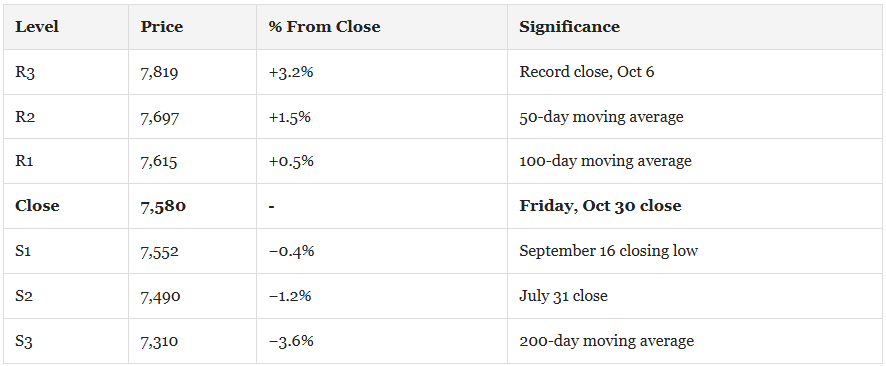
For investors, the single most important level next week is 7,615. If the market can reclaim it, the four-week run in value starts to look exhausted. That’s the setup I walk through in today’s main body. Below, I lay out why the growth vs value trade has reached an extreme, and what has to happen before growth leads again.
🔑 Key Catalysts Next Week
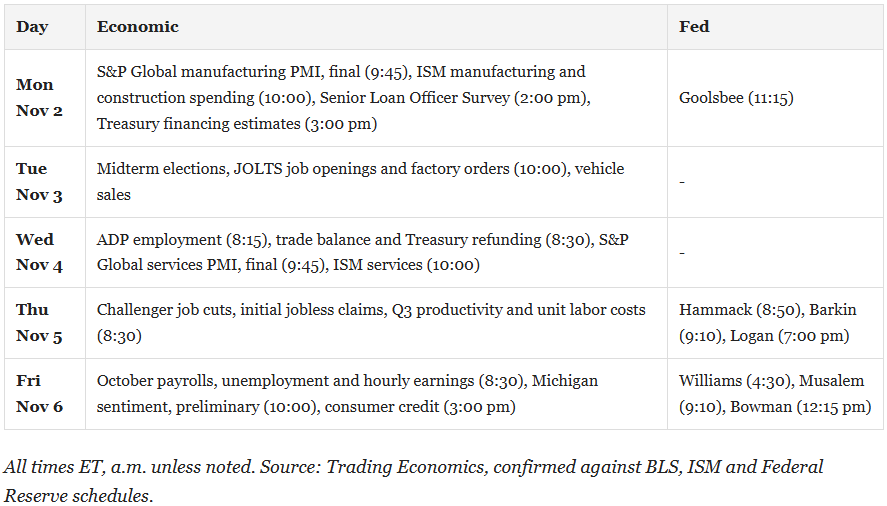
If you thought last week was busy, you get no reprieve next week either. On Monday, we will get Apple’s earnings results. The midterm elections follow on Tuesday, and the October jobs report drops on Friday. Each one lands on a market that just lost its footing.
The midterms are largely priced in. Democrats are favored to win the House at roughly 94% odds and the Senate near 69%, according to Polymarket data cited by Newsquawk. A surprise in a close Senate race is the bigger risk. So is a count that drags on for days.
Furthermore, the economic data calendar is also heavy. On Monday, the ISM manufacturing report is expected to print at 54.7, with its price index running near 78. If that is the case, it is a reminder that the energy shock behind this year’s inflation is still working its way through supply chains and into companies’ prices.
ISM services follows on Wednesday. So does the Treasury’s quarterly refunding announcement, which matters more than usual with the 10-year near 5%. Friday’s payroll report is the main event. Consensus calls for just 55,000 to 65,000 new jobs, with unemployment holding at 4.2% and hourly earnings up 0.3%. A soft jobs number alongside 3.6% inflation would put the Fed’s December hike in genuine doubt.
Fedspeak will be loud. Chicago Fed President Austan Goolsbee speaks Monday. On Thursday, Cleveland’s Beth Hammack speaks fresh off her dissent for a hike. Richmond’s Tom Barkin and Dallas’s Lorie Logan follow. Friday features New York Fed President John Williams, St. Louis’s Alberto Musalem and Governor Michelle Bowman.
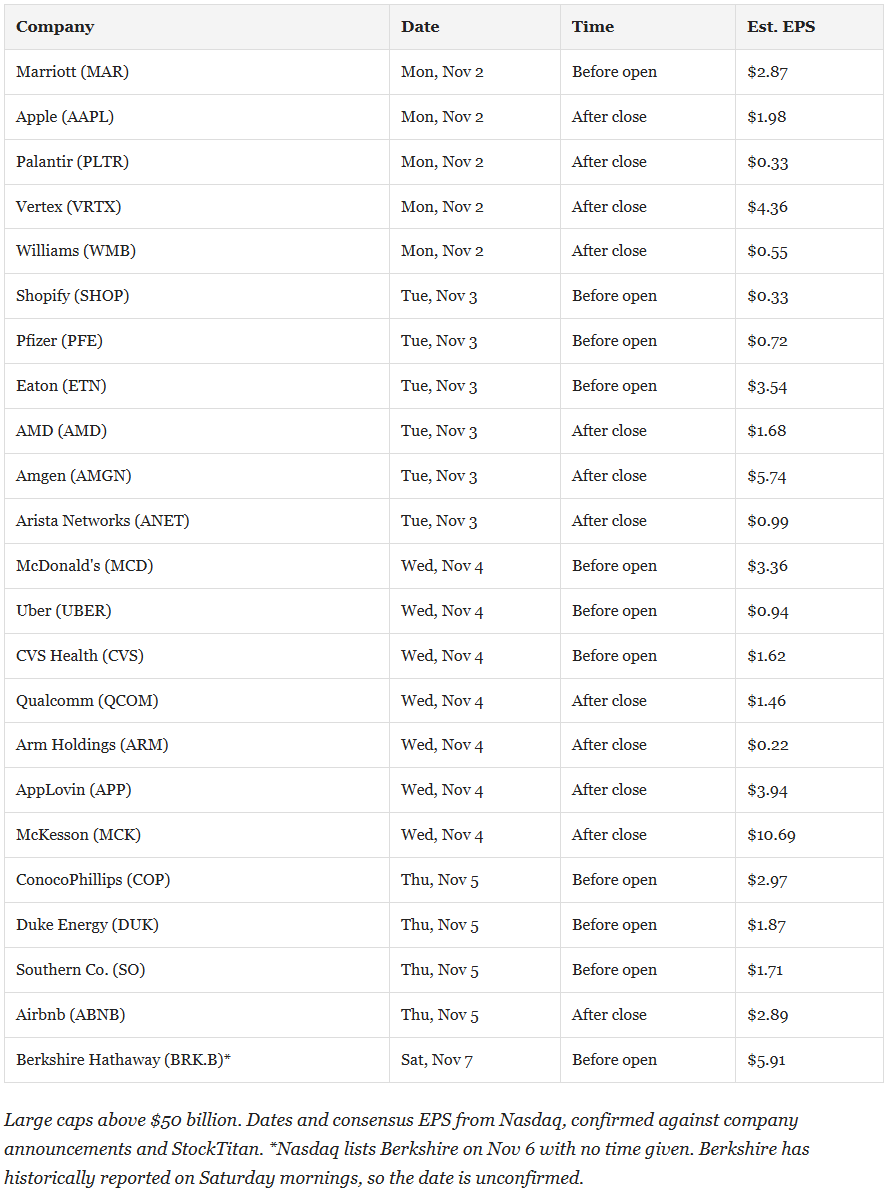
While last week was a heavy earnings week, this week remains heavy also. As noted, Apple reports on Monday, along with Palantir, which will give another look at the AI case. Then on Tuesday, AMD, Amgen, and Arista Networks report, followed by Qualcomm, Arm, and AppLovin on Wednesday.
AMD and Palantir will likely matter the most as they sit at the center of the spending debate that punished Google and Amazon last week. If either one shows that AI demand is still turning into cash rather than just more spending, the oversold chip and software names could bounce hard.
Friday’s jobs report is the single most market-moving event. The outcome to fear is a weak headline number with hot wage growth. That mix would revive the December-hike case just as the AI trade loses its bid.
Need Help With Your Investing Strategy?
Are you looking for comprehensive financial, insurance, and estate planning services? Need a risk-managed portfolio management strategy to grow and protect your savings? Whatever your needs are, we are here to help.

💰 Growth vs Value: Value Had Its Run. The Turn Is Setting Up.
Four weeks ago, we told you that “a market rotation from growth to value is becoming more likely heading into year-end.” We acted on it two days later. On October 5, we trimmed Apple, Nvidia, AMD, and Palantir in our equity model and added Walmart, Costco, JPMorgan, Goldman Sachs, Kinder Morgan, and RTX. We then followed on October 8 by exiting Applied Digital and Vertiv and adding Berkshire Hathaway. We made a matching shift toward value in our ETF model as well. Since that close, the growth vs value spread has moved in our favor. The Vanguard Value ETF (VTV) has gained 4.6% while the Vanguard Growth ETF (VUG) has lost 7.6%, and technology has dropped 10.7%.
That trade did its job; however, it may be close to time to shift in the other direction. In last week’s report, I suggested that we were “potentially set up for a rotation in the other direction, buy growth and reduce value, heading into year-end.” For the year, VTV is up 19.4%, VUG is up just 4.6%, and energy is up 56.6%. When one side wins that decisively, the useful question is how much good news is already in the price.
Value Won 2026 Because Oil And Yields Wrote The Rules
The lead of value over growth has a rather simple explanation. Last week, Brent crude traded near $118 with the 10-year Treasury sitting just under 5% heading into the Fed meeting with odds of a December rate hike still elevated. That’s a hostile backdrop for growth stocks, whose valuations lean on cash flows years down the road. It’s a friendly one for energy producers, banks, and the “defensive” sectors that have soaked up the flows
The chart below measures the growth-versus-value ratio directly. Between October 7 and Friday’s close, growth lost 11.9% against value in 17 sessions, pushing the ratio below both its 50-day and 200-day averages. That’s a REAL trend change. Still, look at where it is now. The ratio sits just above its March low of 85.2. On Friday, its 14-day RSI fell to 28.6, below the 30 level that usually marks a washed-out reading.

Trends like this rarely reverse cleanly. They reverse when selling gets lopsided enough that the last few sellers are acting out of fear of missing the “safe” trade rather than on fundamentals, and the ratio is getting close to that level now.
Energy Is Stretched. Staples Are Just Bouncing.
The “rotation” headlines lump energy and staples together into a single trade. In the data, they look very different. The Energy Select Sector SPDR (XLE) gained 10.8% over the past month. Measured against the S&P 500, which is the fairer test for a sector that has spent the year riding an oil shock, it now trades 14.9% above its own 200-day average, the widest gap of any group in the chart below. Such is what an excess looks like.
Bob Farrell’s Rule #2 says that excesses in one direction lead to an opposite excess in the other direction. The energy sector hit a record high on Friday, and that’s where the excess lives right now. Energy has outrun the S&P 500 by nearly 40 points this year.
Staples started from a very different place, but they’re catching up fast. XLP rallied 11.3% in a month as money hid in “safe” names. Relative to the S&P 500, it climbed from 2.6% below its 200-day trend a week ago to 1.8% above it. That’s a sharp bounce off a deeply oversold base, and it’s starting to look crowded.
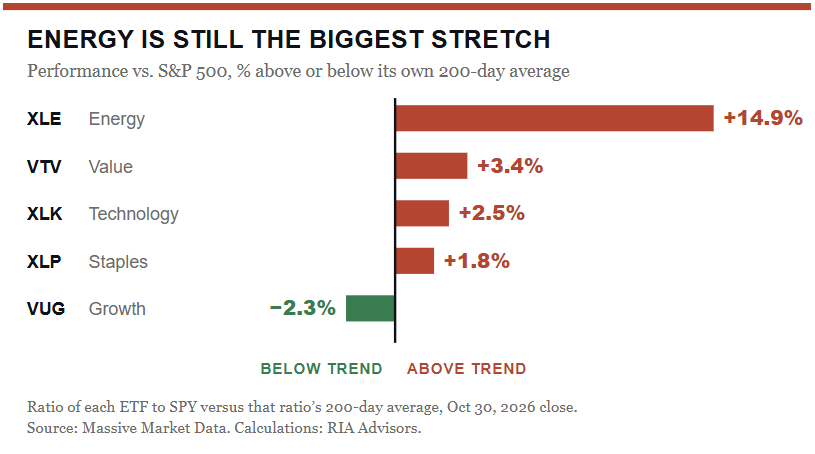
Then there’s the technology sector, which was beaten up hard last week. Since October 6th, XLK has fallen 11.1%, including 4.9% on Friday alone. On October 16, its RSI hit 33.3, the lowest reading since the March 30 bottom. Even so, it still sits 2.5% above its relative 200-day average. The “rotation” bruised tech’s short-term trend without breaking its long-term leadership.
When everyone hides in the same “safe” sectors, the hiding place becomes the risk.
What Has To Happen Before Growth vs Value Flips
A reader emailed this week with a fair question. Isn’t buying tech here just catching a falling knife? It can be. That’s why the entry should rest on conditions rather than conviction: a sector that has dropped 11% in four weeks can easily drop another 6% when the macro pressure that pushed it there hasn’t gone away. Here’s the checklist I’m watching, with readings as of Friday’s close.
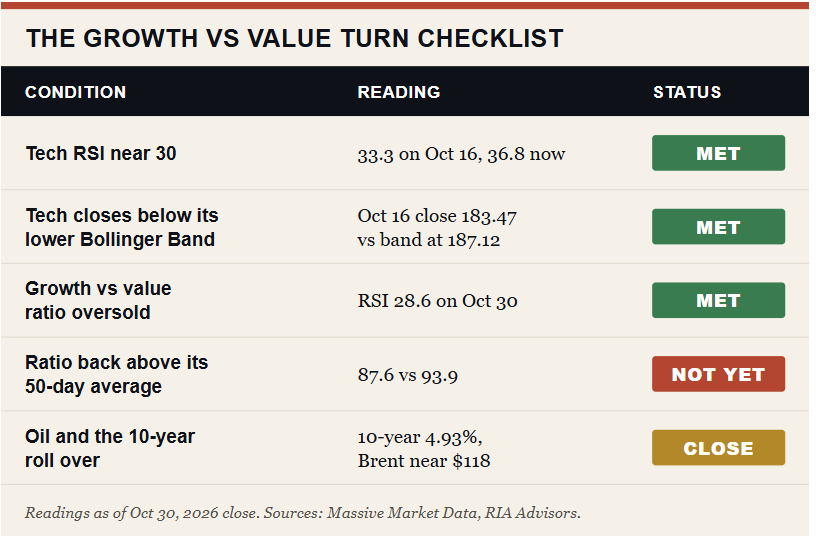
Three conditions are met, and one is close, so this is a setup to prepare for rather than a signal to chase. The first three items tell you the selling is stretched. The last two tell you it’s over. Momentum readings can stay washed out for weeks if the macro pressure doesn’t let up. A close below the lower band is a symptom of panic, and panic can deepen before it clears.
Make no mistake, the earnings reports matter here too. Hyperscaler capital spending is running near $800 billion this year, and investors balked at the bill this week. Alphabet fell 12.6% on Thursday after reporting negative free cash flow. Amazon slid 4.3% ahead of its report and another 1.4% after it. Microsoft, with Azure growing 48%, gave up less than 2% over the same two days. The market isn’t rejecting AI. It’s rejecting AI that can’t pay for itself.
Where The Value Crowd Has A Point
Being that I am in the value camp, the best argument is that nothing driving the trade has changed. September CPI ran at 3.7%, and energy is still the engine of that inflation. A Fed that hikes into an oil shock keeps pressure on long-duration assets. If Brent pushes higher and the 10-year breaks decisively above 5%, the growth vs value ratio could revisit its March low of 85.2.
This is why the plan laid out below is staged. Furthermore, there is a stop under every new growth position, rather than a single bet that the oil shock is already behind us and the Fed is finished. Where caution is required is in the assumption that oil only goes one direction. As we discussed two weeks ago, “bad inflation” tends to cap yields rather than send them higher. Supply-driven price spikes drain the household income needed to sustain them. The diagram lays out both paths.
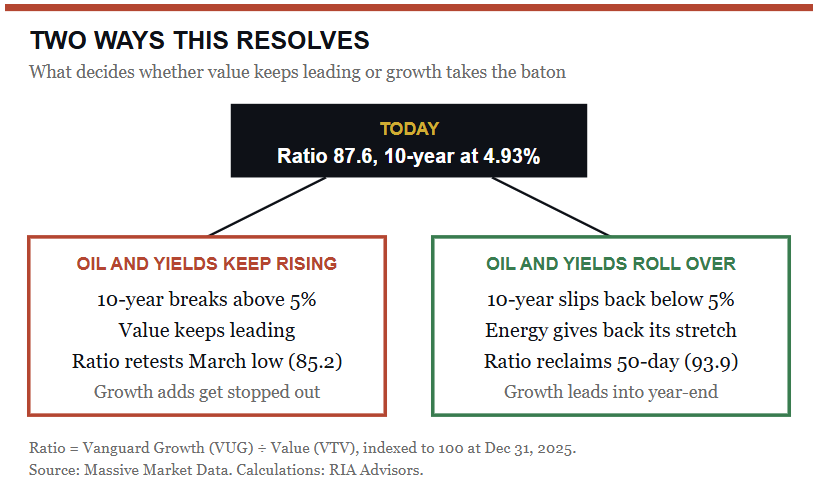
Notice the asymmetry. The value case needs oil and yields to keep rising from already punishing levels, while the growth case only needs them to stop. That’s a lower bar.
What Should Investors Do Now
Nobody has to call the bottom in tech to act on this. The better approach is to trim where the excess is largest. We started last Friday, taking profits in Kinder Morgan and Williams in our equity model as energy pushed into overbought territory. The staples we added on October 5 are where we’d look next. Then rebuild growth exposure in stages and let the market confirm the turn. We continue to recommend the following.
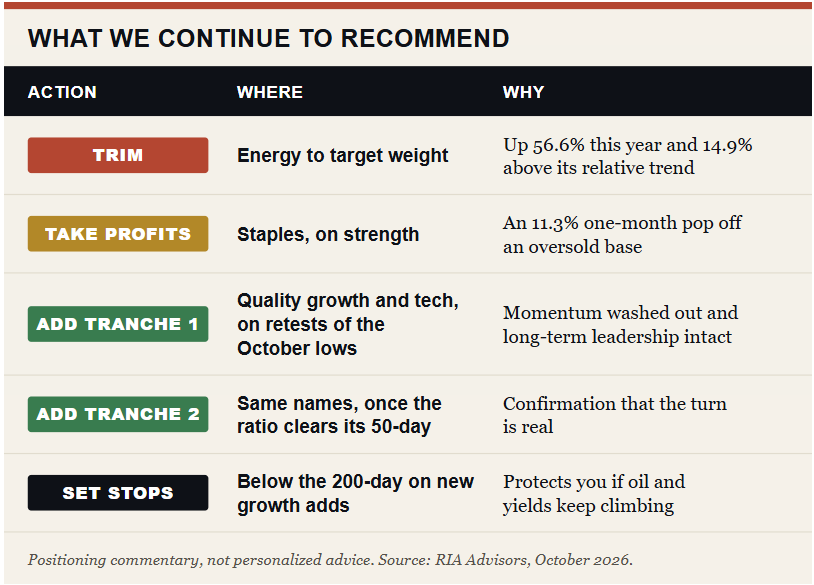
Let me reiterate my point above. The staging matters more than the names themselves. We will use a first tranche on weakness to start gaining exposure at lower levels if the turn is real. At the same time, we will wait until the 50-day mark before adding the second tranche to avoid doubling down on a trade the market hasn’t yet confirmed. Lastly, if the stops trigger, the market has told you the value case won another round, and that’s fine. You’ll have trimmed energy near a record high on the way.
Crowded trades don’t end when the story changes. They end when the last buyer finally shows up.
🖊️ From Lance’s Desk
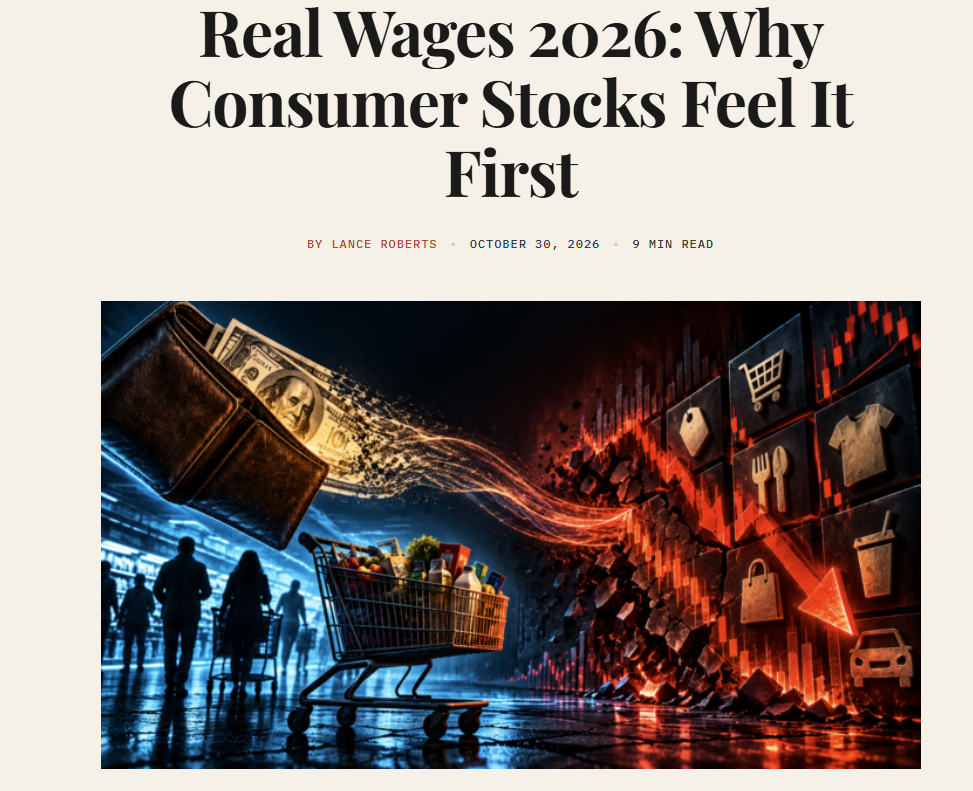
This week’s #MacroView blog explores how real wages in 2026 have slipped below zero for the first time in three years, and the squeeze is showing up in consumer stocks before it shows up in GDP.
Also Posted This Week:
- The Fed Risks Policy Error Fighting Oil Prices– by Michael Lebowitz
- Griffin May Be Right About AI. The Timing Could Be Very Wrong– by Lance Roberts
📹 Watch & Listen
Google (Alphabet) shares are plunging nearly 10% following its latest earnings report, while Microsoft is moving higher. But does Google’s sharp selloff present a buying opportunity, or could the stock fall even further?
Subscribe To Our YouTube Channel To Get Notified Of All Our Videos
📊 The Weekly Market Dashboard
Weekly technical overview across key sectors, risk indicators, and market internals

💸 Market & Sector X-Ray: Market Gains Ground
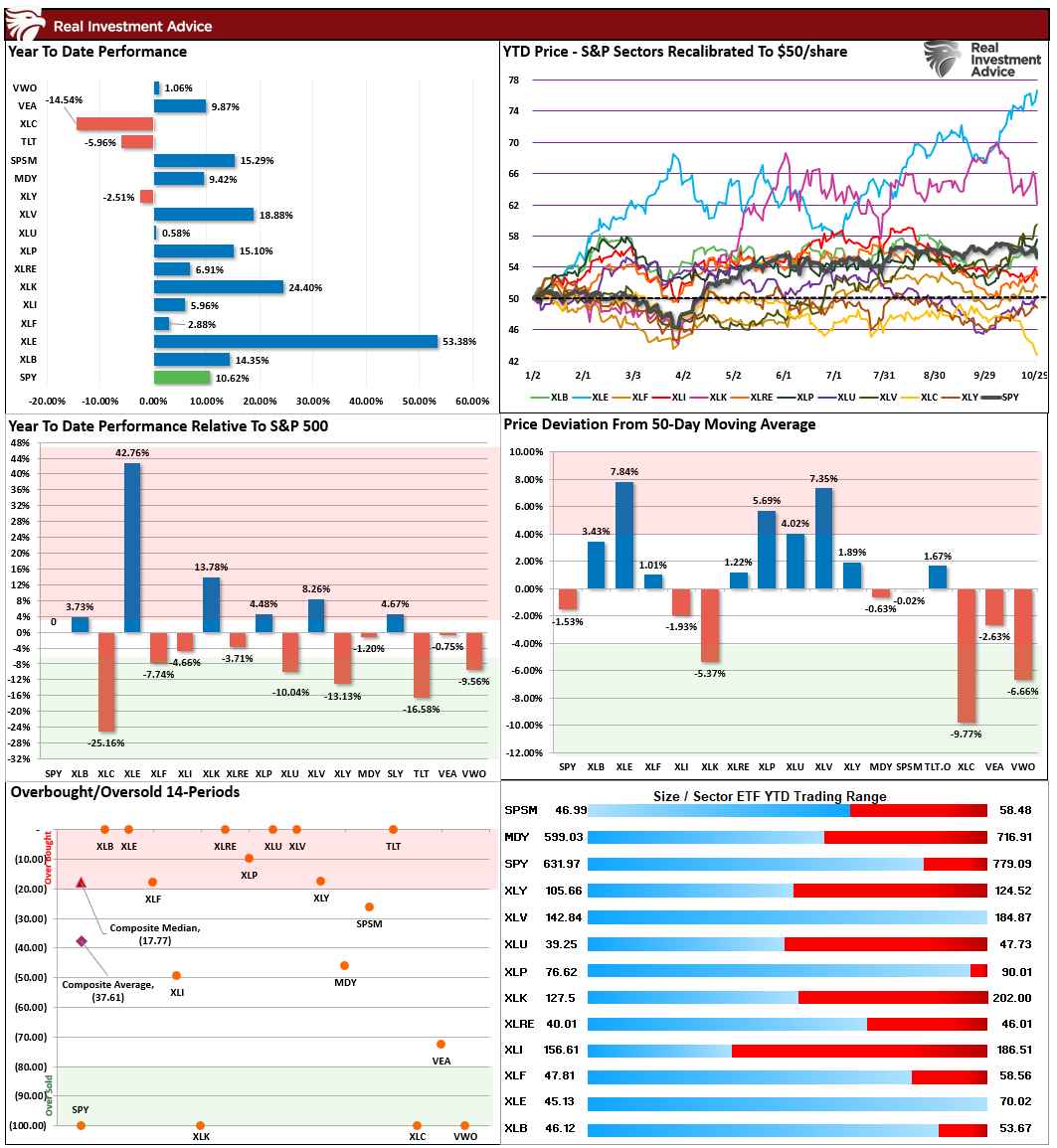
Last week I stated: “This next week, 44% of the S&P 500 will report Q3 earnings. So far, reports have been good, but the market response has been weak. I suspect we could see some more of that action next week, as the technology sector remains under some pressure.” That certainly was the case, but now, on a short-term basis, technology is very oversold, while Energy and Healthcare are the most overbought along with Real Estate, Utilities, and Materials. Take profits and look for a potential reversal in Technology and Communications.
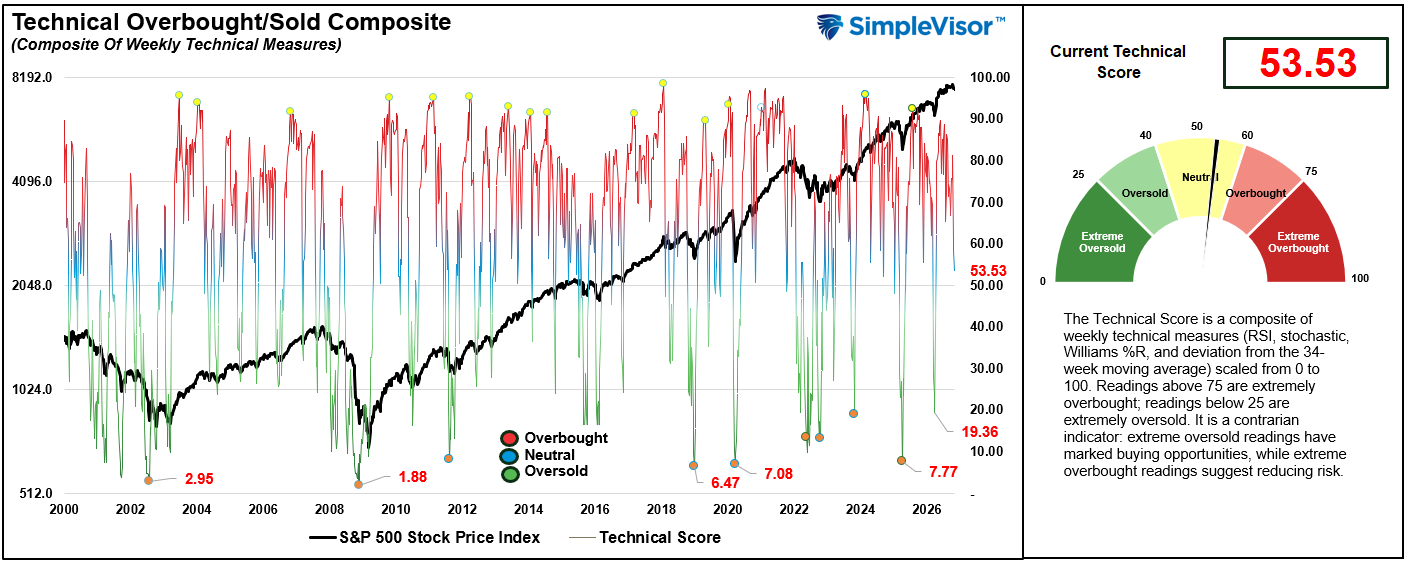
📐 Technical Composite: 53.53 – Sell-Off Reduces Overbought Conditions
The technical condition eased sharply last week dropping from 58.32 to 53.53 as the technology sector came under selling pressure. However, the reduction only brings the overbought condition back to neutral. While rallies can occur from these levels, if this is the beginning of a more severe correction, then markets have more work to do to the downside. Rebalance risk and remain tactically cautious until conditions improve.
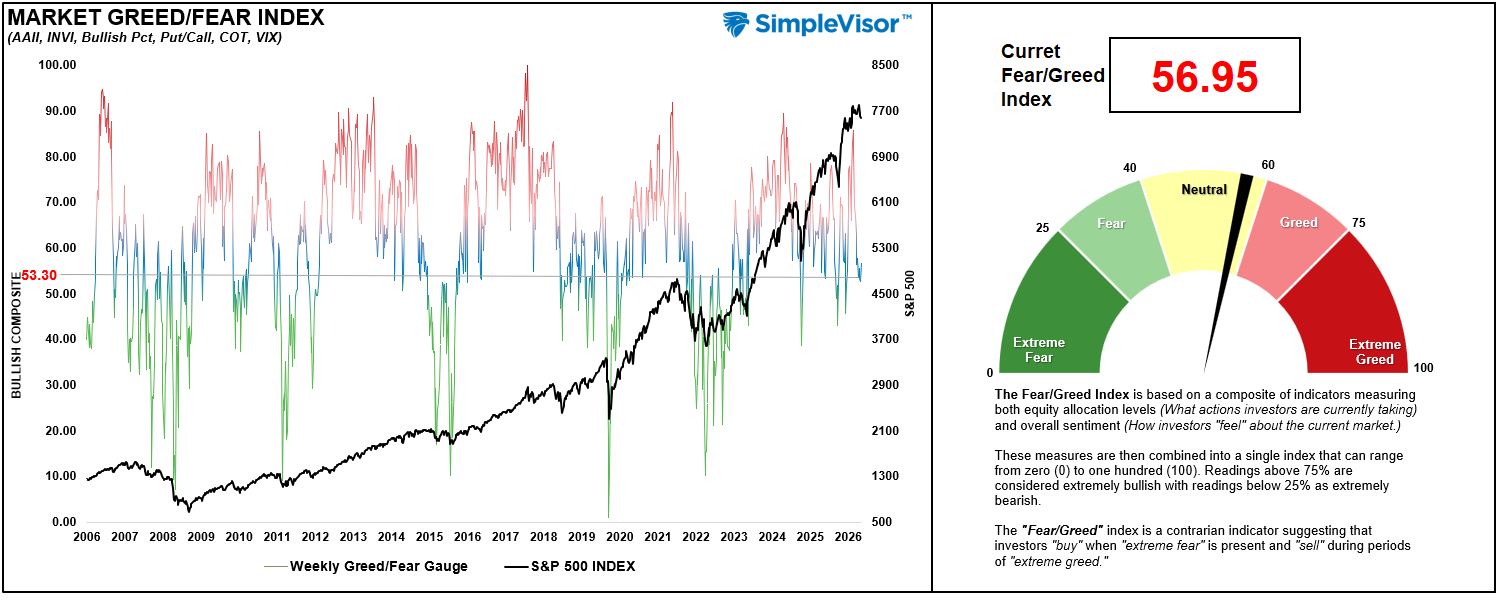
🤑 Fear/Greed Index: 56.95 – Holding At Neutral
Even though the market sold off last week, the underlying market allocation and sentiment remain more neutral. There was a continued weakness in the Commitment of Traders equity allocations; however, investor sentiment turned slightly more bullish last week. With the market getting decently oversold short-term, a reflexive bounce higher following the election on Tuesday may be possible.
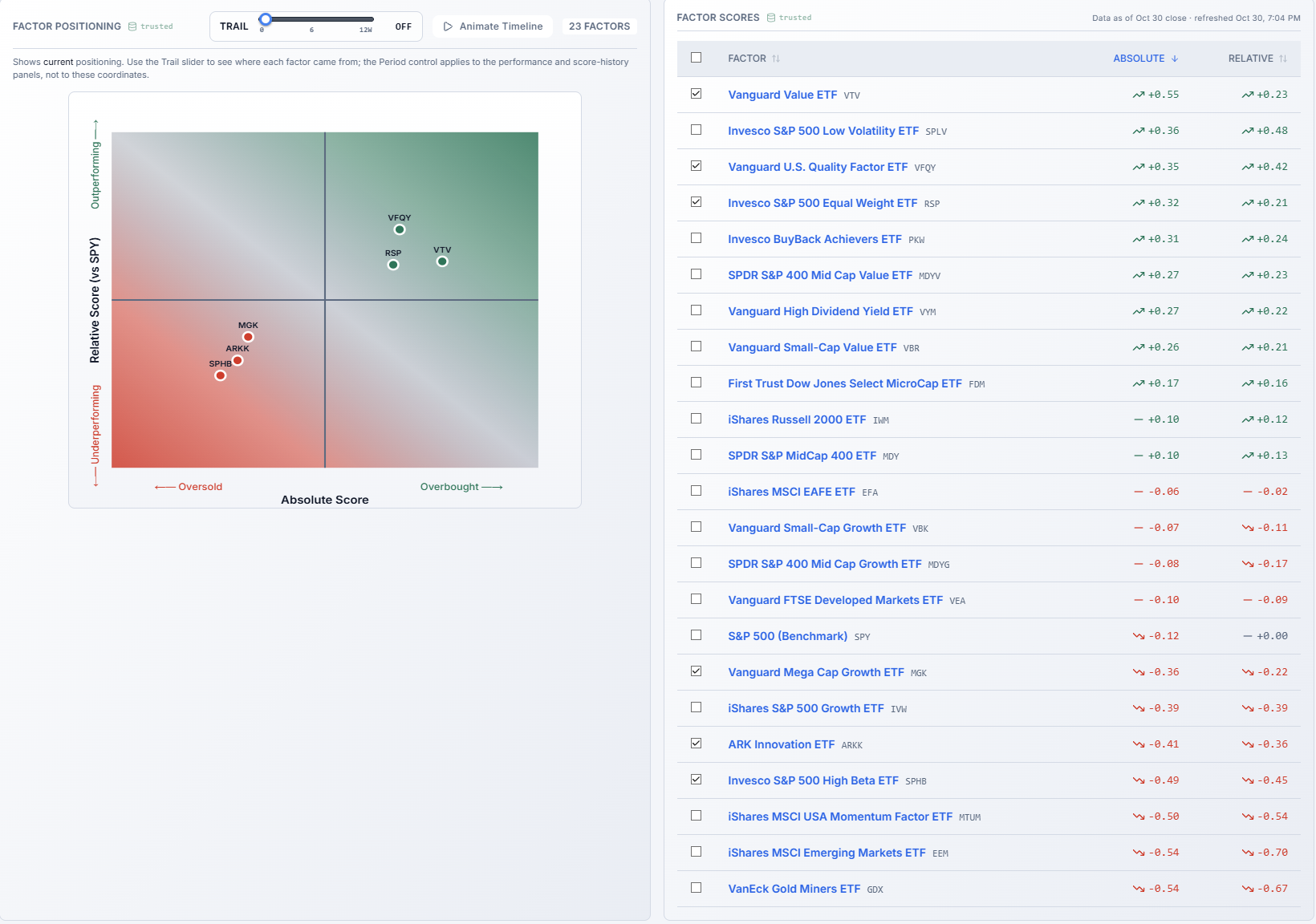
🔁 Relative Factor Performance
Four weeks ago we warned that the more extreme divergence growth from value in the market was due for an eventual rotation. That rotation came rather swiftly over the past three weeks and now those value oriented factors are more overbought and growth is oversold. As shown below, the Quality, Equal Weight, and Value factors have become more overbought, while the High Beta, Megacap, and Speculative Factors are more oversold. As we noted last week “While there may be a bit more work next week, we are getting potentially set up for a rotation in the other direction, growth vs value, heading into year end.” That remains the case this week.
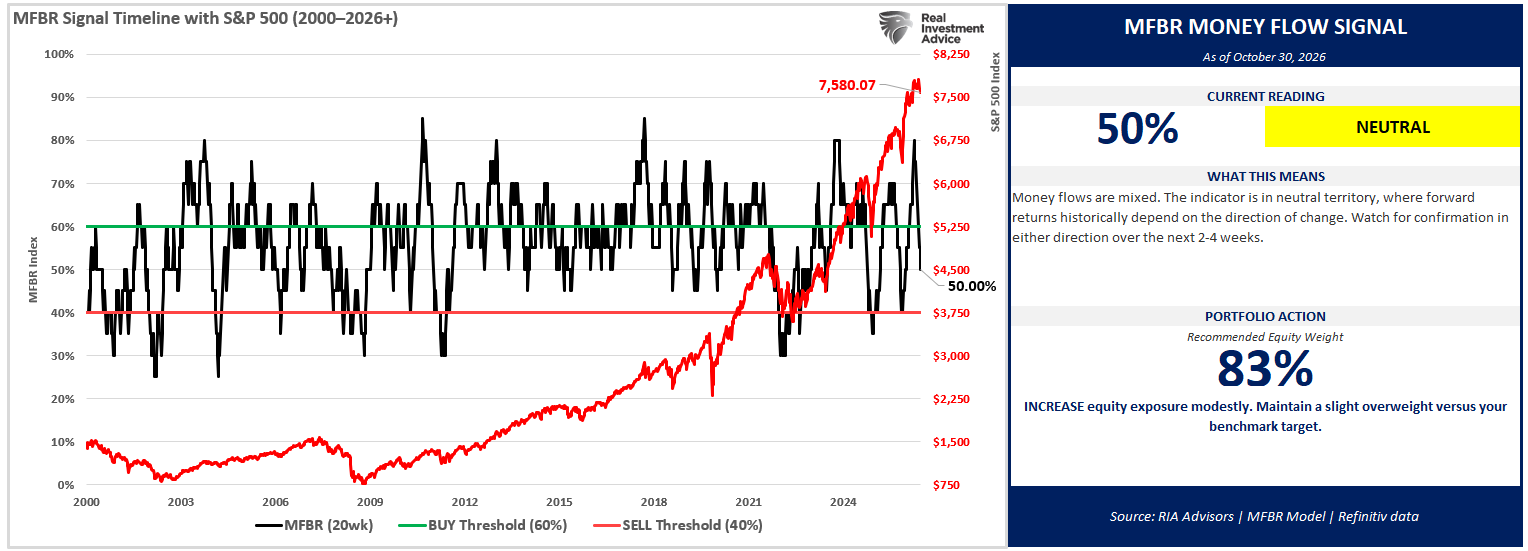
📊 MFBR Index (Money Flow/Breadth Ratio Indicator)
The Money Flow Breadth Ratio (MFBR) model is a rules-based equity allocation framework that uses weekly S&P 500 money flow data to generate buy, sell, and neutral signals. The MFBR systematically adjusts portfolio equity exposure in response to the direction and persistence of institutional capital flows. It aims to reduce drawdowns while capturing the majority of market upside.
“As of October 30, 2026, with the S&P 500 at 7,580.07, the Money Flow Breadth Ratio (MFBR) stands at 50%, down from a peak of 70% set 7 weeks ago and falling versus 55% the prior week. The trailing four-week change is still -10 percentage points, but the near-term trend has rolled over. This places the indicator in the 50-60% range. The raw zone signal reads NEUTRAL, but the model still flags a TOP REVERSAL, with 20 points now off the peak. Read that NEUTRAL as a zone label, not as fresh confirmation – the model reached this band by falling out of overbought, not by building up from below.
Bottom line: hold the target weight. The roll-over off the 70% peak is real and worth watching, but it has carried the gauge into the band that has historically been the best place to own equities. This is neither a chase nor a de-risk. A sustained break below 60% would move the grid to an underweight; a move back above 70% would re-engage the contrarian trim.“
📊 Sector Model & Risk Ranges
We noted two weeks ago that “Energy and Technology are now extremely deviated above their long-term weekly means. Historically, such deviations lead to corrections or consolidations, so profit-taking and rebalancing are recommended.” That advice worked well this past week as the rotation from Technology to Value continued. Bonds also rallied sharply as the rotation to safety accelerated. Energy remains extremely elevated above long-term means, and Healthcare has now joined that club. Profit-taking ahead of an eventual reversion, which could be very swift.

Have a great week.
Lance Roberts, CIO, RIA Advisors
Lance Roberts is Chief Investment Strategist at RIA Advisors in Houston, Texas, and publishes his market research and the weekly Bull Bear Report at RealInvestmentAdvice.com and lanceroberts.substack.com.