



My colleague, Doug Kass, recently penned an interesting note suggesting “Keynesian Economics” will fail. To wit:
“At the core of Keynesian theory is that the coordinated monetary and fiscal policies can stabilize economic output, inflation and unemployment over the business cycle. As noted above, there are exogenous forces at work in this cycle which render policy ineffective.”
While Doug is correct in his statement, there is a more significant reason why Keynesian economics will not only prove to be a failure but instead has failed already.
However, for those not well acquainted with John Maynard Keynes and his theory on economics, let’s start with the basic premise.
“A general glut would occur when aggregate demand for goods was insufficient, leading to an economic downturn resulting in losses of potential output due to unnecessarily high unemployment, which results from the defensive (or reactive) decisions of the producers.” – Keynes
When there is a lack of demand from consumers, producers react defensively to reduce output. In such a situation, Keynes’ theory suggests the Government should intervene.
“In such a situation, government could use policies to increase aggregate demand, thus increasing economic activity and reducing unemployment and deflation. Investment by the government injects income, which results in more spending in the general economy, which in turn stimulates more production and investment involving still more income and spending and so forth. The initial stimulation starts a cascade of events, whose total increase in economic activity is a multiple of the original investment.”
What politicians “heard” was the “spend money” part.

Debt Is “THE” Problem
There is nothing wrong with the Government spending money to provide for infrastructure, national security, communications, and other programs that can pay for themselves over time. The government can even fund those projects with debt as the return on investment from revenue-producing projects pays for itself.
However, when debt gets used for “non-productive” purposes, such as social welfare, those dollars are diverted from productive activities to payment of principal and interest. As discussed in “Negative Multiplier Effect:”
History teaches us that although investments in productive capacity can in principle raise potential growth and r* in such a way that the debt incurred to finance fiscal stimulus is paid down over time (r-g<0), it turns out that there is little evidence that it has ever been achieved in the past.
The chart below illustrates that a rising federal debt as a percentage of GDP has historically been associated with declines in estimates of r* – the need to save to service debt depresses potential growth. The broad point is that aggressive spending is necessary, but not sufficient. Spending must be designed to raise productive capacity, potential growth, and r*. Absent true investment, public spending can lower r*, passively tightening for a fixed monetary stance.” – Stuart Sparks, Deutsche Bank
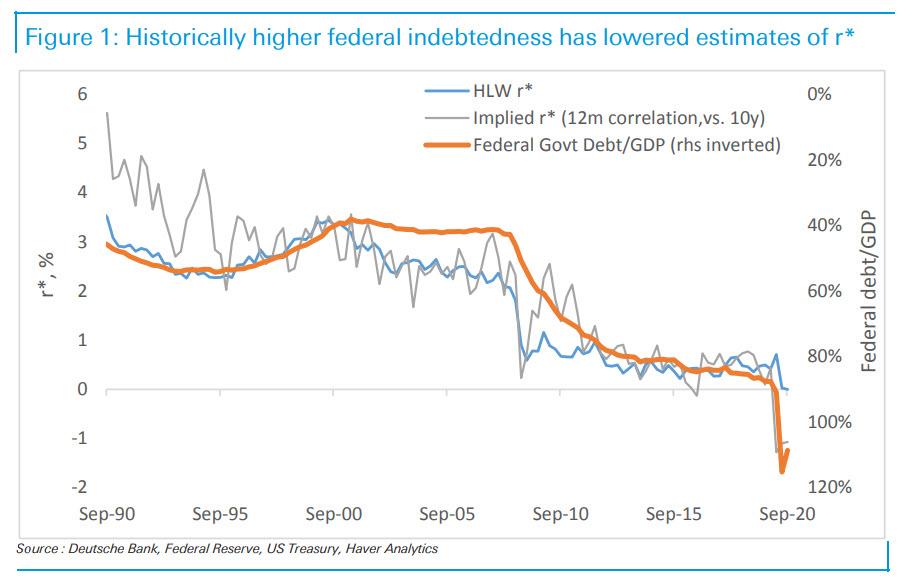
However, politicians always ignore the “other part” of the theory, which states that deficit spending should get cut and surpluses rebuilt when economic activity returns.
As shown, that never happened, and for the last 40-years, economic participants have paid the price of slower growth and prosperity.

However, since Keynes’ model seems to have failed to produce the desired result, economists and politicians believe such failure is only due to the lack of “spending.”
Yet, after $5 trillion of stimulus injections in 2020, economic growth is once again collapsing.

A Broken Transmission System
The desire to use “debt” to cure the “economic illness” seems logical, particularly when viewing it through the political lens of “getting re-elected.” However, the “cure” keeps the patient on “life support.”
The policies enacted, be it stimulus, quantitative easing, or bailout programs, fail to create sustainable economic growth because they are debt-based. Using debt to drag forward future consumption only leaves a void that must get filled in the future. Most importantly, the use of debt for non-productive investments, like a stimulus with a one-time effect, is the debt service that absorbs future revenues.
The view that “more money in people’s pockets” will drive up consumer spending, with a sustainable boost to GDP, is wrong. It has not happened in 40-years.
What gets missed is that things like temporary tax cuts, or one-time injections, do not create economic growth but merely reschedules it. The average American may fall for a near-term increase in their take-home pay, but any increased consumption today will be matched by a decrease tomorrow when the stimulus ends.
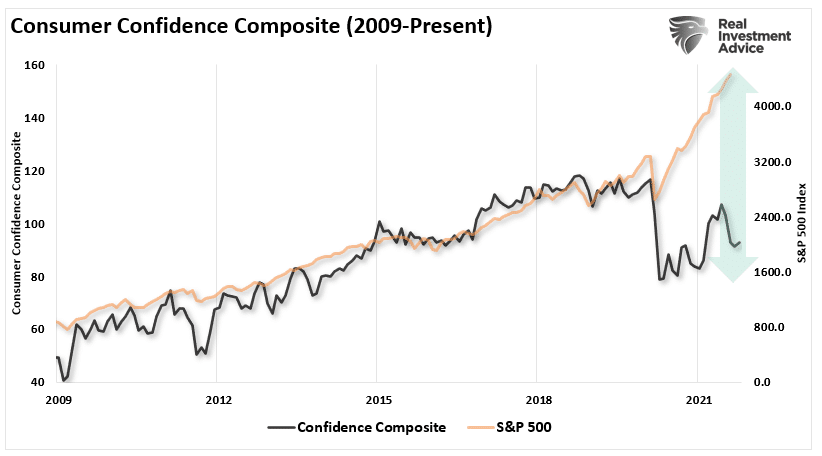
Consumer confidence continues to weaken despite a booming job market, higher wages, and a surging stock market.
During the “Great Depression” period, most economists thought that the simple solution was just more stimulus. Work programs, lower interest rates, and government spending didn’t work to stem the tide of the depression era.
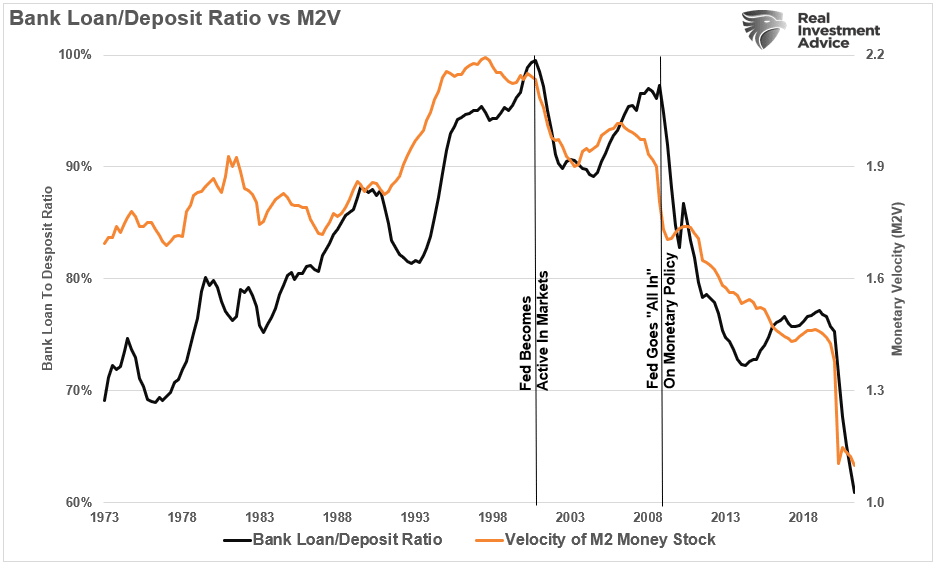
The problem today with surging debt levels, low rates, and weak economic growth is the broken “economic transmission” system. One of the essential drivers of economic activity are banks lending money to support economic activity. The bank loan/deposit ratio has collapsed along with velocity. As a result, there is little benefit to loan money at ultra-low rates relative to the risk of default.

Hayek Might Have It Right
The proponents of Austrian economics believe that a sustained period of low-interest rates and excessive credit creation results in a dangerous imbalance between saving and investment. In other words, low-interest rates tend to stimulate borrowing from the banking system, which leads, as one would expect, to the expansion of credit. This expansion of credit then, in turn, creates an increase in the supply of money.
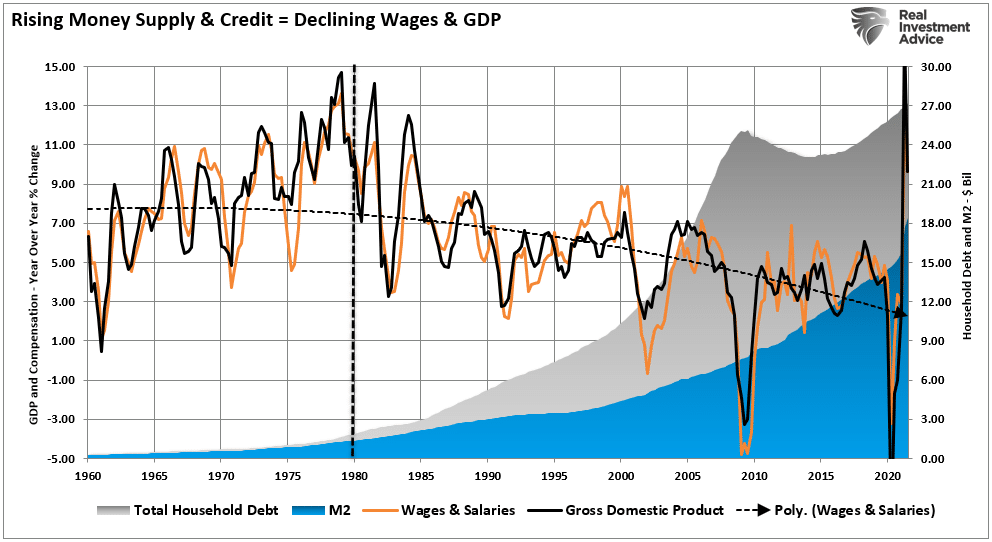
Therefore, as one would ultimately expect, the credit-sourced boom becomes unsustainable as artificially stimulated borrowing seeks out diminishing investment opportunities. Finally, the credit-sourced boom results in widespread malinvestments. When the exponential credit creation can no longer be sustained, a “credit contraction” occurs, which ultimately shrinks the money supply and the markets are finally “clear,” which then causes resources to be reallocated back towards more efficient uses.
Unfortunately, as shown in the chart above, such has not been allowed to happen yet. Each time an economic contraction has started the “clearing” process, artificial interventions get used to stop that process. Unfortunately, weaker growth, widening inequality, and greater instability result.
Keynesian Economics Has Failed
For the last 40 years, each Administration and the Federal Reserve continued to operate under Keynesian monetary and fiscal policies, believing the model worked. The reality, however, has been most of the aggregate growth in the economy has been financed by deficit spending, credit expansion, and a reduction in savings.
In turn, this reduced productive investment in the economy, and the economy’s output slowed. As the economy slowed and wages fell, the consumer took on more leverage, decreasing savings. The result of the increased leverage required more income to service the debt.
Secondly, most government spending programs redistribute income from workers to the unemployed. This, Keynesians argue, increases the welfare of many hurt by the recession. What their models ignore, however, is the reduced productivity that follows a shift of resources toward redistribution and away from productive investment.
All of these issues have weighed on the overall prosperity of the economy. What is most telling is the inability of current economists, who maintain our monetary and fiscal policies, to realize the problem of trying to “cure a debt problem with more debt.”
Such is why “Keynesian” economic policies have failed, be it “cash for clunkers” to “Quantitative Easing.” Each intervention either dragged future consumption forward or stimulated asset markets. Pulling future consumption forward leaves a “void” in the future that must get continually filled. However, creating an artificial wealth effect decreases savings, which could get used for productive investment.
Unfortunately, the actions taken today are the same repeated throughout history. Elected officials remain concerned more about “satiating the mob with bread and games” rather than the short-term pain for the long-term prosperity of the empire. History is clear that every empire fell under the weight of debt and the debasement of its currency.
It’s time we wake up and realize we are on the same path.