


It is often stated that “bears are like a ‘broken clock,’ they are right twice a day.” While it may seem true during a rising bull market, the reality is that both “bulls” and “bears” are owned by the “broken clock syndrome.”
The statement exposes the ignorance, or bias, of those making such a claim. If you invert the logic such becomes clear.
“If ‘bears’ are right twice a day, then ‘bulls’ must be wrong twice a day.”
In the game of investing, it is the timing of being “wrong” that is most critical to your long-term goals. As discussed recently in “The Best Way To Invest,”
“There is a massive difference between AVERAGE and ACTUAL returns on invested capital. Thus, in any given year, the impact of losses destroys the annualized ‘compounding’ effect of money.”
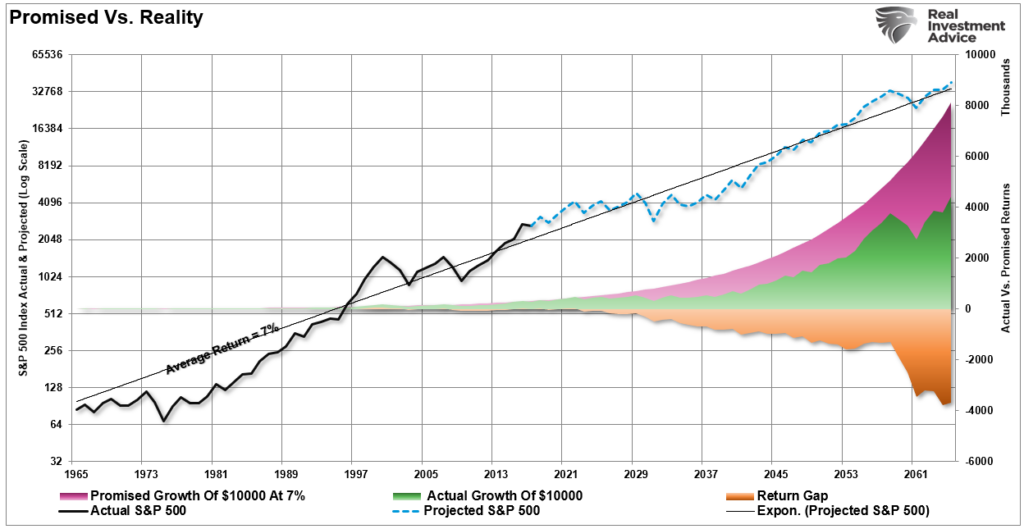
Throughout history, bull market cycles are only one-half of the “full market” cycle. This is because during every “bull market” cycle the markets and economy build up excesses that are then “reverted” during the following “bear market.” In the other words, as Sir Issac Newton once stated:
“What goes up, must come down.”

Bulls Are Wrong At The Worst Time
Recently, Nick Maggiulli penned an interesting article on “the broken clock.”
“But the real tragedy here is that one day he will be right. One day a crash will come and Kiyosaki will take a victory lap for all to see.
Will his prior incorrect calls matter? Not at all. You can try to point out his flawed track record, but it won’t make a difference. Most people aren’t going to see your reply. But what they will see is his tweet. They will feel the pain from the crash after it happens and then they will think, “Kiyosaki knew it all along.”
Oh he got it wrong eight times before? Who cares? He is right now, isn’t he?”
Nick is correct. No one will remember the “bears” wrong calls when the crash eventually comes. But where Nick is incorrect is that the same applies to the “bulls.”
Few remember Jim Cramer’s “Top 10-Picks” in March of 2000 or the numerous bullish media analysts who said “buy” all the way down the crash in 2008. No one remembers those wrong calls, but they do remember eventually the “buy” recommendations were right. Unfortunately, few investors had capital left at that point.
We give Nick a pass because he is young and has not lived through an actual bear market. As anyone who has will tell you, it is not an adventure they care to repeat.
The problem with being “bullish all the time” is that when you are eventually wrong, it comes at the worst possible cost; the destruction of investment capital. While being “bearish all the time” also has a cost, it comes only at the expense of underperforming markets during a bullish phase. A lack of performance is easily recovered, a loss of capital is not.
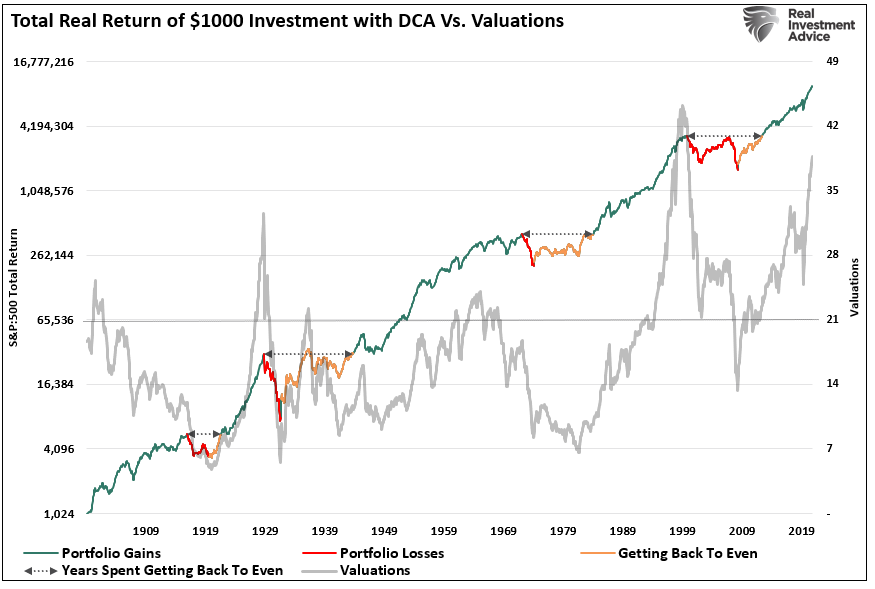
While the “bulls” seem to have their way during rising markets, there is a problem overlooked by the always bullish media. Over the past 120-years, the market has indeed risen. However, the markets spent 85% of that time making up previous losses. The markets spent only 15% of the time making new highs.
The importance of this point should not be overlooked. For most investors, their investing “time horizon” only covers one cycle of the market. If you are starting at or near all-time highs, there is a relatively significant possibility you may wind up spending a significant chunk of your time horizon “getting back to even.”


The Fallacy Of The “Broken Clock”
Ed Yardeni, of Yardeni Research, recently stated the majority of retail investors are down 35% in their portfolios in 2022. This is substantially worse than the 20% decline in the S&P 500 at the time of this writing.
However, such should not be surprising as the realization of excess speculative risk-taking has come home to roost. But as stated such is just part of the full market cycle. Dr. John Hussman, who put an excellent point on the importance of understanding the “full market cycle:”
“Put simply, most apparent “opportunities” to obtain investment returns above zero in conventional assets over the coming decade are based on a misunderstanding of valuations, total returns, and historical yield relationships. At current valuations, virtually everything is priced for a decade of zero. The unwinding of these speculative extremes is likely chaotic and will occur over a shorter horizon than investors imagine. That chaos, driven not by central bank tightening but by an emerging default cycle, will usher in fresh investment opportunities in conventional assets, where there are none.”
That last sentence is the most crucial as we are now in the central bank tightening cycle, with a recession on the horizon. While many suggest such won’t happen, there are many reasons it could.
“It will arrive precisely because they have sustained yield-seeking speculation for too long already because they have amplified the vulnerability of the debt and equity markets to normal economic fluctuations; and because the consequences of this fragility are now fully baked in the cake.” – Dr. John Hussman
The mainstream dismissal of such warnings is indicative of the willful blindness to the underlying problems and the inherent disaster to long-term goals that currently await many unwary individuals in the markets.
As I have often stated, I am not bullish or bearish. While my discussions of “risk management,” market conditions, and valuations are often perceived as bearish, many assume we are all in cash. Such is never the case.
My job as a portfolio manager is simple; invest money in a manner that creates returns on a short-term basis but reduces the possibility of catastrophic losses which wipe out years of growth.
We believe you should not be “bullish” or “bearish.” While being “right” during the first half of the cycle is essential, it is far more critical not to be “wrong” during the second half.

The Art Of Being A Contrarian
Howard Marks once stated that being a “contrarian” is tough, lonely, and generally right. To wit:
“Resisting – and thereby achieving success as a contrarian – isn’t easy. Things combine to make it difficult; including natural herd tendencies and the pain imposed by being out of step, particularly when momentum invariably makes pro-cyclical actions look correct for a while. (That’s why it’s essential to remember that ‘being too far ahead of your time is indistinguishable from being wrong.’)
Given the uncertain nature of the future, and thus the difficulty of being confident your position is the right one – especially as price moves against you – it’s challenging to be a lonely contrarian.”
The problem with being a contrarian is the determination of where you are during a market cycle. The collective wisdom of market participants is generally “right” during the middle of a market advance but “wrong” at market peaks and troughs.
Despite the correction so far in 2022, there are plenty of warning signals that suggest investors should remain cautious with portfolio allocations. As Mr. Marks suggests, being a “contrarian” is a tough and lonely existence. However, you can approach your portfolio management in a manner to reduce the risk of capital destruction.
- Avoid the “herd mentality” of paying increasingly higher prices without sound reasoning.
- Do your own research and avoid “confirmation bias.”
- Develop a sound long-term investment strategy that includes “risk management” protocols.
- Diversify your portfolio allocation model to include “safer assets.”
- Control your “greed” and resist the temptation to “get rich quick” in speculative investments.
- Resist getting caught up in “what could have been” or “anchoring” to a past value. Such leads to emotional mistakes.
- Realize that price inflation does not last forever. The larger the deviation from the mean, the greater the eventual reversion will be. Invest accordingly.
Being a contrarian does not mean always going against the grain regardless of market dynamics. However, it does mean that when “everyone agrees,” it is often better to look at what “the crowd” may be overlooking.