
According to A Statistical Revamp Is About To Lower Inflation by The Wall Street Journal, the Bureau of Economic Analysis (BEA) is reformulating its Core PCE calculation. The markets seem to focus on CPI as its inflation gauge, while the Fed often touts PCE as its key inflation indicator.
Economists expect the BEA’s changes will lower the Core PCE by roughly two-tenths of a percentage point when the changes take effect with the August data reported in September. The changes target three PCE sub-categories:
- Software: the BEA currently borrows a BLS index that includes items like flash drives, whose prices are currently surging due to AI demand. In their logic, this distorts the reading with hardware costs that are unrelated to actual software inflation. The fix blends in videogame and web-hosting data. Per UBS economist Alan Detmeister, the change will lower PCE by about a tenth of a point.
- Investment management: the BEA is changing how it treats investment advisory fees. Currently, most investment managers charge a percentage of a client’s assets. Thus, when the stock market rises, advisory fees follow. Former Fed governor Stephen Miran has argued that rising fees on a bigger asset base reflect more service volume, not a higher price for the service. Per Alan Detmeister, this change could also reduce PCE by another one to two-tenths.
- Legal services: the BEA will now use data from the BLS PPI report instead of the BLS CPI report. This change will increase PCE inflation but not by enough to offset the other two.
The timing of the BEA action will draw scrutiny given that some pundits think the Fed should hike rates. Moreover, we suspect the media will ask if politics played a role in the reformulation. According to the Wall Street Journal, the changes won’t impact Warsh’s perception of inflation.
A few tenths of a percentage point won’t alter the big picture. Inflation has run well above the Fed’s 2% target for more than five years. The new Fed chairman, Kevin Warsh, has said he isn’t interested in splitting hairs, adding that he prefers to focus on how the inflation rate looks “to the left of the decimal point.“

What To Watch Today
Earnings

Economy

Market Trading Update
Yesterday, we laid out the overview for SpaceX’s earnings report. Today, I want to touch on something noted by JPM’s Mark Schilsky, who argues the market is becoming increasingly convinced that hyperscaler AI capex is generating returns well in excess of its cost. This is a stark difference from the “AI Capex Is The Hyperscalers Waterloo” narrative.
The S&P 500 closed Monday at 7,600.50, up 1.48% and above 7,600 for the first time. The Dow set a record at 53,178.41. By Tuesday morning, the index printed a fresh all-time intraday high, its first since June 2. Now look at what carried it. Microsoft added 4.90%, Amazon 4.64%, and pushed through a $3 trillion market cap, Meta 6%, and Alphabet 4.9%. Nvidia managed 2.9%. The hyperscalers led. The chips followed.
That composition matters more than the index level, because this isn’t a new AI melt-up. It’s a catch-up trade. Over the past twelve months, three of the four hyperscalers trailed the chip complex badly, and two of them fell outright.
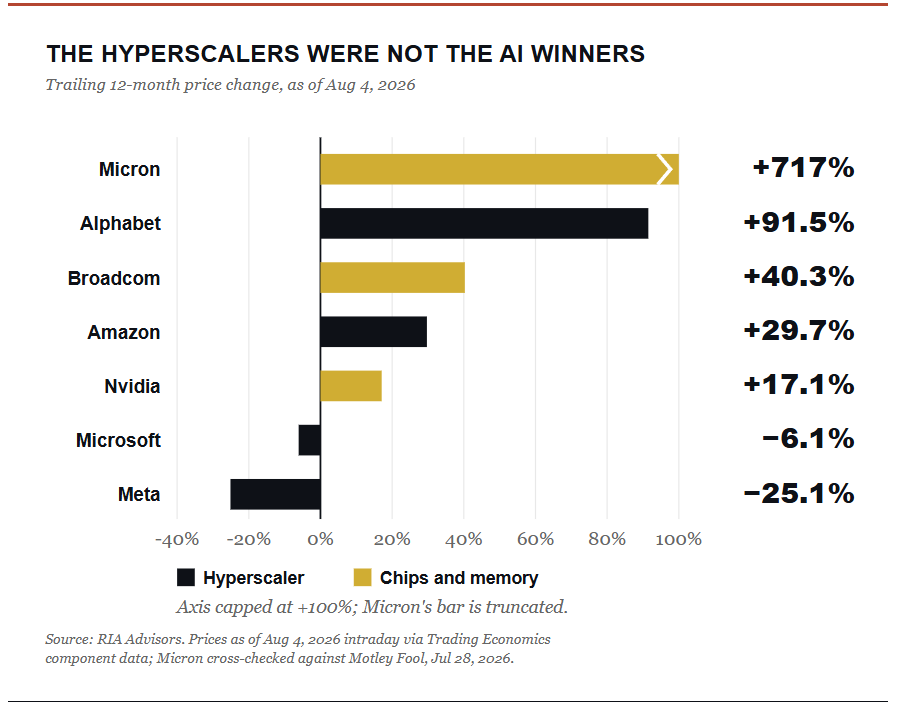
Meta is down 25.1% over the year, and Microsoft is down 6.1%, while Micron is up roughly 700%. For a year, the market paid a premium for the picks and shovels and charged the hyperscalers a discount for the privilege of buying them. Second-quarter results broke that. Not the capex guides, which went UP again at all four. The margins did it. AWS’s operating margin expanded 520 basis points, excluding a one-off item, to roughly 39%. Google Cloud went from 20.7% to 35.6%.
Here is the part most coverage skips. Notice in the chart below where the profit in each AI dollar actually settles.

Hyperscalers keep 29.7 cents of every dollar spent on AI, more than the entire chip and equipment complex, which together keep 26.1 cents. Neoclouds keep three-tenths of a cent, which explains most of what CoreWeave’s chart has been saying. Bob Farrell’s Rule #9 fits the moment. When every desk agreed the spending was value-destructive, something else happened.
I’m treating this as a rotation to respect, not a green light. We continue to favor hyperscaler exposure over semiconductor exposure here, funded by trimming the most stretched memory and chip positions rather than by spending the cash buffer. Keep that buffer. August through October is historically the weakest three-month stretch of the year. Breadth is still thin, and one Hormuz headline reprices oil inside an hour. Add to the group collecting the profit, trim the group collecting the multiple, and manage risk at the line rather than after it breaks.

Two Bitcoin Woes: One Real, One Overblown
A firmware flaw in Coinkite’s Coldcard hardware wallet (self-custody) has resulted in over $100 million in bitcoin being stolen from 5,200 addresses during the last few days. Coinkite has supposedly fixed the problem, but users who generated seeds under the vulnerable firmware remain exposed and must migrate to new wallets. This is an engineering failure worth taking seriously if you own a Coldcard, but it is a one-off vendor bug, and importantly, not a threat to bitcoin or to hardware wallets generally. That said, as we share in our Tweet of the Day, self-custody of bitcoin is proving more risky than holding it with traditional centralized custodians.
Strategy’s latest move is the more structurally important story for bitcoin holders to consider. The company just sold 1,638 bitcoin, raising $104.7 million, its third sale in recent months. The action reduces its holdings to 842,138 coins, leaving it still the largest corporate bitcoin holder. Michael Saylor moved quickly to separate himself and his prior statements about never selling bitcoin from Strategy’s decision:
When I say ‘never sell your Bitcoin,’ I speak as one saver to another. I have never sold mine. Not one satoshi. Strategy is a public company, not my wallet.
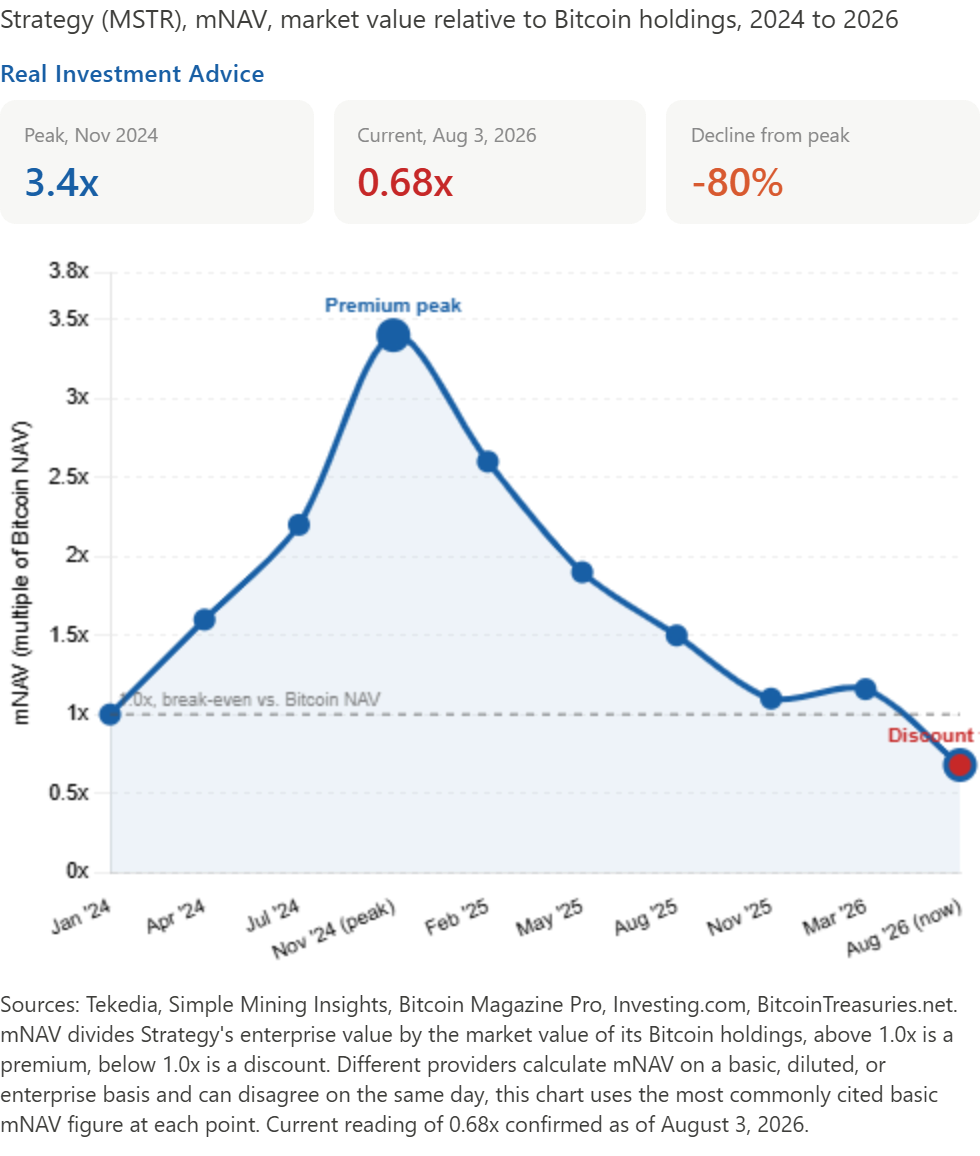
The latest bitcoin sale was used to help pay a $400.7 million preferred dividend. While selling to fund its leverage is not an indicator that Saylor or Strategy are having doubts about bitcoin’s worth, it is the third consecutive break from Saylor’s promise, one that helped build a hefty premium for Strategy a few years ago. The premium, as shown below, peaked in 2024 at 3.4x. It has since fallen steadily, now sitting well below 1.0x.

Tweet of the Day

New UPDATED Trading Rules With Desktop Printout
“Want to achieve better long-term success in managing your portfolio? Here are our 15-trading rules for managing market risks.”
Please subscribe to the daily commentary to receive these updates every morning before the opening bell.
If you found this blog useful, please send it to someone else, share it on social media, or contact us to set up a meeting.