Kevin Warsh delivered his first semiannual testimony to Congress earlier this week. In it, he used every opportunity to stress the urgency of returning inflation to the Fed’s 2% target. To wit, he stated, “Inflation will be a thing of the past.” He also said the Fed “has no tolerance for persistently elevated inflation.”
The June CPI inflation report, showing a 0.4% decline in prices, was released 90 minutes before his House testimony on Tuesday. It gave Warsh room to sound determined without the need to promise immediate action via a rate hike. He made it clear that while the inflation data was great news, “It’s one data point…. I don’t want to overread or cherry-pick data.”
Kevin Warsh’s aversion to forward guidance was another key theme. His argument, in essence: “We’re human.” Importantly, Warsh seems to understand that behavioral flaws can negatively impact policy. Publish a projection,” he said, and the committee inevitably starts “taking information that’s consistent with our priors and rejecting information that’s inconsistent.” When a person or group anchors to a forecast, they tend to favor it and may be less likely to consider opposing data. In Warsh’s view, when members are not saddled with the perception of prior forecasts, they can be “more circumspect,” which is a better way to set policy.
Warsh did receive a few questions about the Fed’s independence. To wit, Rep. Nydia Velázquez asked whether Warsh “works for” the administration. Warsh replied, “We’re an independent central bank.” When pressed further, he committed only to “follow the law and follow the data.”
The graphic below shows the Fed is currently split on the odds of a September rate hike.

What To Watch Today
Earnings

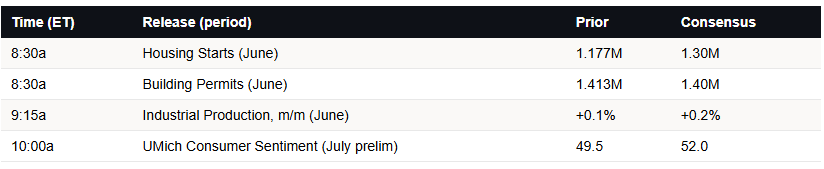
Economy
Fed Speakers
None scheduled. The pre-FOMC blackout begins Saturday, July 18, ahead of the July 28–29 meeting, so Friday is the last open day on the calendar. Chair Kevin Warsh’s semiannual monetary policy testimony wrapped on Wednesday before the Senate Banking Committee.
Market Trading Update
In yesterday’s report, we walked through semiconductors stretched to a historic extreme and made the case for trimming the parabola before it trims you, as we covered here. Today, I want to discuss what happens when that trade finally cracks, because the underlying tape is telling a very different story from the headline index.
On the surface, the markets look dull, well, actually just boring. The S&P 500 remains barely lower than its record high, but that calm is a cap-weighting illusion. The Nasdaq 100 slipped below its 50-day moving average for the first time in months, while the VanEck Semiconductor ETF (SMH) dropped roughly 3% as the chip bid unwound. The generals took the damage.

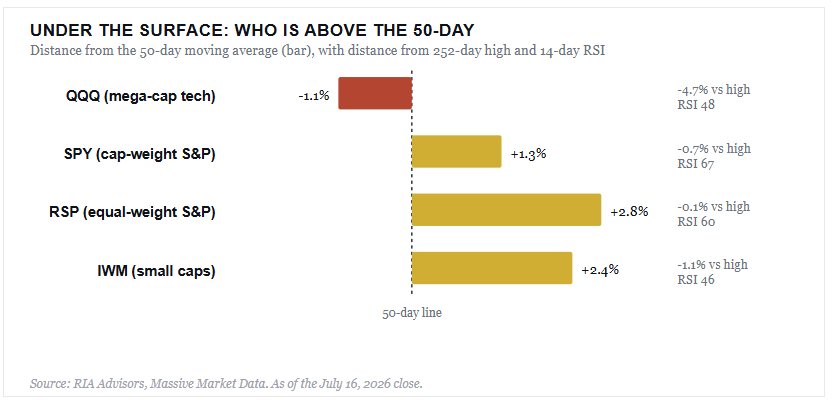
Now look at what the troops did. The equal-weight S&P 500 (RSP) rose, and its RSI is a healthy 60. Small caps (IWM) also lifted, with the Dow also gaining ground. On a day when Semiconductors and Technology retreated, the average stock advanced. As the chart below shows, RSP now sits 2.8% above its 50-day line, while the cap-weighted Nasdaq has fallen below its own 50-day line.
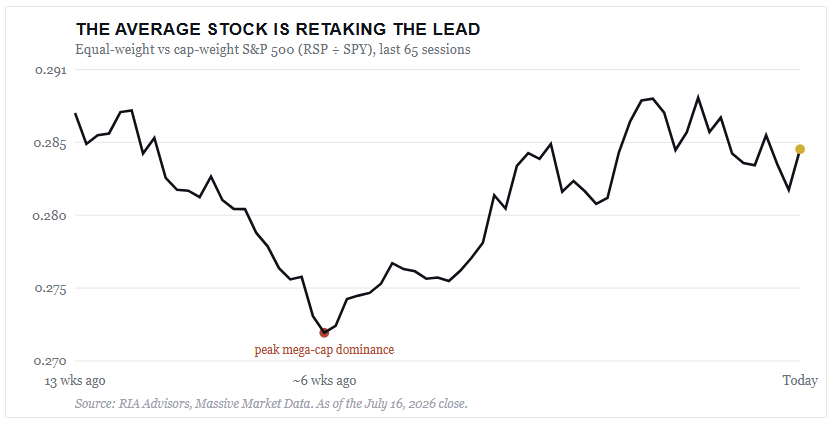
With the market broadening, there remains a bullish backdrop for investors for now. While the rally from the March lows has been impressive, it has relied primarily on a handful of stocks. With the relative strength of the equal-weight versus cap-weight index bottoming six weeks ago and climbing since, it is clear that money isn’t leaving the market. It’s changing seats.
Here’s the catch. Yes, the market’s broadening is healthy, but the trigger matters. This rotation is being FORCED by tech rolling over, not pulled by fresh optimism about growth. Small caps still have to prove they can lead with a hawkish Warsh Fed and yields backing up on higher oil. IWM remains shy of its high with an RSI of just 54. A rotation that is really only tech deleveraging can reverse in a single session.
So, what does this mean to you? That is THE question, and there are no guarantees. Therefore, you manage the risk and let the markets dictate your next course of action. We are not chasing small caps up here, and we would rather add on a pullback toward the S&P’s 50-day near 7,456 than pay up into resistance at the old high. Keep quality high, keep a little dry powder, and most notably, continue to manage risk at the line. Broad is good. Forced-broad still has to prove itself.
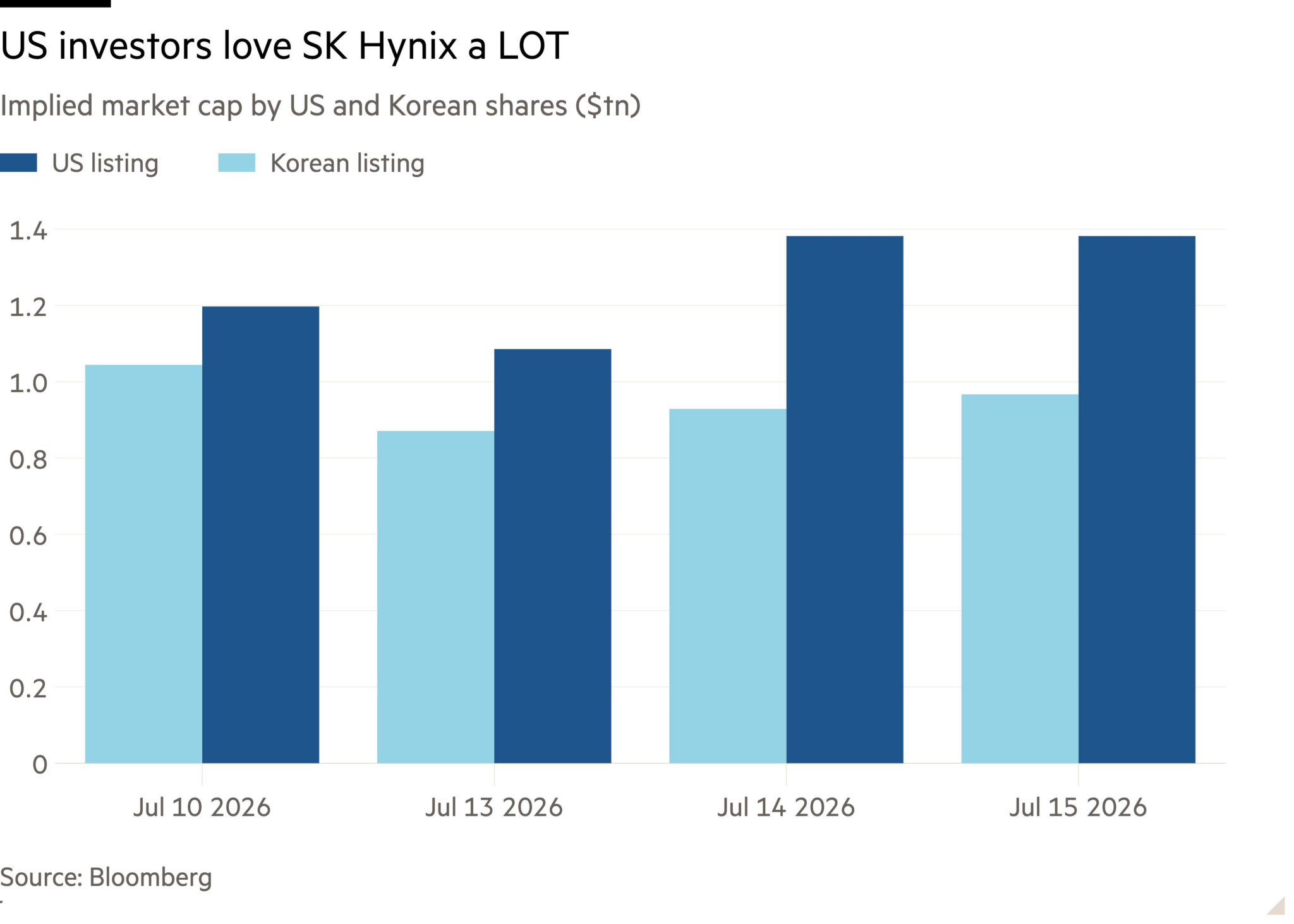
One Company- Two Prices: Examining SK Hynix’s Reverse Kimchi Premium
South Korea has long had what is called a “Kimchi discount.” This is the tendency for Korean companies to trade at lower valuations than their global peers due to weak governance and limited shareholder returns. South Korean memory chip maker SK Hynix just demonstrated the discount in its new US ADR listing.
SK Hynix’s Nasdaq-traded ADR (SKHY) began trading on Tuesday, closing at $193.92, up over 25%. Each ADR represents one-tenth of an ordinary Korean share. That same day, the Seoul-listed shares closed at $1,280. The ADR should have been $128. US investors are paying an approximately 50% premium for identical ownership, underlying business, dividends, and earnings. The only difference is which exchange processes the trade.
Why doesn’t arbitrage close the gap immediately? Part of the gap reflects the structure of the listing itself. SK Hynix’s ADRs can be converted freely into Seoul-listed shares, but conversions in the other direction require regulatory approval. This one-way conversion model mirrors TSMC’s approach. Its US-listed shares have maintained persistent premiums of 13% to 20% for years as the arbitrage mechanism is hobbled by the same conversion limitations.

Tweet of the Day
New UPDATED Trading Rules With Desktop Printout
“Want to achieve better long-term success in managing your portfolio? Here are our 15-trading rules for managing market risks.”
Please subscribe to the daily commentary to receive these updates every morning before the opening bell.
If you found this blog useful, please send it to someone else, share it on social media, or contact us to set up a meeting.