
We publish this article hours before the Fed updates monetary policy at its September 16, 2026, FOMC meeting. Prior to its decision, the Fed has kept the Fed Funds rate steady even as inflation runs stubbornly above target. At the same time, longer-term bond yields have risen appreciably and, in the process, are tightening financial conditions. The 10-year Treasury just surpassed 5%, and mortgage rates, corporate borrowing costs, and equity discount rates have all risen similarly. The combination of no Fed tightening but relatively significant market tightening raises a question. If long-maturity yields are weighing on economic activity, has the bond market already done the Fed’s job?
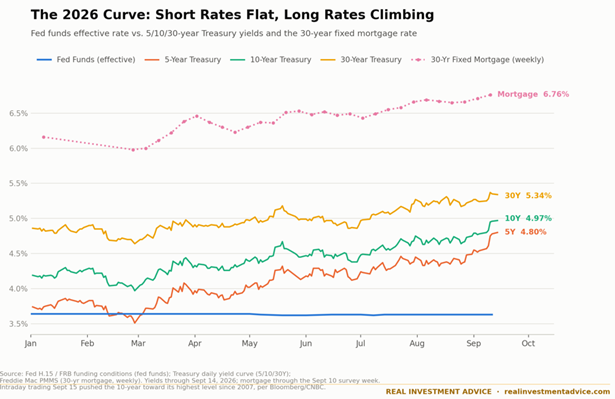
The answer is complicated. The short and long ends of the yield curve impact the economy and inflation differently; accordingly, they are not necessarily substitutes for each other. Both impact GDP and inflation, but through separate channels and timelines.
What The Long End Impacts
The 5-year, 10-year, and 30-year bond yields influence personal consumption, corporate capex plans, and the pricing of assets valued off a moderate or long stream of future cash flows.
Consider the following important sources of economic activity:
Housing
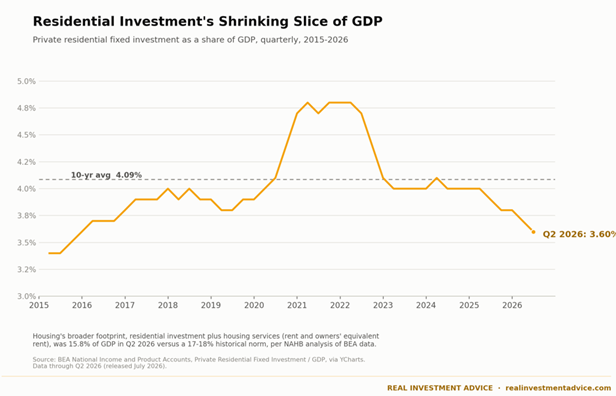
The 30-year mortgage rate closely tracks the 10-year Treasury plus a spread. With the 10-year yield at 5.00% and mortgage rates near 7.00%, new and existing home sales, buyer demand, and housing turnover are depressed. As a result, residential fixed investment as a percentage of GDP has fallen from nearly 5% in late 2021 to 3.6% today as mortgage rates more than doubled.

Corporate financing
Corporate bond issuance is priced as a spread to Treasury yields. Thus, higher Treasury yields raise borrowing rates and increase corporate interest expense. The impact lags, as shown in the graph below. Higher yields also raise project hurdle rates for capital expenditures.
Higher interest costs reduce profits, often leading executives to cut expenses, including payroll. At the same time, higher project hurdle rates often cause firms to delay or reduce capex. In both cases, higher rates dampen economic activity over time.
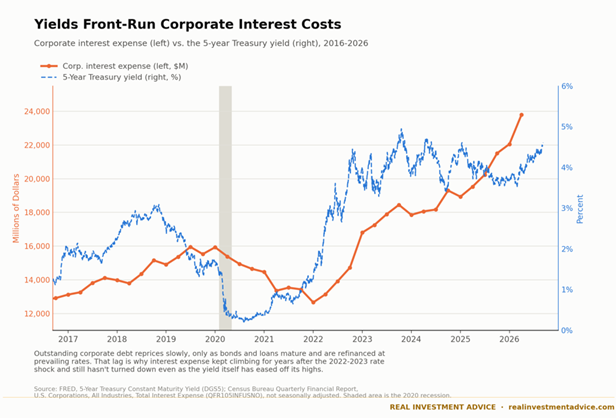
It’s worth adding that higher rates today may have a greater impact than in the past because corporations borrowed extensively when rates were historically low in 2020 and 2021. A good portion of cheap debt is maturing over the next two years. Refinancing it at much higher rates will have a greater impact on interest expenses than in the past, even if Treasury yields stay at current levels or decline.
Auto Loans
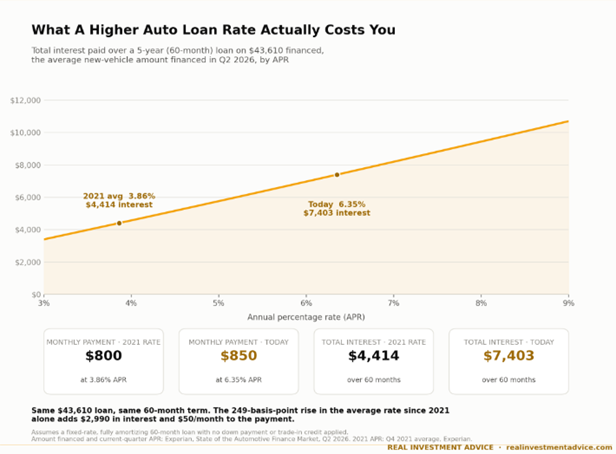
New and used auto loan rates price mainly off the three- to seven-year part of the Treasury curve, which matches the loan’s duration. These short- to intermediate-term yields are up nearly 100 basis points since their late-February low, pushing auto financing costs higher even though the Fed hasn’t raised rates. Auto sales account for approximately 5% of GDP.
Equity valuations
Equities are long-duration assets, with cash flow duration estimated at roughly 20 or more years on average. A higher long-term discount rate compresses fair-value calculations. In turn, lower valuations, if they weigh on stock prices, can hurt consumer sentiment through the psychological wealth effect. It’s debatable whether higher yields have impacted equity markets yet, but regardless, the odds of them negatively affecting stocks rise as bond yields rise.
Federal Interest Expense
Higher yields raise the government’s borrowing costs, but that increase in expense takes time, as most debt is set at lower rates and only resets when it matures. The first graph shows the sharp increase in the government’s interest payments since 2020. The following graph shows the lag between changes in rates and changes in the government’s average interest rate. Note that longer-term bonds have a much longer lag than bills.
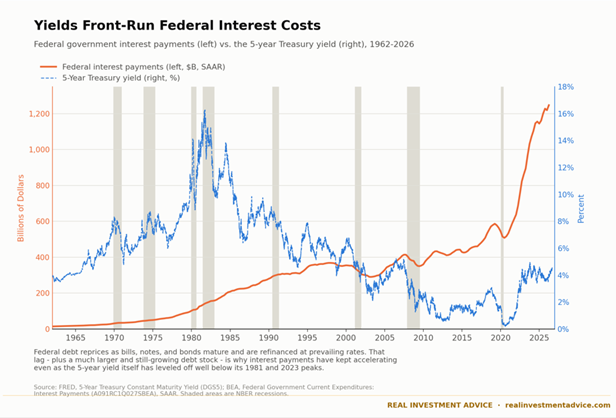
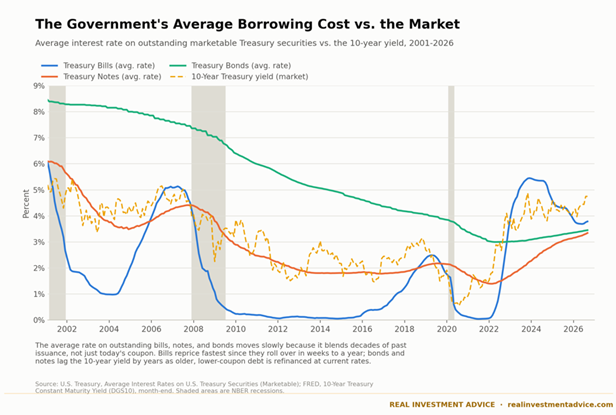
The important takeaway is that as the government demands more money to finance its debts, it crowds out financing for consumers and corporations, ultimately raising their borrowing costs.
Higher Long Rates Are A Headwind
While those economic sectors and assets, and many others we don’t mention, are negatively impacted by higher long-term rates, none are a direct inflation channel. Rising long-term yields cool the economy by discouraging borrowing and spending, and lower demand or weak sentiment eventually feeds through to prices, but the diffusion is slow.

What The Short End Impacts
The Fed Funds rate and short-term Treasury bills govern different financial channels that tend to influence inflation more directly and quickly than longer-term yields.
Consumer Revolving Credit
Credit card rates, home equity loans, and floating-rate auto and small business loans are typically priced off the Prime Rate, which is the Fed Funds rate plus a fixed spread. A change in the Fed Funds Rate, and thus the Prime Rate, hits household and business cash flows within a billing cycle and directly alters consumption decisions with immediate effects on both prices and economic activity.
Bank Net Interest Margin And Credit Supply
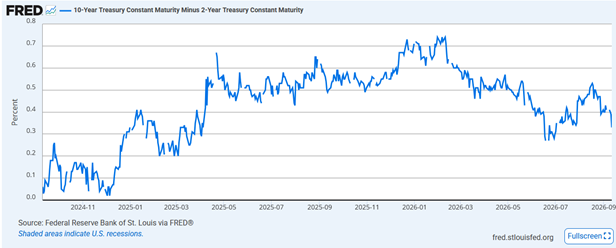
Banks tend to fund their long-term assets, like loans and mortgages, with short-term liabilities. Short-term rates, along with the shape of the yield curve, determine lending profitability, i.e., a bank’s net interest margin. Banks are more willing to extend credit when lending margins are high. Thus, an increase in the Fed Funds rate, which often flattens the yield curve and, by default, banking profitability, can materially reduce lending activity.
As we show below, the yield curve is flattening (tightening net interest margins) as the market anticipates rate hikes.
Savings And Cash Yields
Money market and short Treasury Bill yields determine what households and businesses earn on cash. Those rates shape the propensity to spend versus hold cash. This can be a fast-moving channel that works opposite the slow equity wealth effect. Higher yields incentivize consumers to save rather than spend, thus slowing economic activity.

Inflation Expectations And Fed Credibility
This may be the most important factor in answering the question of “has the market done the Fed’s job” question. The Fed Funds rate is the primary tool the FOMC uses to manage monetary policy. Consumers, businesses, and investors are watching it closely today as a credibility signal of whether the central bank is committed to its 2% inflation target.
A tightening bond market, as we have, can restrain growth but says little about the Fed’s resolve. Only the Fed’s policy actions on the Fed Funds rate can do that.
Federal Reserve Governor Christopher Waller made a similar point in comments this month. He said policy is:
“currently only slightly restricting aggregate demand,” and that “it may not take much acceleration in inflation to nudge me into supporting tighter policy.”
That describes someone who views the front end, not the back end, of the yield curve as the inflation-credibility lever.
Summary
Long-term yields impact the economy and inflation but often with a decent lag. Thus, the impact of higher yields hasn’t largely been felt yet. Short-term rates tend to affect growth and inflation more immediately. All that said, while stubbornly high inflation is a big problem and argues for Fed action, the recent inflation uptick and deviation from the downward inflation trend is largely due to the Iranian conflict and higher energy prices.
The Fed Funds rate can’t solve the Iranian oil problem. So, we must ask: Is the price of “restoring inflation credibility” worth it, if higher Fed Funds rates have a very limited impact on inflation but risk meaningful damage to economic activity?
Hiking into a supply shock driven by geopolitical matters could be a big policy error. Accordingly, if they do hike rates, they could likely be followed shortly by rate cuts, an admission of sorts of a policy error.