
A weak Treasury auction brings doom-and-gloom headlines, while strong ones go largely unnoticed. Simply, the good auctions don’t feed the bearish bond narrative. Despite bond bears warning yields will hit 6% or higher, demand for this past week’s 10- and 30-year auctions was off the charts.
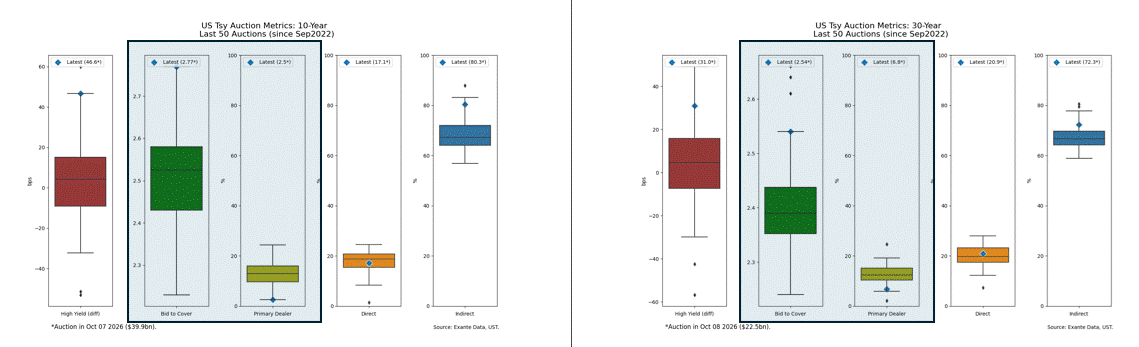
The 10-year note auction on Wednesday sold $39 billion at a 5.300% high yield. It stopped 1.7 basis points through the when-issued level, meaning it cleared much better than the market expected. Thursday’s 30-year $22.5 billion bond auction was similar. The box plots below, courtesy of Exante Data, show how far outside normal both readings sit. The bid-to-cover measures the amount of dollars bid for every dollar sold. The 10-year came in at 2.77 compared to a twelve-month average of 2.51, higher than any of the last 50 auctions. The 30-year was 2.54 against a 2.40 median, at the upper edge of the last 50 auctions.
Primary dealer participation may be the most important auction statistic. The Treasury’s primary dealers must bid and absorb whatever nobody else wants. When an auction has a high percentage dealer take, it means the auction struggled, and Wall Street got stuck with inventory. Dealers took a mere 2.5% of the 10-year, their lowest share on record for the tenor, and 6.8% of the 30-year. Indirect bidders, largely foreign central banks and domestic institutions, took 80.3% and 72.3%, both far above their averages.
As we have noted before, one auction just paints the supply-and-demand story at that brief moment in time. A series of poor auctions, as we have recently had, tells us that investor demand has been weak. While the 10- and 30-year auctions we discuss are outstanding, they are just two auctions. If the Treasury can string together more good auctions with accompanying falling yields, this would be a good sign the bond market may be reversing.
What To Watch Today
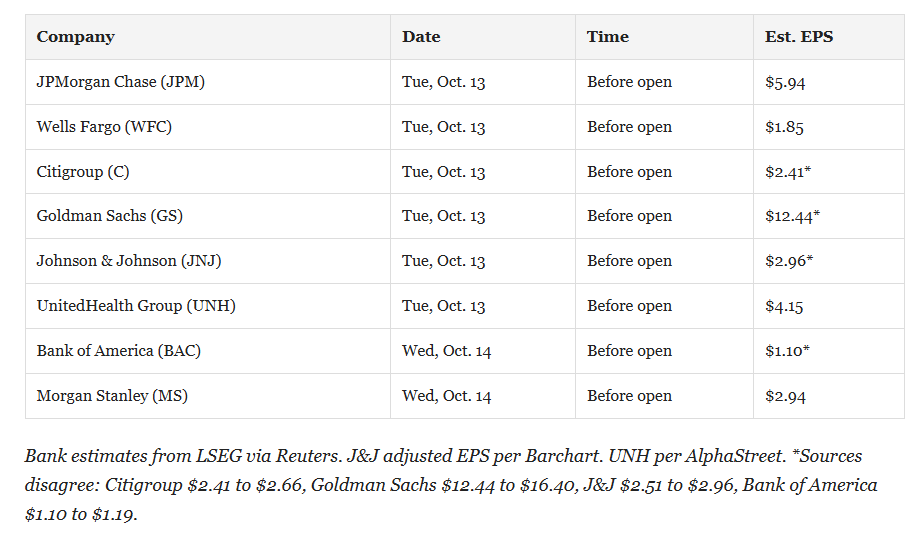
Earnings
Economy
Market Trading Update
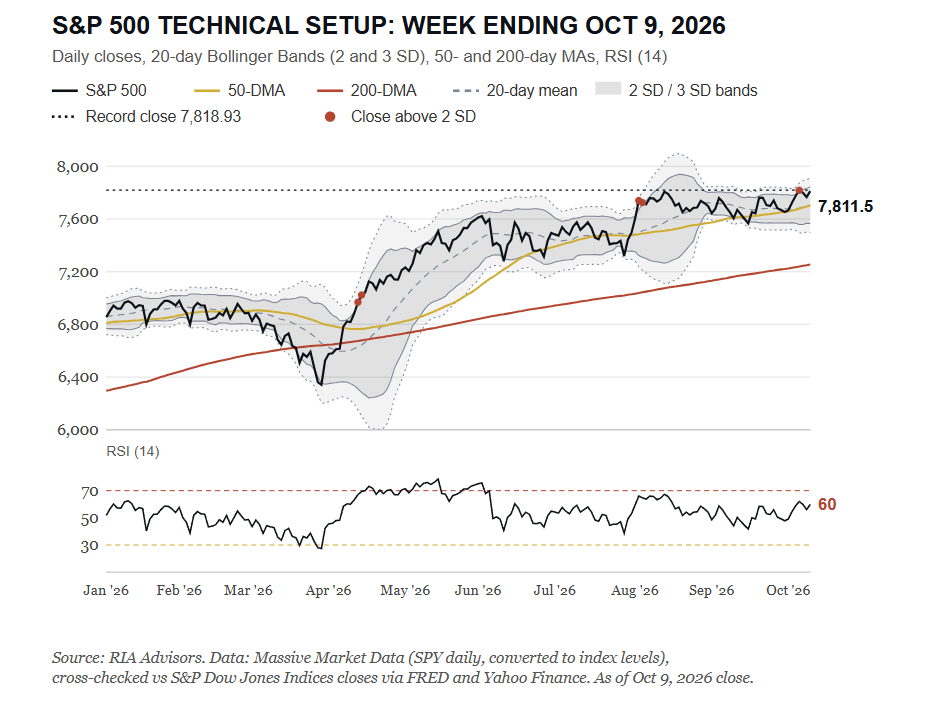
The S&P 500 closed Friday at 7,811.51, up 1.15% for the week and less than 0.1% below Tuesday’s record close. The index sits 1.4% above its 50-day moving average near 7,700 and 7.7% above its 200-day average near 7,250. Both averages are rising, which keeps the primary trend intact.
Zoom out, and the chart shows a market that spent two months in a range. Since mid-August, the index has chopped between roughly 7,570 and 7,800 before this week’s push to a record close. Ranges that resolve near the highs usually favor continuation, but this one is resolving on a narrow foundation. The 200-day average sits 7.7% below the close, so the longer-term trend has plenty of cushion. That distance also shows how far a normal correction could run without breaking the bull market.
Momentum improved. The 14-day RSI rose to 59.8 from 54.5 a week ago, leaving room before the 70 line that marks overbought territory. MACD crossed back above its signal line this week, a fresh buy signal after September’s chop. The index also sits about 1.5 standard deviations above its 20-day mean, so the upper Bollinger Band near 7,846 is the first ceiling.
Breadth is where the story gets more complicated. Only three of the 11 sector ETFs sit above their 50-day averages. Technology leads at 5.1% above, followed by energy at 3.7% and health care at 1.2%, which reclaimed its line this week. Last week, only two sectors cleared that bar. The laggards also closed much of the gap. Real estate improved to 4.1% below its average from 7.1%, and utilities to 2.0% below its average from 6.7%. Financials, the group that reports first next week, still sit 3.1% below their average.
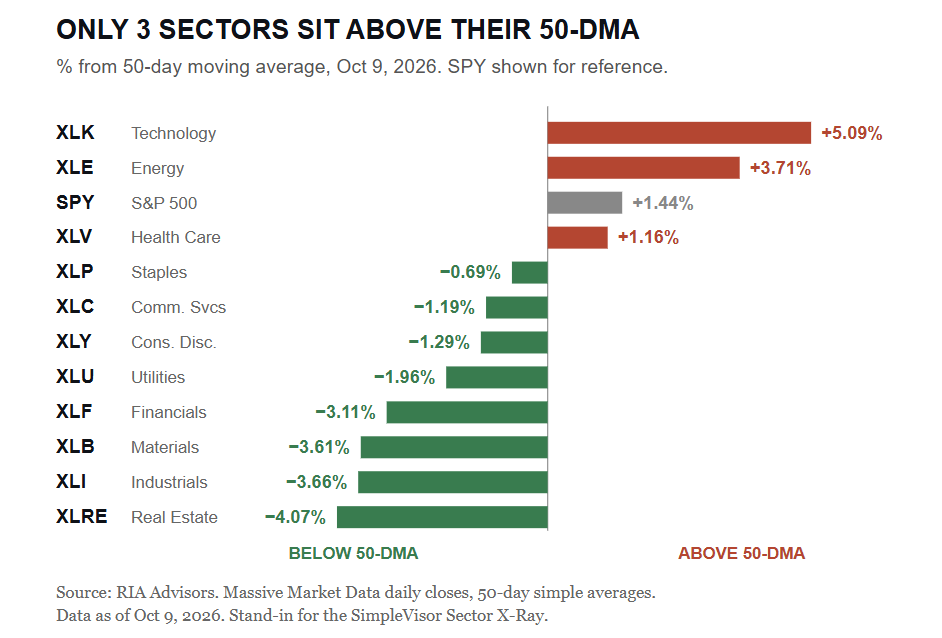
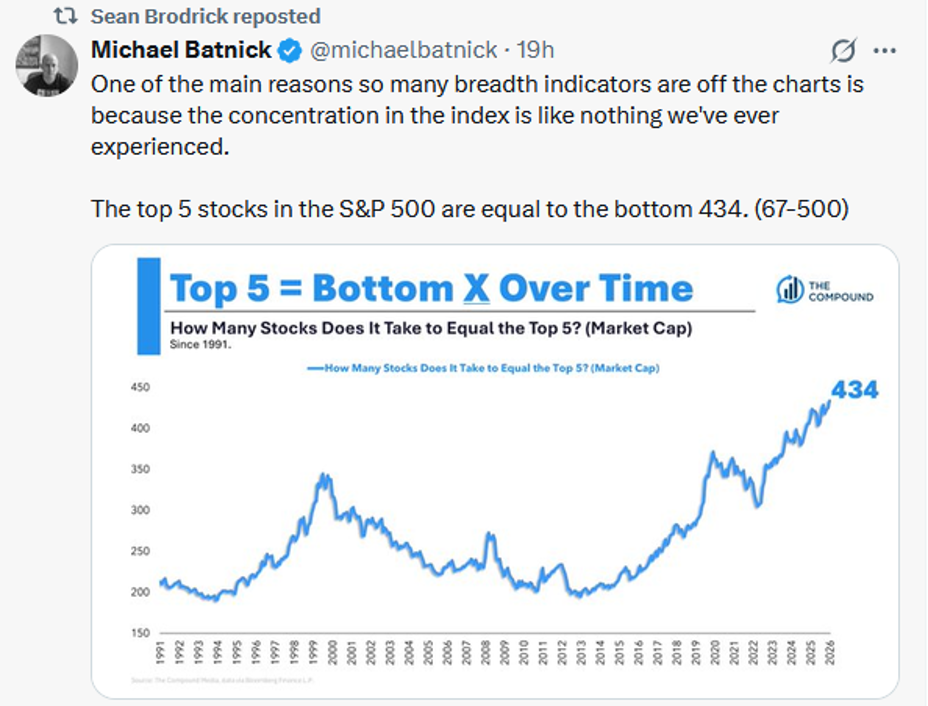
That improvement cuts both ways. Oversold sectors are exactly where a broadening move has to come from, and the equal-weight index outperformed this week. But the defensive rally came as semiconductors fell 4.5%, with chips driving earnings growth. Evercore also counts a record 140 S&P 500 members with negative beta, per Friday’s commentary. A record standing on a few names is NOT the same as a broad advance.
For traders, the playbook is simple. Don’t chase at the highs. A close above the record and the upper band near 7,846, with semis participating, would open a run toward 8,000. Pullbacks toward the 50-day average near 7,700 are the place to add exposure. A break below the Sept. 16 low of 7,567, which also lines up with the lower Bollinger Band, would warrant raising hedges and cash. We continue to recommend rebalancing winners back to target weights ahead of earnings and using the 50-day average as the stop-loss line.
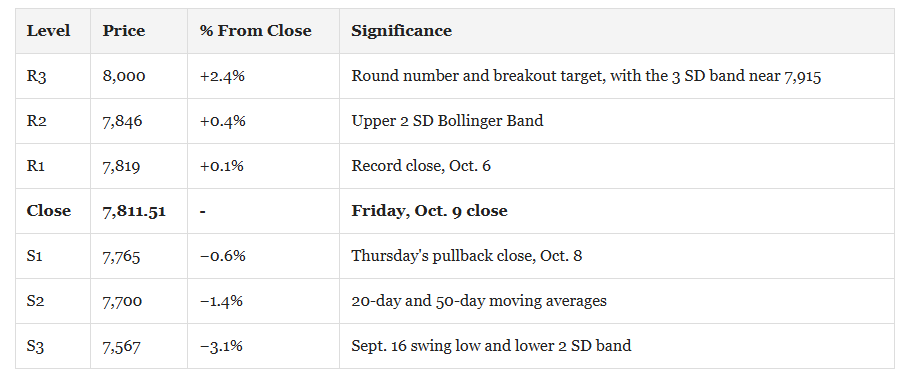
The level that matters next week is the record close at 7,818.93. A close above it with chips joining in confirms the breakout. A failure there, with bank earnings and CPI on deck, likely keeps the index boxed between 7,700 and 7,850. A close below 7,700 would shift the near-term trend back to neutral.

The Week Ahead
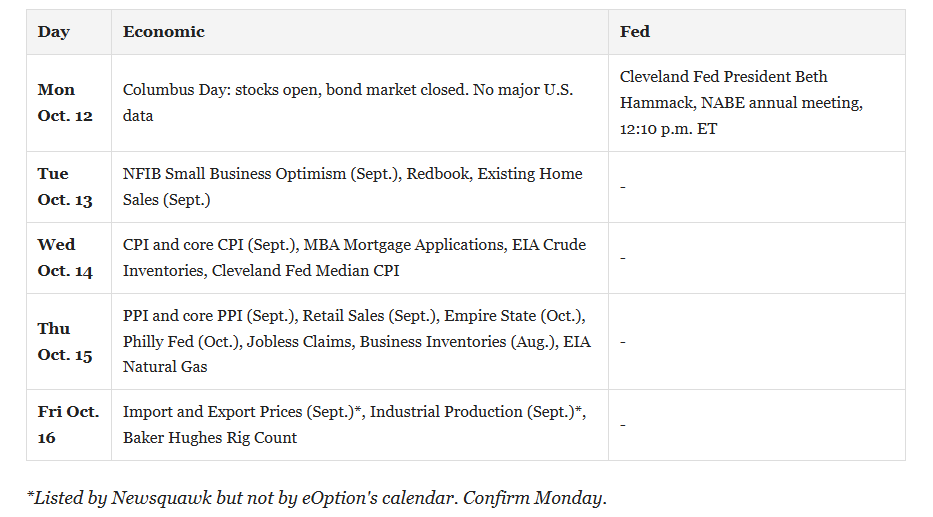
With the Fed’s decision on whether to hike rates coming in three weeks, CPI on Wednesday and PPI on Thursday will be important gauges. CPI is expected to increase by 0.5% on a monthly basis. However, the core reading, excluding food and energy, is expected to rise only 0.2%. Higher energy prices are driving headline inflation. PPI is similar, with 0.5% headline expectations and 0.3% core. After rising a much better-than-expected 1.2% last month, retail sales are expected to be weak, at just 0.1%. This data will provide an early indication of how higher rates are affecting consumer spending.
The big banks and brokers release earnings this week, including JPMorgan, Bank of America, Goldman, Citi, and Wells Fargo. Bank commentary on credit conditions will likely matter more than headline earnings, as financials are down slightly this year while the S&P 500 is up 14%.
Today is Columbus Day. Bond markets are closed, but stocks are trading on a regular schedule.
Gambling Epidemic: Gen Z Bets Against Their Future
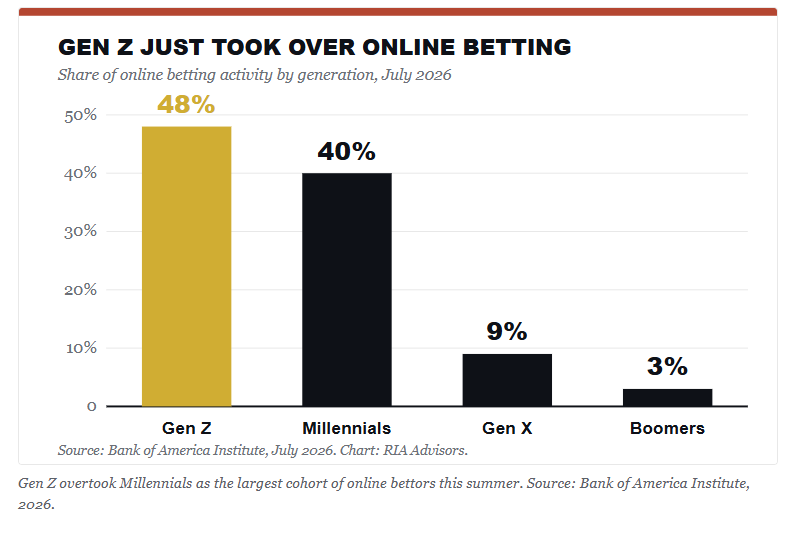
Something changed this summer. Bank of America, which monitors money moving across its customers’ accounts, found that roughly 5% of its customers sent cash to an online betting platform in July, with the number of bettors up 40% since January. The Gen Z gambling epidemic stopped being a headline and became a trend line. First-time bettors in June and July ran more than triple the January pace. And here is the part that should stop every parent and every advisor cold: one in five of these users now calls it “investing.”
By generation, Gen Z and Millennials now make up 88% of online betting activity. Gen X trails at 9%. Boomers barely register. As recently as this spring, Millennials were the bigger group. Then Gen Z passed them, and Bank of America called it a “turning point.” A turning point is the moment when a behavior stops being the domain of early adopters and becomes the default for a whole cohort.

Tweet of the Day
Trading Rules With Desktop Printout
“Want to achieve better long-term success in managing your portfolio? Here are our 15-trading rules for managing market risks.”
Please subscribe to the daily commentary to receive these updates every morning before the opening bell.
If you found this blog useful, please send it to someone else, share it on social media, or contact us to set up a meeting.