Robinhood, the financial brokerage company, just introduced an AI credit card agent. The AI credit card agent can scan for the best prices, monitor availability, and make purchases automatically onto your credit card based on your instructions. Instead of spending hours researching and tracking prices and waiting for deals, your credit card agent will do the work for you. When the agent meets your demands, it will also make the purchase.
A great use example of the new AI credit card is airline reservations. With Robinhood’s new AI credit card and AI technology coming soon for all credit cards, you can tell your personal agent to find a flight from Houston to Paris for the week of September 20th. Then stipulate your cost, flight times, seating needs and other information. The card will constantly search the airline websites and if such a deal becomes available, make the purchase. From there, you can have it seek out the best hotel and rental car deals. The AI agent is essentially a team of travel agents working constantly to meet your needs.
From an economic perspective, it gives pricing power to consumers by enabling them to find the lowest prices more easily. We have heard many examples of how companies are using AI to boost profit margins and reduce expenses. The AI credit card and many other soon-to-come consumer agents will increase competition and help reduce prices. In combination, the innovation of AI and the massive productivity benefits help both consumers lower prices while producers of goods and services can reduce costs.
AI agents are the next step in the AI boom and bringing purchasing power and productivity to consumers.

What To Watch Today
Earnings

Economy

Market Trading Update
Yesterday, we discussed the technical backdrop of the market. As noted, the S&P 500 closed Friday at a record 7,580, its ninth straight weekly gain. On the surface, clear skies. Underneath, market breadth and the bid for downside protection are both flashing a caution worth your attention.
Start with what fear costs right now. Almost nothing. The VIX finished near 15, the equity put/call ratio sank to 0.42, and Goldman’s trading desk notes that average single-stock skew has collapsed to the lowest level in their data. Translation: investors aren’t paying for downside protection. They’re paying for upside calls instead, chasing the AI trade with borrowed conviction and, as Goldman’s prime desk flags, gross hedge fund leverage now sitting near 323%, a fresh five-year high that quietly raises the stakes on any reversal.
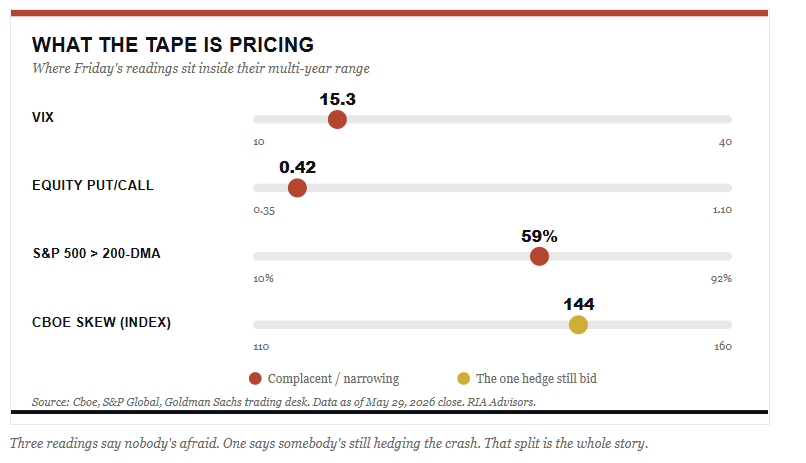
Here’s the wrinkle, and it’s the part most headlines miss. The CBOE SKEW Index, which tracks demand for deep out-of-the-money crash puts on the index itself, is currently elevated at 144 and rose on Friday. So the deep tail is still bid, while the everyday hedge is not. That barbell, lottery tickets on the upside and crash insurance on the far downside with nothing in the middle, is exactly what a complacent-but-quietly-nervous market looks like.
Then there’s market breadth. With the index at an all-time high, only 59% of S&P 500 stocks trade above their 200-day average, and barely half trade above their 50-day average. Make no mistake, a record built on fewer and fewer shoulders is a fragile record. As Bob Farrell’s Rule #9 reminds us, when everyone agrees on the trade, something else tends to happen.
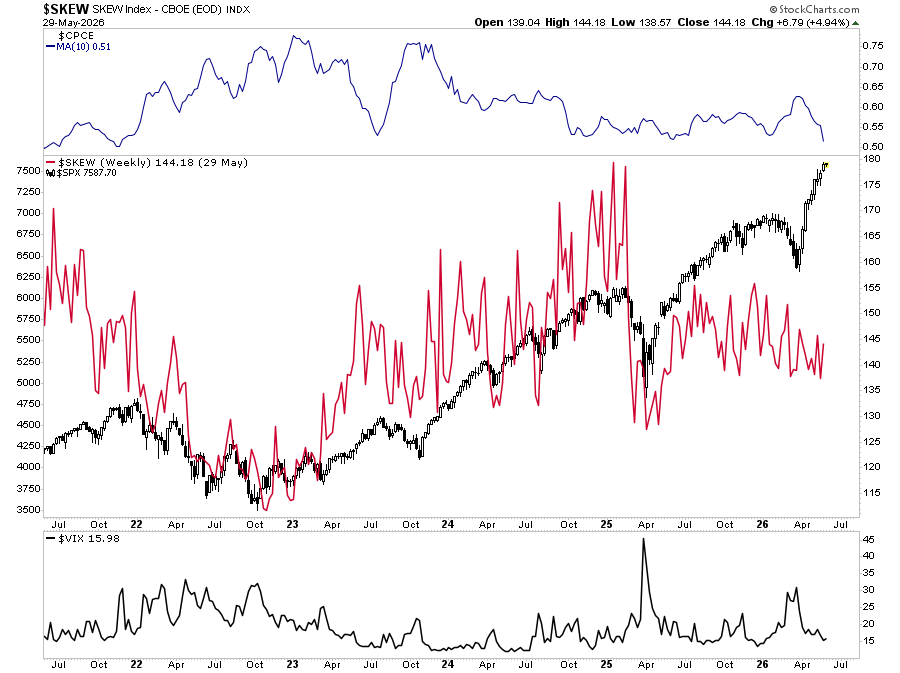
The question, however, is how long this can last. The simple answer is: “Longer than you’d think.” Complacency is a terrible timing tool, and that’s the trap. Narrow breadth and cheap protection have persisted for months at a stretch, back to 1999 and again into late 2021, before the bill finally came due. What history does tell us is what the ending looks like. When there’s no put cushion under the market, and correlations are pinned near record lows, the eventual drawdown isn’t gradual. It’s fast, because everyone reaches for the same exit at once.
So what does this mean for you? Not panic, and not cash under the mattress. It means discipline. It’s why we’ve been trimming our biggest winners back to target weights and carrying a little more cash than usual. With protection this cheap, adding a hedge costs less than it has in years. Rebalance, raise quality, and stop confusing a rising index with a HEALTHY one.

Transportation Stocks Signal Economic Strength
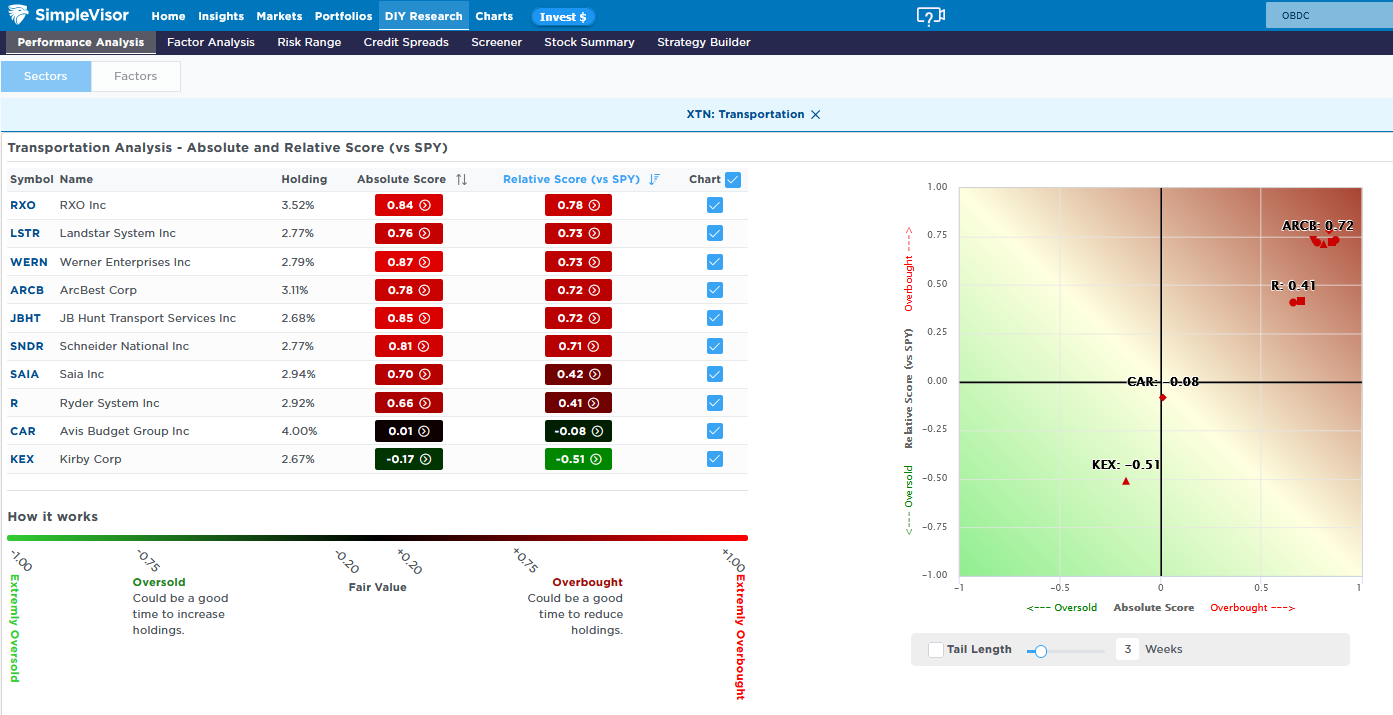
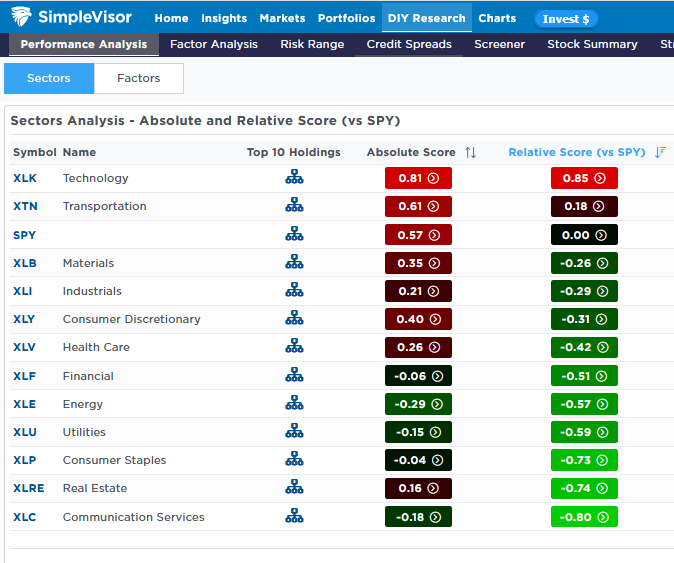
While consumer confidence languishes, signaling that the economy may be weakening, the transportation sector has been trading well of late, suggesting the economy may be picking up speed. Given the recent poor confidence readings, in part due to high oil prices, one would think that shipping and freight companies would be struggling. Instead, as we share below, many of the outperforming stocks in the transportation ETF (XTN), including RXO (Freight brokerage and “last mile” delivery), LSTR (freight broker and logistics), WERN (trucking), ARCB (trucking and logistics), JBHT (trucking), and SNDR (freight), are freight, trucking, or logistics companies. Unlike the prior episode when XTN was very overbought, the bulk of the top ten stocks are driving the performance, not a single stock, as we saw with AVIS (CAR).
Technology stocks and, in particular, semiconductor, hardware, and more recently software stocks are driving the huge outperformance of the technology sector compared to all of the other sectors, as we share in the second graphic below. If a rotation occurs, we suspect technology stocks will underperform, with communications, staples, and real estate stocks are most likely to outperform. Note that those three sectors tend to have many stocks that pay higher dividends. A continued decline in yields could be the catalyst for such a reversal.
Risk Management For Retirees: When To Reduce Exposure
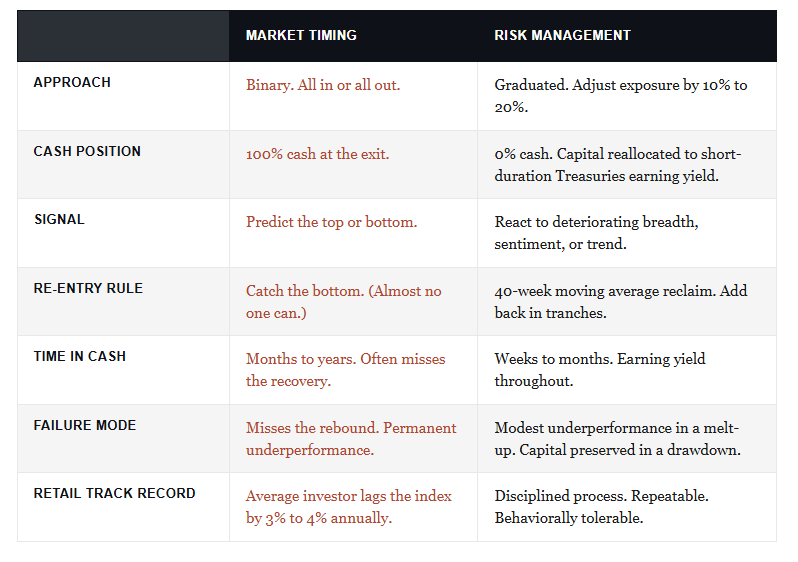
Risk management is a graduated process, not a switch. When conditions deteriorate, you reduce equity exposure modestly. Maybe 10%. Maybe 20%. Cash isn’t the destination. Staying invested matters because a sharp reversal to the upside shouldn’t leave you stranded on the sidelines. The proceeds go into something that earns yield while you wait, like short-duration Treasuries or a money market currently paying north of 4%. That leaves room to add exposure back when the setup improves.
I went through this distinction in detail in Correction Continues: The Value Of Risk Management. The key insight is that going to zero exposure is just market timing with extra steps. Maintaining some equity exposure while reducing risk produces materially better outcomes than either extreme.
Tweet of the Day
New UPDATED Trading Rules With Desktop Printout
“Want to achieve better long-term success in managing your portfolio? Here are our 15-trading rules for managing market risks.”
Please subscribe to the daily commentary to receive these updates every morning before the opening bell.
If you found this blog useful, please send it to someone else, share it on social media, or contact us to set up a meeting.