
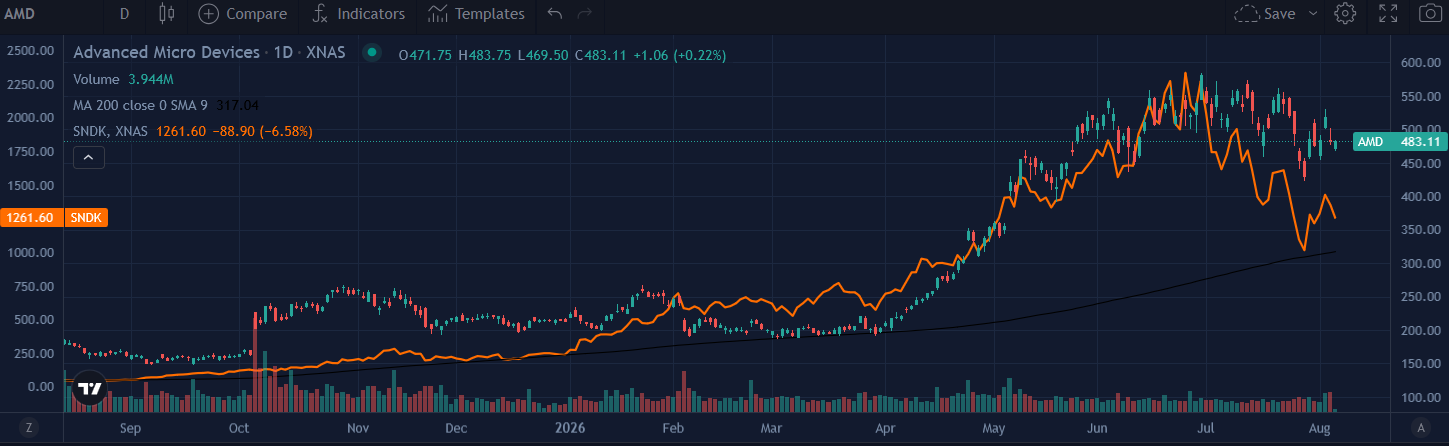
AMD and SanDisk (SNDK) delivered earnings beats this week, yet both stocks fell. AMD posted record revenue up 50% year over year, with data center revenue more than doubling. Its CEO Lisa Su said she expects “Data Center sales to accelerate in the second half of 2026.” Guidance for the current quarter came in near Wall Street estimates, but it fell short of “whisper” expectations. Despite the seemingly good earnings, AMD shares initially fell by more than 8% and remain down by a similar amount a few days later.
SanDisk’s earnings report was similar. Its EPS beat consensus by more than 12%, revenue grew by a whopping 372% year over year, and gross margins held at 78%. Shares still fell roughly 10%, because guidance for the coming quarter was slightly below the more bullish estimates.
The thread across AMD, SNDK, and other AI-related stocks is that investors are expecting absolute perfection not only in what happened but in guidance for what will happen. The market reactions to AMD and SNDK allow us to start focusing on Nvidia’s earnings report, due August 26. If AMD’s data center revenue can more than double and still disappoint, and if SanDisk’s margins can hold at 78% and still disappoint, Nvidia’s bar is set equally high. Nvidia guided Q2 fiscal 2027 revenue to approximately $91 billion, which would mark another 11.5% sequential increase and roughly 80% annual growth. We think NVDA investors will heavily rely on guidance including:
- Commentary on the Blackwell to its next-generation (Vera Rubin) ramp and any supply constraints that could lessen deliveries
- Forward capex commentary from its hyperscaler customers
- Revenue and Gross margin guidance
Nvidia will again test market sentiment. Can they exceed the incredible investors’ demands and see a 10-15% surge, as MSFT and AMZN did, or will they struggle like AMD and SNDK?
What To Watch Today
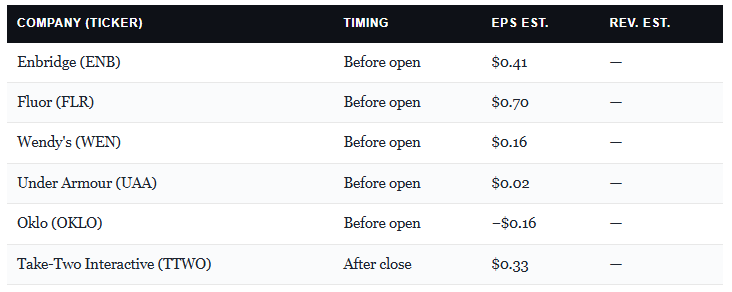
Earnings
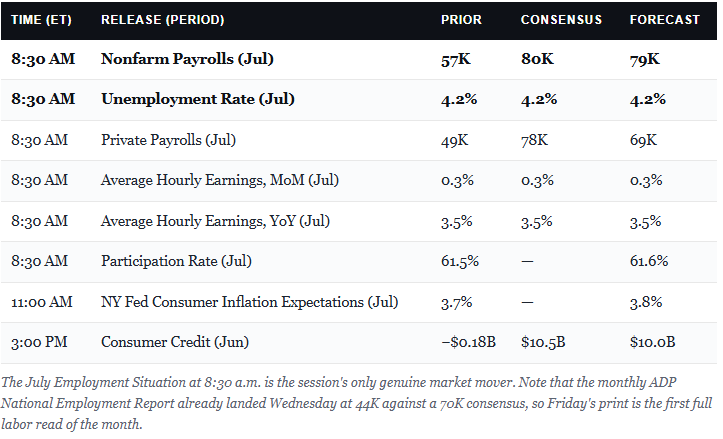
Economy
Fed Speakers
Richmond Fed President Tom Barkin speaks at 10:00 a.m. ET, ninety minutes after the payroll print. The Fed is not in its pre-meeting blackout period, with the next FOMC meeting scheduled for September 15 and 16.
Market Trading Update
Yesterday, we walked through the base rates behind the breakout to record highs, and why new highs tend to beget more of them. Today I want to flip the lens and ask what the options market is charging to insure that breakout. Implied volatility says remarkably little, and that gap is worth your attention.
The VIX closed Wednesday at 15.81. On July 29, it printed 20.66. That is a 23% collapse in five sessions, which fits the story of a tape that just absorbed two months of overhead supply, and had the largest 5-day advance since April 2025.
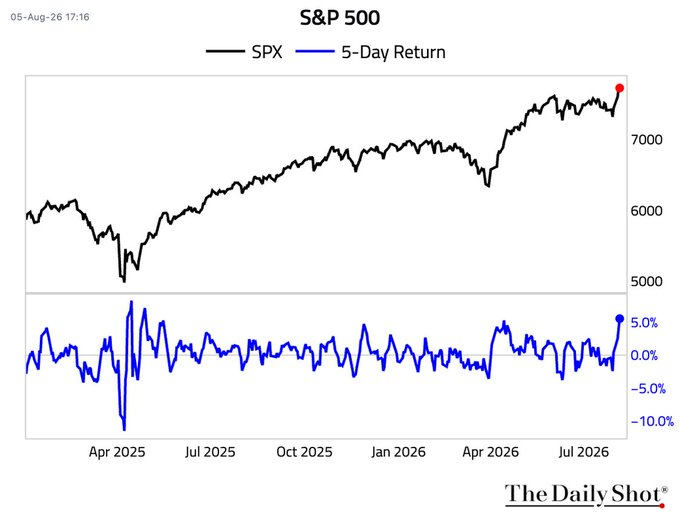
Here is the problem. Realized volatility went the other way.
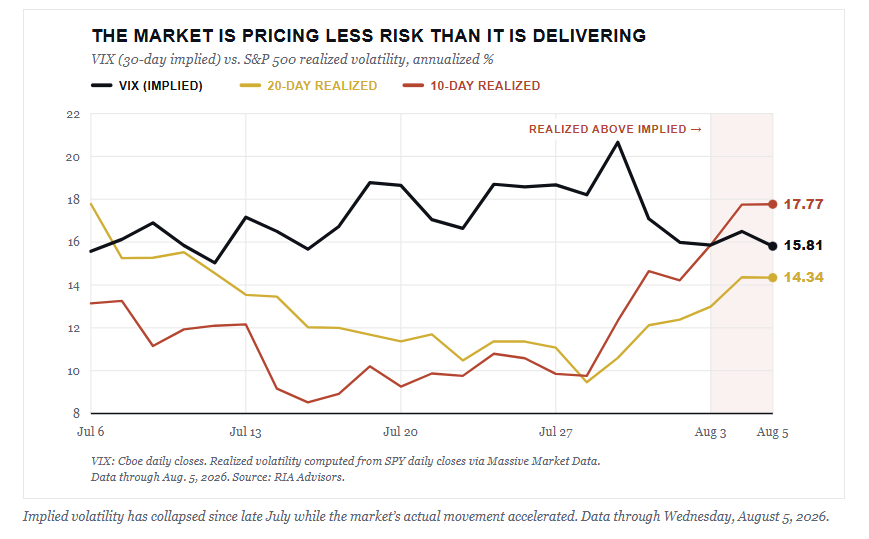
Notice what happened underneath. While implied volatility dropped nearly five points, actual movement in the S&P 500 accelerated. Twenty-day realized volatility bottomed at 9.46 on July 28 and has since climbed to 14.34. In other words, on a ten-day window, realized volatility now sits at 17.77, which is almost two full points ABOVE the VIX.
So what? Well, it matters more than just looking at the index level in isolation. According to the CBOE’s own educational material, the normal state of affairs is that expected volatility priced into S&P options tends to run at a premium to the volatility that actually shows up later. That premium is the compensation for underwriting somebody else’s risk.
The problem is that it has now disappeared.

So why is index volatility this cheap? Dispersion. We flagged the mechanism back in July, when Goldman Sachs’s volatility desk noted that one-month implied correlation had fallen to roughly its lowest level in twenty years. When individual names move hard in opposite directions, they cancel each other out at the index level. The surface looks calm while the water underneath is churning. Bob Farrell’s ninth rule is the relevant one when everybody agrees the ride will stay smooth.
None of this is a sell signal, and I am not calling a top. The market trend remains intact, and as we noted yesterday morning, risk management is key for now. Make no mistake, while the recent action is bullish, the setup deserves respect. The index finished Wednesday roughly 9.7% above its rising 200-day moving average, and July’s employment report lands this morning at 8:30 a.m. Eastern. Furthermore, we are just starting the weakest stretch of the calendar.
For now, we are maintaining our holdings and will likely rebalance our portfolios soon. What is different this week is the cost of protection. Remember, even if you are very bullish on the market, an umbrella is only useful if you carry it before the rain starts.

Amazon Crosses $3 Trillion, Bezos Sells $4 Billion
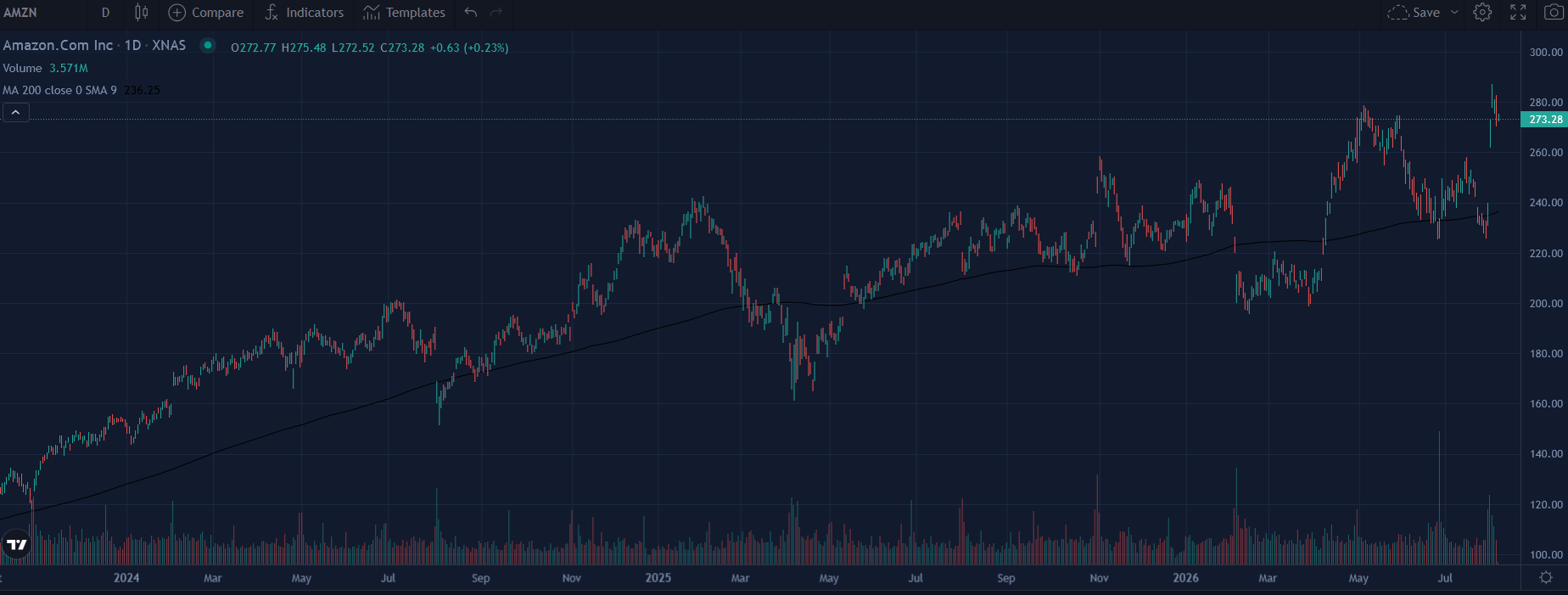
Amazon crossed $3 trillion in market capitalization Monday, becoming just the fifth company in history to reach that milestone. The move occurred after a strong earnings beat sent the stock up roughly 20% over two trading sessions. As the stock was crossing the $3 trillion milestone, Jeff Bezos filed to sell 15 million shares worth a little more than $4 billion. Shares fell slightly on the news of his sale. CNBC pundit Jim Cramer called Bezos’ timing “a buzzkill.”
The optics are worse than it appears. His stock sale falls under a SEC Rule 10b5-1 trading plan Bezos adopted in 2025, well before Amazon’s stock crossed the $3 trillion threshold. Many executives use such prearranged, scheduled selling to avoid the appearance of market timing. Bezos’ sale follows a prior sale of roughly $5.7 billion sold between late June and late July, bringing his recent total to about $10 billion. Measured against Amazon’s 10.78 billion shares outstanding, the sales are a rounding error, and Bezos remains the company’s largest individual shareholder by a wide margin.
Founders and senior executives at Nvidia, Meta, and Alphabet have also filed large share sales in recent months as AI-driven valuations reached new highs. The sales likely reflect routine diversification, but we must keep in mind executives know a lot more than we do about their companies and the industry. Could they be making a statement that valuations are too high?

Tweet of the Day

New UPDATED Trading Rules With Desktop Printout
“Want to achieve better long-term success in managing your portfolio? Here are our 15-trading rules for managing market risks.”
Please subscribe to the daily commentary to receive these updates every morning before the opening bell.
If you found this blog useful, please send it to someone else, share it on social media, or contact us to set up a meeting.