



Investor psychology is one of the most significant reasons why individuals consistently fall short of their investment goals. While one of the most common truisms is that “investors buy high and sell low,” the underlying reason is the behavioral traits that plague our investment decision-making.
George Dvorsky once wrote that:
“The human brain is capable of 1016 processes per second, which makes it far more powerful than any computer currently in existence. But that doesn’t mean our brains don’t have major limitations. The lowly calculator can do math thousands of times better than we can, and our memories are often less than useless — plus, we’re subject to cognitive biases, those annoying glitches in our thinking that cause us to make questionable decisions and reach erroneous conclusions.“
Cognitive biases are an anathema to portfolio management as it impairs our ability to remain emotionally disconnected from our money. As history all too clearly shows, investors always do the “opposite” of what they should when it comes to investing their own money. They “buy high” as the emotion of “greed” overtakes logic and “sell low” as “fear” impairs the decision-making process.
In other words:
“The most dangerous element to our success as investors…is ourselves.”
Here are the top-5 of the most insidious behavioral traits which keep us from achieving our long-term investment goals.

Behavioral Trait #1 – Confirmation Bias
As individuals, we tend to seek information that confirms our current beliefs. If we believe the stock market will rise, we tend to only read news and information that supports that view. This confirmation bias is a primary driver of the psychological investing cycle of individuals, as shown below.
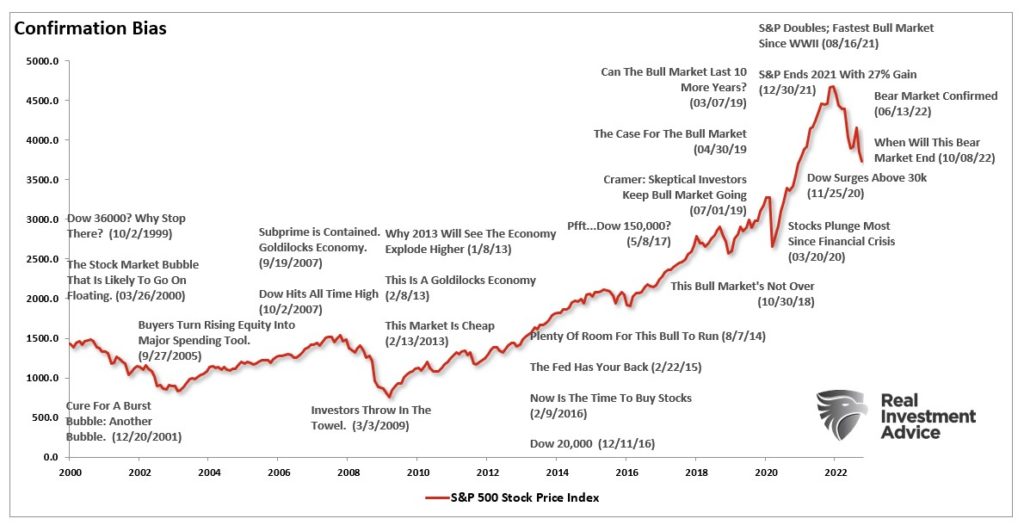
As individuals, we want “affirmation” our current thought processes are correct. Such is why we tend to join groups on social media that confirm our thoughts and ideals. Therefore, since we hate being told we are wrong, we subconsciously seek out confirming sources of information.
For investors, it is crucial to weigh both sides of each debate equally and analyze the data accordingly.
Being right and making money are not mutually exclusive.
Behavioral Trait #2 – Gambler’s Fallacy
The “Gambler’s Fallacy” is one of the most common behavioral traits. As emotionally driven human beings, we tend to put a tremendous amount of weight on previous events believing that future outcomes will somehow be the same.
That bias is addressed at the bottom of every piece of financial literature.
“Past performance is no guarantee of future results.”
However, despite that statement being plastered everywhere in the financial universe, individuals consistently dismiss the warning and focus on past returns expecting similar results in the future.
This is one of the key issues that affect investors’ long-term returns. Performance chasing has a high propensity to fail, which then pushes individuals to jump from one late-cycle strategy to the next. This is shown in the periodic table of returns below. “Hot hands” only tend to last 2-3 years before going “cold.”

I traced out the returns of the small-cap equity index for illustrative purposes. Importantly, you should notice that whatever is at the top of the list in some years tends to fall to the bottom in subsequent years.
“Performance chasing” is a major detraction from investors’ long-term investment returns.
Behavioral Trait #3 – Probability Neglect
When it comes to “risk-taking” there are two ways to assess the potential outcome. There are “possibilities” and “probabilities.”
We tend to lean toward what is possible such as playing the “lottery.” The statistical probabilities of winning the lottery are astronomical, in fact, you are more likely to die on the way to purchase the ticket than actually winning it. However, it is the “possibility” of being fabulously wealthy that makes the lottery so successful as a “tax on poor people.”
As investors, we tend to neglect the “probabilities” of any given action which is specifically the statistical measure of “risk” undertaken with any given investment. As individuals, our bias is to “chase” stocks that have already shown the biggest increase in price as it is “possible” they could move even higher. However, the “probability” is that most of the gains are likely already built into the current move and that a corrective action will occur first.
Probability neglect is another major component to why investors consistently “buy high and sell low.”

Behavioral Trait #4 – Herd Bias
Though we are often unconscious of the action, humans tend to “go with the crowd.” Much of this behavior relates back to “confirmation” of our decisions but also the need for acceptance. The thought process is rooted in the belief that if “everyone else” is doing something, they if I want to be accepted I need to do it too.
In life, “conforming” to the norm is socially accepted and in many ways expected. However, in the financial markets the “herding” behavior is what drives market excesses during advances and declines.
As Howard Marks once stated:
“Resisting – and thereby achieving success as a contrarian – isn’t easy. Things combine to make it difficult; including natural herd tendencies and the pain imposed by being out of step, since momentum invariably makes pro-cyclical actions look correct for a while. (That’s why it’s essential to remember that ‘being too far ahead of your time is indistinguishable from being wrong.’
Given the uncertain nature of the future, and thus the difficulty of being confident your position is the right one – especially as price moves against you – it’s challenging to be a lonely contrarian.”
Moving against the “herd” is where the most profits are generated by investors in the long term. The difficulty for most individuals, unfortunately, is knowing when to “bet” against the stampede.
Behavioral Trait #5 – Anchoring Effect
This is also known as a “relativity trap” which is the tendency for us to compare our current situation within the scope of our own limited experiences. For example, I would be willing to bet that you could tell me exactly what you paid for your first home and what you eventually sold it for. However, can you tell me what exactly what you paid for your first bar of soap, your first hamburger or your first pair of shoes? Probably not.
The reason is that the purchase of the home was a major “life” event. Therefore, we attach particular significance to that event and remember it vividly. If there was a gain between the purchase and sale price of the home, it was a positive event and, therefore, we assume that the next home purchase will have a similar result. We are mentally “anchored” to that event and base our future decisions around a very limited data.
When it comes to investing we do very much the same thing. If we buy a stock and it goes up, we remember that event. Therefore, we become anchored to that stock as opposed to one that lost value. Individuals tend to “shun” stocks that lost value even if they were simply bought and sold at the wrong times due to investor error.
After all, it is not “our” fault that the investment lost money; it was just a bad stock. Right?
Make Better Bad Choices
My nutrition coach had a great saying about dieting; “make better bad choices.”
We are all going to make bad choices from time to time. The goal is to try and make bad choices that don’t have an outsized effect on our plan. When it comes to dieting, if you eat a burger, order it without cheese and mayonnaise.
When it comes to your portfolio, if you make speculative bets, do it in smaller sizes. Or, if you are leaning towards “panic selling” everything, start by selling some but not all of your holdings.
Importantly, focus on the rules and your investment discipline.
- Do more of what is working and less of what isn’t.
- Remember that the “Trend Is My Friend.”
- Be either bullish or bearish, but not “hoggish.” (Hogs get slaughtered)
- Remember it is “Okay” to pay taxes.
- Maximize profits by staging buys, working orders, and getting the best price.
- Look to buy damaged opportunities, not damaged investments.
- Diversify to control risk.
- Control risk by always having pre-determined sell levels and stop-losses.
- Do your homework.
- Not allow panic to influence buy/sell decisions.
- Remember that “cash” is for winners.
- Expect, but do not fear, corrections.
- Expect to be wrong, and will correct errors quickly.
- Check “hope” at the door.
- Be flexible.
- Have the patience to allow your discipline and strategy to work.
- Turn off the television, put down the newspaper, and focus on your analysis.
Importantly, keep your market perspective in check and make sure you aren’t anchoring to something that will lead to poor decisions over time.
More importantly, if you don’t have an investment strategy and discipline you are stringently following, that is an ideal place to begin.