

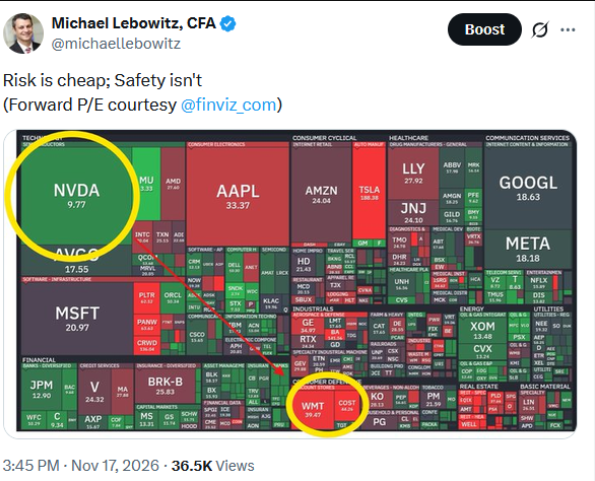
We tweeted the graphic below to show just how cheap NVDA shares have gotten compared to Walmart. While many replies agree with our view, quite a few didn’t.
Some of our critics argue that Nvidia’s earnings growth will not come close to the 65% annual pace analysts expect, making the stock far riskier than a steady, dependable defensive stock like Walmart. We agree, Nvidia may fall short of the lofty forecasts. However, the important analysis for investors is a deep dive into the combination of valuations and expectations.
The analysis we share is a valuation comparison of NVDA to WMT, not a comparison of either stock to the market or any other stock. It is incredibly instructive to show how valuations and expectations play into investment strategy.
A stock’s PEG ratio divides a company’s P/E by its expected five-year earnings growth. Using trailing P/E ratios, Walmart trades at 45 times earnings with expected growth of 11%, for a PEG of 4.09. Nvidia, at 17 times earnings with 65% expected growth, has a PEG of 0.26. For Nvidia’s PEG to equal Walmart’s, it only needs to grow earnings by about 4.2% per year over five years. That is only about 10% of current expectations and even half of Walmart’s.
Here’s another way to think about it. If Walmart shares stay the same price for five years and it achieves its expected 11% growth, its P/E falls to about 26.7. Nvidia’s P/E would also be 26.7 if its earnings declined by over 8% a year.
So yes, we are comfortable taking the “risk” that Nvidia doesn’t meet earnings growth expectations versus the “safety” of Walmart. Simply, the market is providing a lot of cushion for being wrong.
What To Watch Today
IPO
Anthropic (ANT) prices Wednesday evening and is scheduled to begin trading on the Nasdaq Global Select Market today. Proposed range: $70 to $78 per share, 825 million Class A shares. Settlement Friday, November 20.
Economy
| Time (ET) | Release (period) | Prior | Consensus | Forecast |
|---|---|---|---|---|
| 8:30 a.m. | Initial Jobless Claims (week of Nov 14) | 200K | 196K | 194K |
| 8:30 a.m. | Continuing Jobless Claims (week of Nov 7) | 1,697K | n/a | 1,725K |
| 8:30 a.m. | Philadelphia Fed Manufacturing Index (Nov) | 20.9 | 19.2 | 19.0 |
| 10:00 a.m. | Conference Board Leading Index MoM (Oct) | 0.0% | 0.1% | -0.1% |
| Source: Trading Economics (primary), confirmed against the U.S. Department of Labor and Federal Reserve Bank of Philadelphia release schedules. Real Investment Advice | RealInvestmentAdvice.com | ||||
Earnings
| Company (Ticker) | Timing | EPS est. | Rev. est. |
|---|---|---|---|
| Walmart (WMT) | Before open | $0.64 | $186.5B |
| Alibaba (BABA) | Before open | $1.56 | n/a |
| PDD Holdings (PDD) | Before open | $2.61 | n/a |
| Intuit (INTU) | After close | $2.47 | n/a |
| Ross Stores (ROST) | After close | $1.82 | n/a |
| Source: Nasdaq earnings calendar via StockTitan, Earnings Whispers, company investor relations. Real Investment Advice | RealInvestmentAdvice.com | |||
Fed Speakers
Hammack 8:50 a.m. · Goolsbee 12:30 p.m. · Barr 2:15 p.m. · Barkin 4:00 p.m. · Paulson 6:30 p.m. (all ET)
Market Trading Update
On Tuesday, we laid out the supply side of the Anthropic IPO and why roughly $90 billion of new stock matters more than the valuation debate. This morning, the deal goes live. Anthropic (ANT) priced last night and opens for trading on Nasdaq today. The question I’m getting most is simple. Should you buy it?
History gives a fairly blunt answer. Back in June, the Bull Bear Report warned readers to wait on the SpaceX IPO because big debuts usually sell off in the first couple of months. SpaceX (SPCX) priced at $135, jumped 19% on day one, and closed at $201.80 on June 16. By August 5, it had closed at $108.27, a 46% decline from the peak. On Monday, it finished at $137.36, barely above the offer price five months later.

That wasn’t bad luck. Such is the nature of new issues. The table below, rebuilt from Carson Investment Research, tracks 36 major IPOs since Google in 2004. The average first-day gain was 49%, and 92% closed higher on day one. The average maximum drawdown in the first 12 months was 55%, and NOT one of these companies escaped a decline of at least 13%.
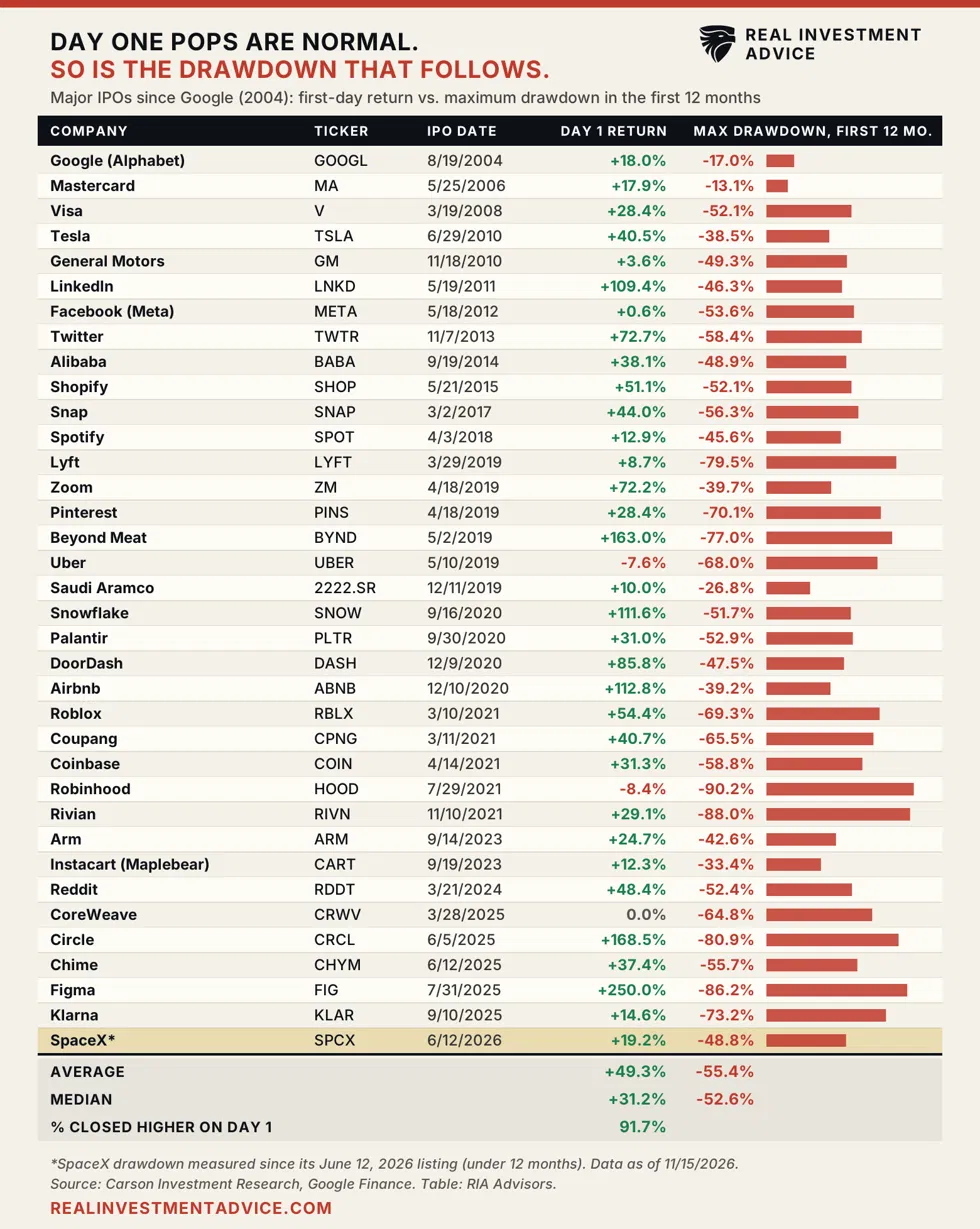
The reasons are mechanical. Floats are tiny at the start, so modest buying moves the price a lot. Then supply arrives as lockups expire and insiders sell. Anthropic is selling 825 million shares, roughly 5% of its fully diluted share count, a float about the size of SpaceX’s. Sentiment is running hot, too. On Monday, a crypto contract tracking ANT on Hyperliquid traded at $98.67, and CNBC reported Tuesday that demand is likely to push prices above the $70-$78 range.
None of this says Anthropic is a bad company. It says the first few months of a “hot” IPO are usually the worst time to own it. If you want exposure, here are the rules we’d follow:
- Don’t buy the open. Let price discovery and the first-day pop play out.
- Use limit orders only. Market orders on debut day are an invitation to overpay.
- Start small. A starter position of 1% or less limits the damage if history repeats.
- Build in thirds. Add after the first earnings report, after analyst coverage begins, and after the first lockup expires.
- Calendar the lockups. Know when insider supply hits the market.
- Define the exit before the entry. Decide what price or event proves you wrong.
Our portfolios will sit out the debut. We’d rather pay a little more later with real information than pay a premium today for a story.
The pop is the marketing. The drawdown is the tuition.

Nvidia Kills It: Investors Aren’t Jumping For Joy
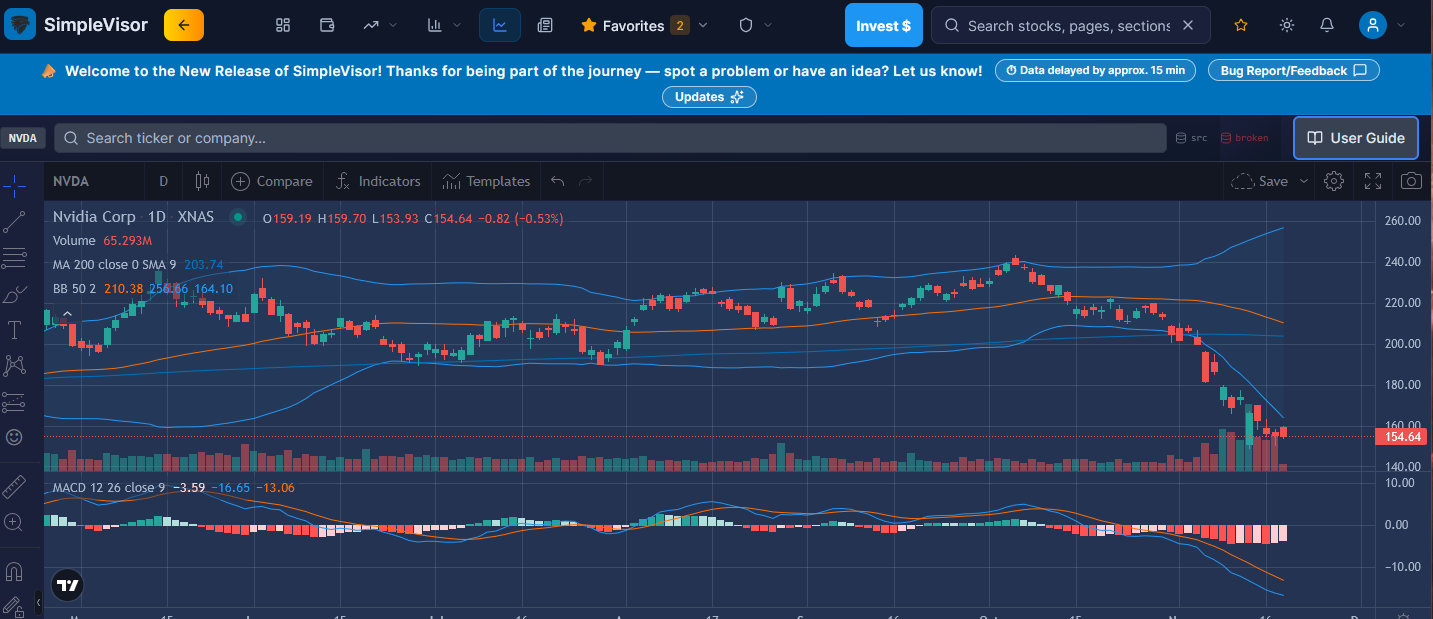
Nvidia delivered a near-perfect quarter, and the market responded with a rather tame golf clap. Revenue of $115.8 billion rose 103% from a year ago and beat the roughly $109 billion consensus. Further, management guided the coming quarter about $5 billion higher than prior expectations, and the board added $150 billion to the buyback authorization. Shares opened Wednesday morning about 3% higher but turned negative within the first hour of trading, as we share below. Not what one would expect given the excellent results.
Investors have ample reason to be reserved. For starters, gross margin guidance fell to 72% from nearly 75% this quarter. On $130 billion of revenue, three points of margin is roughly $4 billion of gross profit. Rising memory costs are the likely culprit. Further, long-term debt climbed to $32.4 billion from $7.5 billion at fiscal year-end, meaning Nvidia is now borrowing while it repurchases stock and finances its customers. Lastly, and most importantly, the company has no permanent chief executive, and an independent board committee investigation remains open with a wide range of potential outcomes, some of which can be problematic for the company.
Here is what we find most telling. CoreWeave rose about 5.4% and Nebius about 7%, both outpacing Nvidia itself. They are very beaten up, but it’s a vote of confidence that one of their key financiers (NVDA) will continue to provide financing.
Buy And Forget? It’s Not That Easy
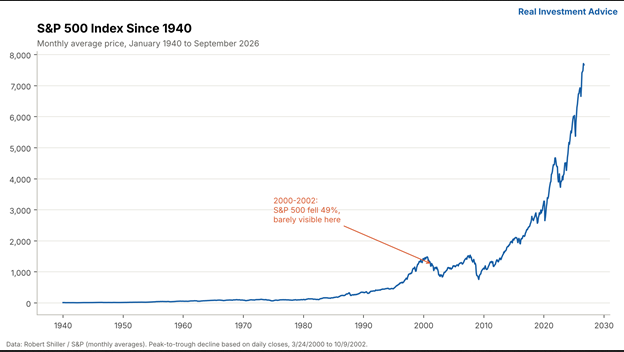
Buy an S&P 500 index fund, set up automatic contributions, and forget about it. It’s one of the most common pieces of retirement advice, and the chart below makes a strong case for it. In January 1940, the S&P 500, as reconstructed by Robert Shiller, stood at about 12. Today, it’s around 7,500. World War II, regional wars, recessions, oil shocks, a pandemic, and a long list of financial crises look like minor speed bumps. For anyone saving for retirement, the answer seems obvious: why do anything other than buy and forget?
Unfortunately, it’s not that easy. The chart shows what the market did over 86 years. It doesn’t show what happened to investors who depended on it during the 20 or 30 years that mattered most to them.

Tweet of the Day

Trading Rules With Desktop Printout
“Want to achieve better long-term success in managing your portfolio? Here are our 15-trading rules for managing market risks.”
Please subscribe to the daily commentary to receive these updates every morning before the opening bell.
If you found this blog useful, please send it to someone else, share it on social media, or contact us to set up a meeting.