



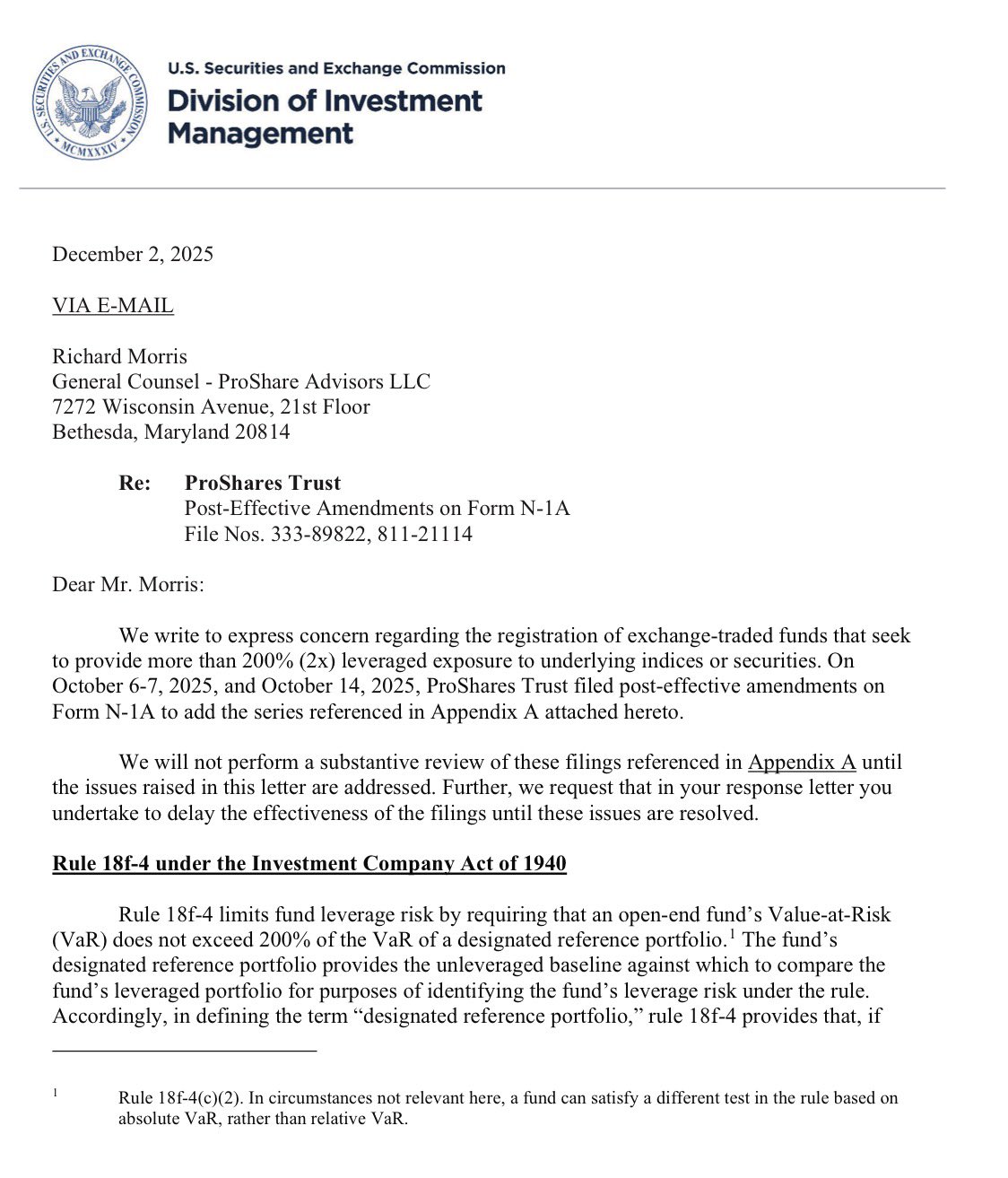
Wall Street’s financial engineers thought they had found yet another way to turn financial markets into casinos. The gimmick this time is with 3x, 4x, and even 5x leveraged ETFs tied to individual stocks and cryptocurrencies. The SEC just ruled against these new proposals, apparently drawing the line at 2x leverage as the rules state.
Nine issuers filed with the SEC for 3x, 4x, and 5x ETFs, betting that the new leadership at the SEC would be more open to speculation and be willing to ignore the significant risk entailed in these securities. Their strategy hinged on gaming the SEC’s derivatives rule—Rule 18f-4—by changing how “risk” is measured. Under Rule 18f-4, a leveraged or inverse ETF must run a Value-at-Risk test using the actual asset it tracks as its benchmark.
For example, if your proposed 5x ETF is based on Apple’s stock price, the risk test is anchored to Apple’s stock price. Once you apply an apples-to-apples, no pun intended, analysis, 5x and other ETFs levered more than 2x fail the SEC test. The issuers tried to redefine the “designated reference portfolio” (benchmark) to an asset that is less risky than the actual underlying asset. Doing so effectively lowers the apparent risk, thus, using their logic, allowing 3x, 4x, and even 5x leverage. The SEC’s latest comment letter shut that door. They didn’t mince words in their ruling:
“We write to express concern regarding the registration of ETFs that seek to provide more than 200% (2x) leveraged exposure to underlying indices or securities”
What To Watch Today
Earnings
- No earnings releases today
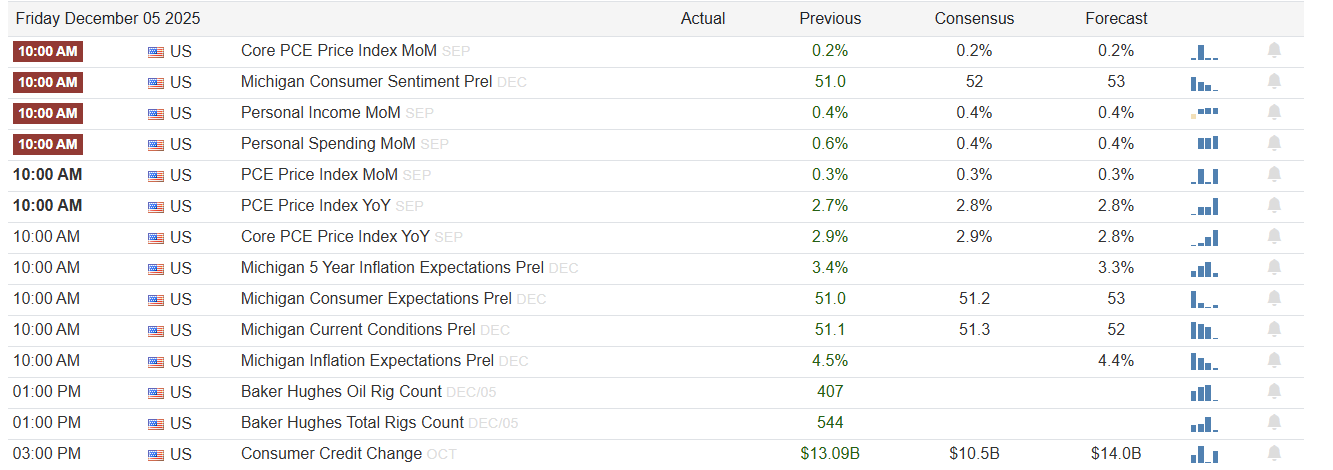
Economy
Market Trading Update
Yesterday, we discussed the potential trading opportunity for bonds. Today, I wanted to touch on our outlook for 2026, which is characterized by higher volatility and lower risk-adjusted returns. The reason for this caution has been the well-above-average returns over the last three years. The S&P 500 has posted a strong three-year price return of approximately 76.7 percent, excluding dividends. That translates to an annualized return of 20% to 22%. This is well above the long-term average annual return of roughly 10% to 11% with dividends reinvested. Such elevated returns over a short period suggest that the market is trading well above its historical trend.
Historically, when the S&P 500 rolling 3-year return is two standard deviations above its three-year moving average, the market is statistically extended. This deviation typically precedes a shift in volatility and return outcomes. In other words, when markets reach this level of extension, two patterns emerge: increased volatility and weaker forward returns.
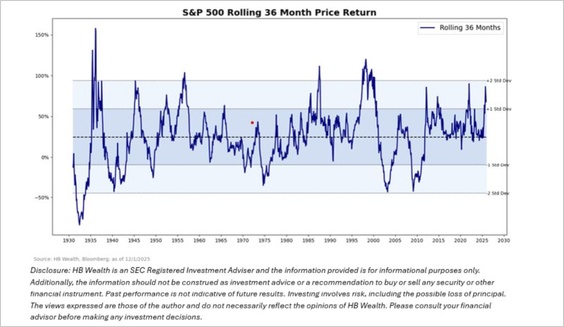
Volatility tends to spike when valuations are stretched. Empirical market data indicate that the standard deviation in daily returns for the S&P 500 has historically hovered near 1 percent. When the index trades far above its moving average, volatility rises. These periods often see sharp drawdowns, and corrections become more frequent, with increased variance in returns leading to larger losses in downturns, which compounds the problem.
The second pattern is declining risk-adjusted returns. When returns run far above or below the trend, future returns tend to revert toward the mean. This mean reversion is driven by stretched valuations resetting. Over time, high volatility and large price swings reduce compound returns. Even if average returns remain positive, the math of compounding is compromised by losses, weakening full-cycle gains.
Today, the S&P 500’s elevated three-year return and deviation from trend suggest a higher probability of increased volatility and lower forward returns. For investors, heading into 2026, may well mean a re-evaluation of the risk you are taking in your portfolio to chase returns. You can stay invested and accept higher volatility, or reduce risk to protect capital. There are consequences for whichever choice you make, so choose wisely.

Might Saylor Break Rule #1 Of Bitcoin?
Michael Saylor, CEO of Strategy, the world’s largest Digital Asset Treasury Company (DATACO), may have upset the crypto markets with some comments he made last weekend. Before sharing his remarks, it’s important to highlight that Michael Saylor has on many occasions said in no uncertain terms that Strategy will never sell its Bitcoin holdings. We asked Grok to provide quotes from Michael Saylor about never selling Bitcoin, and we share a few noteworthy ones from his X feed.
- Sell a kidney if you must, but keep the Bitcoin
- Sell a tooth if you must, but keep the bitcoin
- Never sell your Bitcoin
- The first rule of Bitcoin is: You do not sell your Bitcoin. The second rule of Bitcoin is: You do not sell your Bitcoin
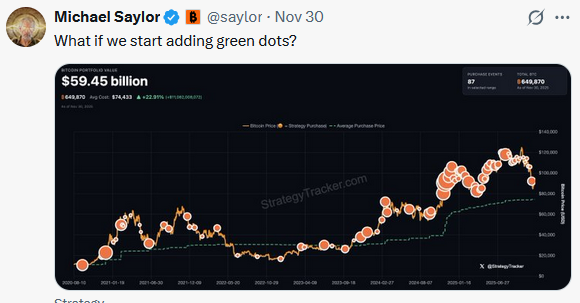
This past weekend, he fueled speculation that his buy-and-hold forever investment strategy could change. The tweet below charts Bitcoin’s price, with Strategy’s purchases highlighted in orange bubbles. He asks, “What if we start adding green dots?” In other words, what if we start selling Bitcoin? Further, of concern for Bitcoin holders, is the following paragraph from an article in CryptoNews:
CEO Phong Le said the company would consider selling some of its holdings only if two events occur at once: if Strategy’s market-to-net-asset-value ratio falls below one, and if the company cannot raise new capital.
To wit, Strategy stock is now trading at a discount to its net asset value. Furthermore, the ability to raise capital other than diluting common stock shareholders is greatly diminished
Year End Financial Planning
The end of the year tends to sneak up on people. One minute, it’s late summer; the next, you’re staring at a calendar and wondering how to wrap up your financial goals before the deadline hits. A thoughtful approach can make a measurable difference in what you keep, what you owe, and how prepared you feel heading into the new year. A reliable end-of-year financial checklist gives you clarity during a notoriously chaotic season.
Key Takeaways
- A structured year end tax planning process helps reduce surprises at filing time
- Maximizing retirement contributions remains one of the most efficient ways to lower taxable income
- Tax loss harvesting can help offset gains if used correctly
- RMDs, FSA deadlines, and employer benefits need attention before December 31
- A year-end review with an advisor helps catch overlooked opportunities and set next year’s strategy
Tweet of the Day

“Want to achieve better long-term success in managing your portfolio? Here are our 15-trading rules for managing market risks.”
Please subscribe to the daily commentary to receive these updates every morning before the opening bell.
If you found this blog useful, please send it to someone else, share it on social media, or contact us to set up a meeting.