
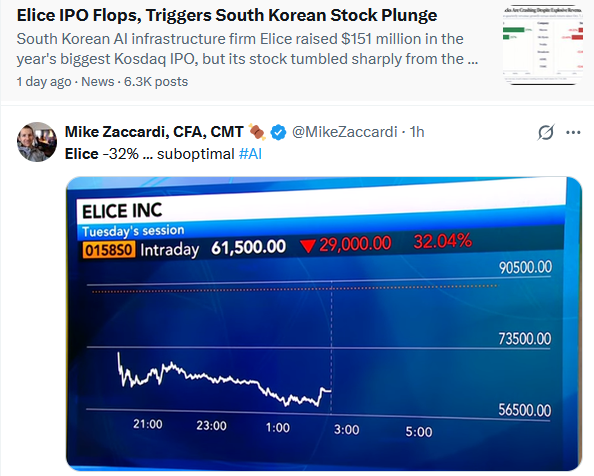
Elice Group went public on South Korea’s Kosdaq exchange yesterday and fell roughly 30%. A week earlier, Nvidia-backed Firmus shelved a planned $5 billion IPO. In the same vein, as we discussed in CoreWeave Shares Tumble As Its Debt Flounders, CoreWeave’s 2032 debt now yields near 15%, up from below 10% a week earlier. To appreciate what is going on with these datacenter stocks and why not all datacenter providers are the same, it is important to compare the business models of neocloud companies like those mentioned versus the large hyperscalers.
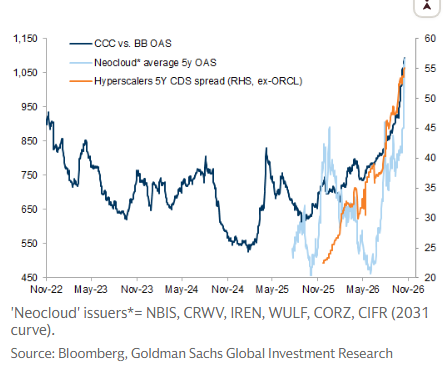
Neoclouds essentially run a spread business. They borrow money, buy GPUs, rent the compute capacity, and keep the difference, or the spread, after debt service and depreciation. Such a business model can be very profitable and works well if its product, compute in this case, is in high demand, and financing is cheap. Financing has become very expensive for neocloud firms. As we share below, credit default spreads (CDS) for neocloud companies are over 1000bps versus about 55bps for the large hyperscalers.
Hyperscalers are in a different business. Microsoft, Amazon, Alphabet, and Meta will spend roughly $800 billion this year building out compute capacity, but unlike neocloud companies, they will fund most of it with operating cash flow and won’t have to rely on the debt and/or equity markets. Further, hyperscalers are their own customer, so a falling data center rental rate has little impact on them. Their customer bases are thousands of enterprises rather than a small handful of counterparties.
If neoclouds are forced to cut capacity or liquidate GPUs to service debt, hyperscalers gain pricing power on GPU purchases or rentals and a chance to buy distressed capacity cheaply. However, a wave of used GPUs hitting the market could also depress the resale value of their own GPUs and possibly signal that compute scarcity is easing. This could also have implications for the big semiconductor companies, as the prices of chip makers are currently signaling.
What To Watch Today
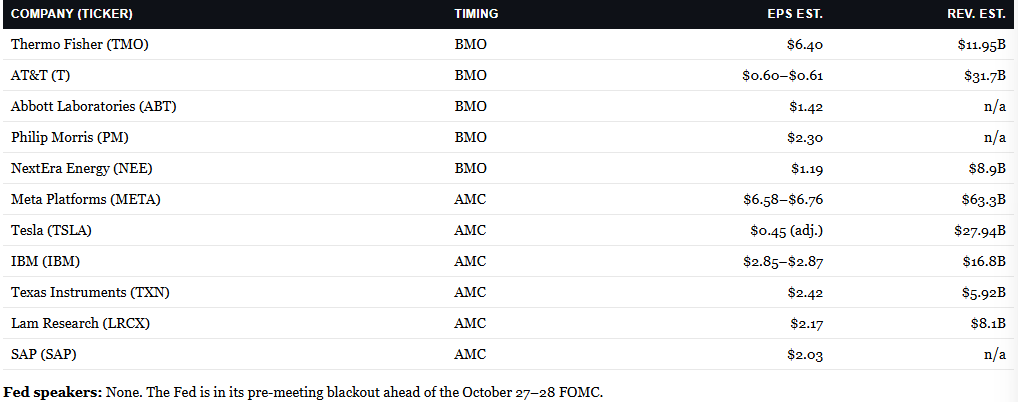
Earnings
Economy

Market Trading Update
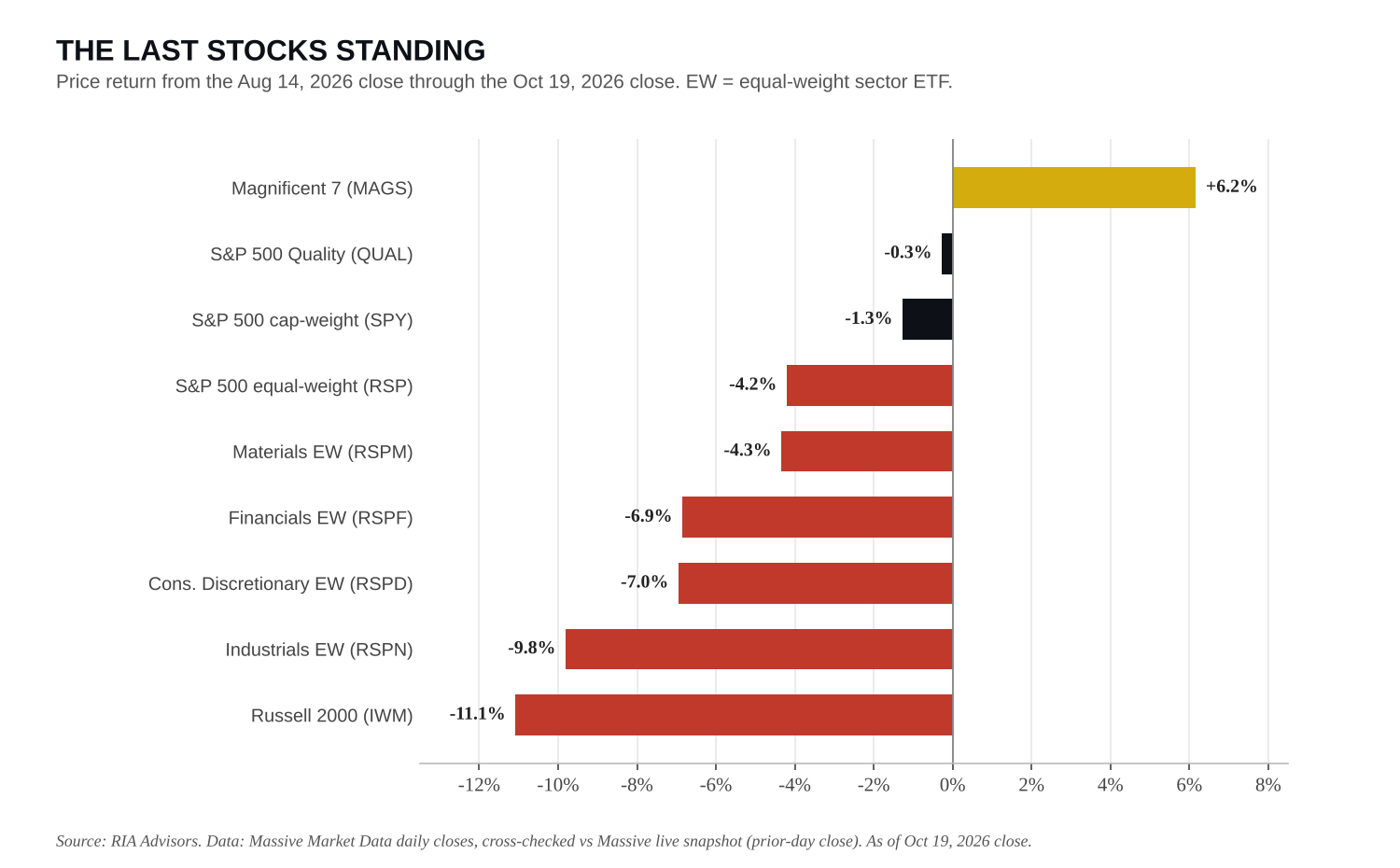
Yesterday, we discussed how the breadth reversal under the megacap selloff may set up a better run into year-end. Today, I want to push that idea a bit further. Morgan Stanley’s Michael Wilson argues the correction won’t end until the last stocks standing finally catch “down” to everything else.
He is referring to the “Mag 7.” However, for the average stock, the damage is already done. From the August 14 close through Monday, the equal-weight S&P 500 (RSP) fell 4.2% while the cap-weighted index (SPY) slipped just 1.3%. Equal-weight industrials lost 9.8%, and the Russell 2000 dropped 11.1%. Over the same stretch, the Magnificent 7 (MAGS) gained 6.2%. For Wilson, that is the problem in one picture.
Morgan Stanley’s work also shows much of the same analysis. Their quality factor is up roughly 6% since mid-August and just broke out to a 52-week high. The earnings revisions gap between high- and low-quality companies is near 10 percentage points, the second widest since 2010. MS’s financial conditions composite, comprising yields, the dollar, and energy, is the tightest since 2022. In other words, the market has already done some of the Fed’s work, and the average stock paid the bill.
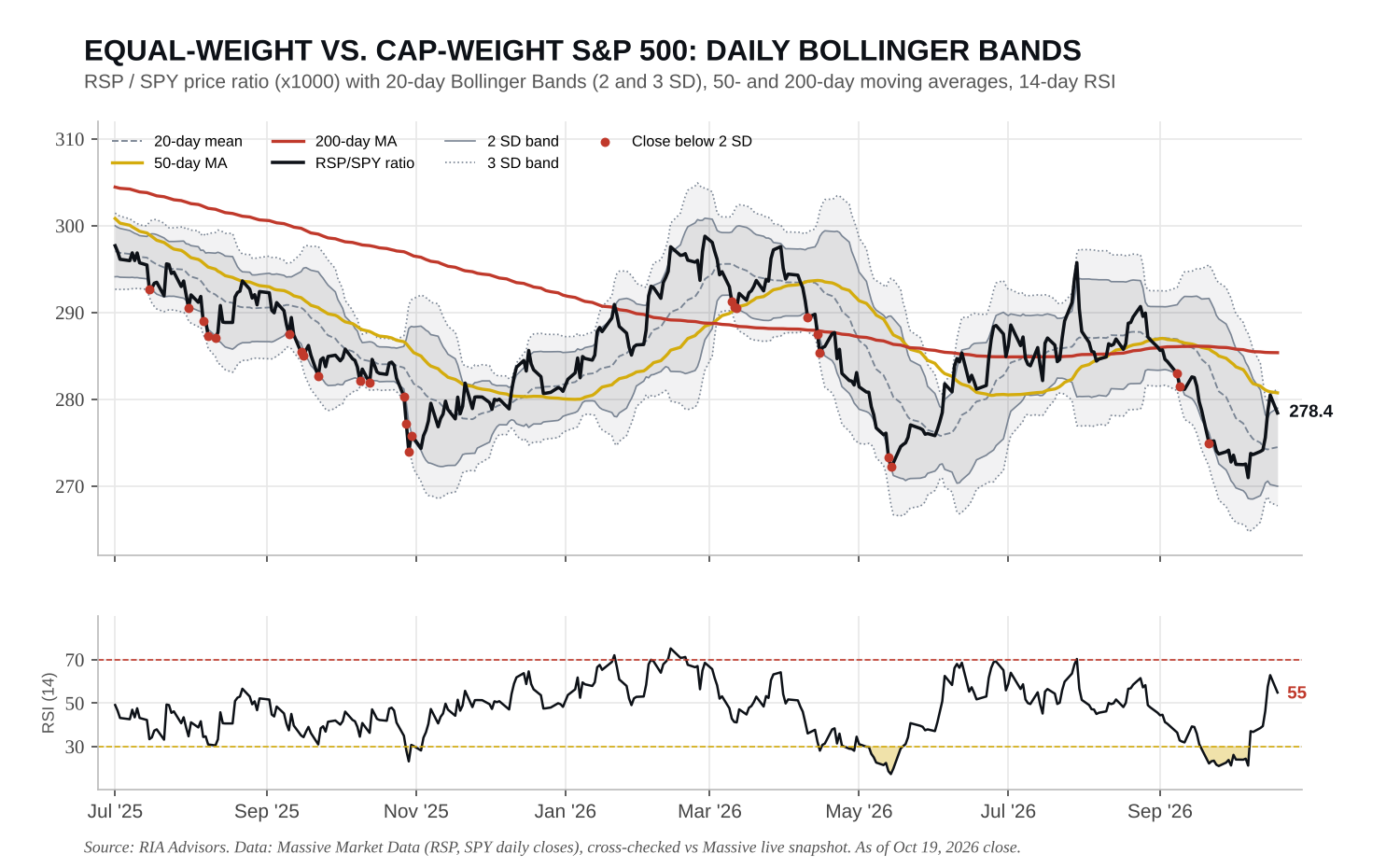
Notice in the chart below that the RSP/SPY ratio hit 270.97 on October 7. That’s its weakest reading since at least mid-2024, with RSI buried under 30. Last week’s bounce lifted it 3.5% to 280.50, but it still sits below both its 50-day (280.74) and 200-day (285.37) averages. One good week isn’t a regime change, but it is worth paying attention to.
Wilson’s twist is that mid-cycle corrections often END with those blue chips catching down. His suggestion is that the bottom of the market won’t truly be seen until the leaders finally break. As the old axiom goes, “A washout isn’t finished until the selling reaches the holdings nobody wanted to sell.“
We will certainly get a test tonight after the market closes, with Meta, Tesla, IBM, Texas Instruments, and Lam Research all reporting after the close. The S&P 500 sits near 7,682, about 1.8% below the October 6 record. Such is the setup. If the leaders crack and the rest of the market holds, Wilson’s “convergence” may be the final flush rather than the start of something worse.
Our posture hasn’t changed. We’re holding technology at target weight into these reports, not adding to it. We’re using megacap strength to rebalance toward sectors that have already taken their hit, and building a watch list of equal-weight industrials and financials for when the gap closes. As we laid out in Monday’s commentary, a close below 7,567 still means raising cash and adding hedges.
The last stocks standing rarely leave quietly.

CoreWeave And The Fed: Not As Distant A Relationship As You May Think
A Bloomberg Opinion piece makes a compelling argument. Corporate credit, which the author calls “monetary policy’s sleeping giant,” has spent four years failing to transmit the Fed’s tightening to the real economy. CoreWeave and the neocloud bond rout may be signaling a change.
The author’s case is straightforward. Companies locked in ultra-low borrowing costs during the pandemic, so when the Fed began raising rates in 2022, the impact on corporations was minimal. Returns on corporate cash balances repriced immediately to the higher yields while their liabilities repriced slowly as bonds matured. Bureau of Economic Analysis data shows corporate net interest paid rose roughly $86 billion over five years while nonfinancial corporate profits grew about $1.2 trillion.
As that low-cost pandemic-era debt matures, Fed policy via higher rates is taking hold, and the link between monetary policy and financial conditions is reconnecting. Junk yields are at their highest levels since 2025, and investment-grade yields since 2023. Roughly a quarter of the Bloomberg US High Yield index has bonds maturing in the next one to three years.
The policy implication is important. The author distinguishes between a tightening that cools AI capital spending while component supply catches up, which would help return inflation to target, and “a disorderly widening of credit spreads” that turns the coming wave of debt refinancing from challenging into a funding crisis.
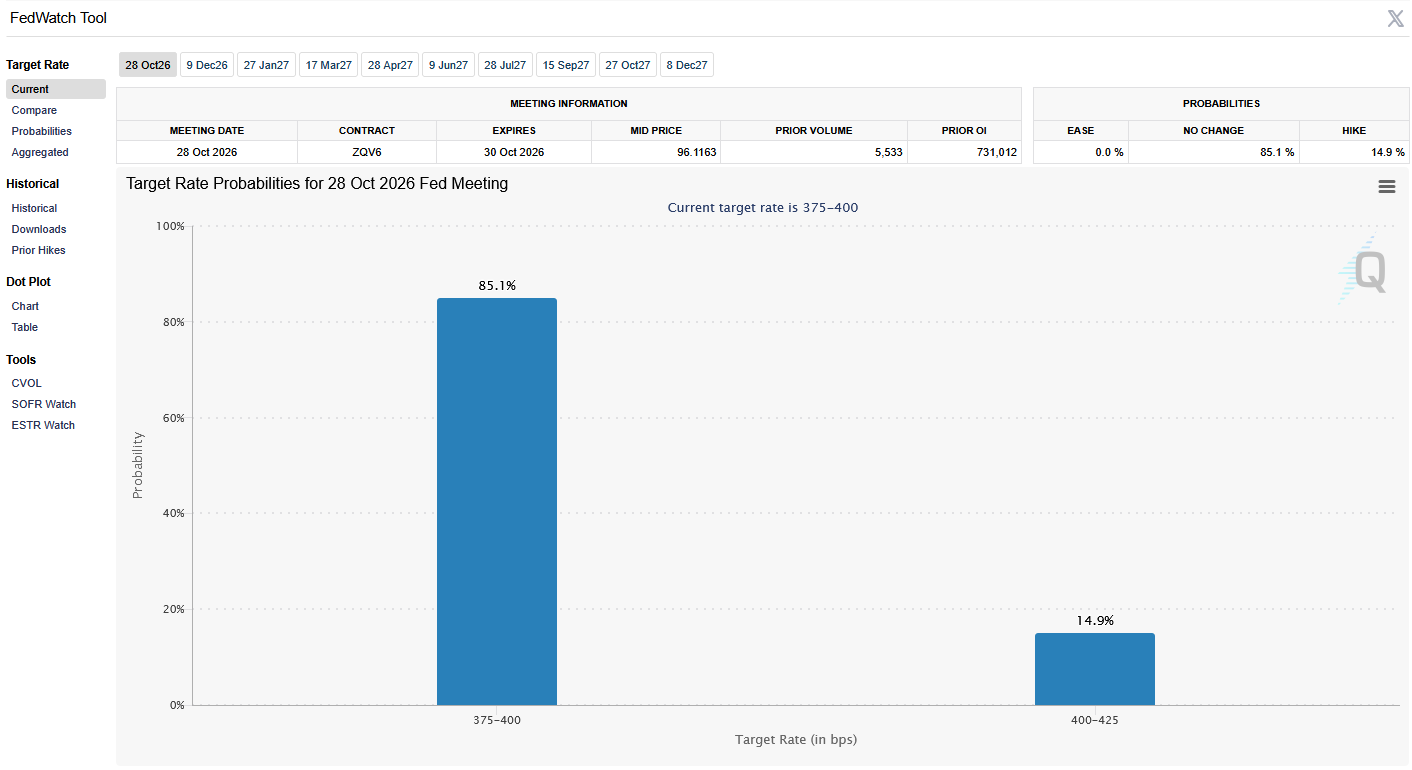
As we show, the market is assigning 85% odds the Fed holds rates steady next week.

Tweet of the Day
Trading Rules With Desktop Printout
“Want to achieve better long-term success in managing your portfolio? Here are our 15-trading rules for managing market risks.”
Please subscribe to the daily commentary to receive these updates every morning before the opening bell.
If you found this blog useful, please send it to someone else, share it on social media, or contact us to set up a meeting.