Heading into the September 16 FOMC meeting, the debate over whether the Fed should raise rates or hold is heated. To help you appreciate the range of views, we present this article as a courtroom exercise. We will let the prosecution make its case for a rate hike, and the defense make its case for a hold. We will render our verdict after both sides present their cases.
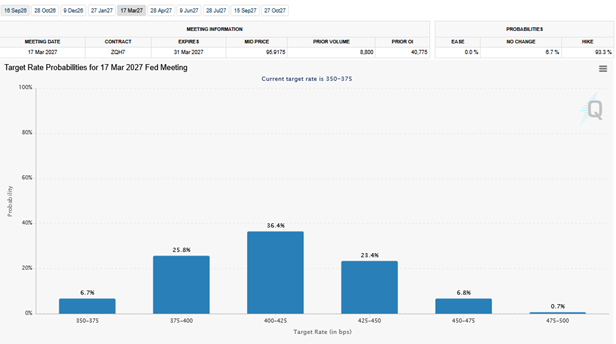
To set the stage, Fed funds futures are pricing in a 60% chance of a September rate hike, with further hikes possible at subsequent meetings. The graph below shows the market is pricing in a 36% chance of two rate hikes by mid-March 2027, with roughly equal 25% chances of three hikes or only one.
The Prosecution’s Case: Rate Hike
With the strong August BLS employment data, the case for a hike now has three legs.
The first is Fed Chair Kevin Warsh’s Jackson Hole address on August 28. His policy-related comments were direct: he wants to restore credibility to his pledge to get inflation back to 2% in short order. Below are comments we wrote in Warsh Makes A Hawkish Pivot:
Warsh was blunt in his assessment of inflation. He signaled the Fed may not be done fighting inflation, saying financial conditions didn’t look restrictive enough to him and that recent benign inflation readings hadn’t convinced him the trend was improving meaningfully. Per Warsh’s speech:
“And while this summer’s PCE and CPI readings were better than expected, they do not tell me that underlying trends have meaningfully improved.”
“Here is my standard: We must be confident that underlying inflation is moving to our objective, clearly and at sufficient speed. Otherwise, we have work to do. That’s our job . . . our mandate . . . and our charge to keep.”
In his words, Warsh says the Fed has “work to do.”
The second leg is the most recent BLS jobs report. Nonfarm payrolls jumped 162,000 in August, more than triple the 50,000 number Wall Street expected. Furthermore, the prior negative 23,000 number was revised upward to a positive 21,000, and the unemployment rate held steady at a historical low of 4.1%.
For the prosecution, that exhibit fits well with New York Fed President John Williams’s claim that rising bond yields simply “reflect the strength of the economy.” Fed Governor Lisa Cook, a more dovish member, seems to be coming around to the idea of rate hikes, telling reporters, “I would support an increase if it becomes necessary to bring inflation down. It may not.“

Beth Hammack- The Lead Prosector
Beth Hammack, President of the Cleveland Fed, has been the most consistently hawkish voice on the committee and presents the third leg- the persistence of high inflation. She dissented at the last FOMC meeting in favor of a hike, arguing that the Fed likely needs a sequence of rate increases rather than a single move, and has recently said that “now is the time to act.”
Hammack doesn’t seem concerned that higher interest rates will impede the economy. To wit,
One 25 basis point move probably doesn’t do a whole lot for the economy
Her overarching reasoning is that current rates aren’t restrictive; accordingly, they won’t bring inflation back to 2%.
I just don’t see it coming back on its own
Furthermore, she believes delaying rate hikes only makes the job harder later and that inflation is more broad-based than just oil.
Regarding the labor market, she has pushed back on weak-jobs narratives, saying she’s “still not seeing a problem” and pointing to unemployment close to full employment.
The labor market is right around my level of maximum employment.
Her employment view helps explain why she’s comfortable prioritizing fighting inflation over the health of the labor market. The most recent employment data will strengthen her opinion.
The Defense’s Case: Hold Rates Steady
The defense will not put much faith in the recent employment report. Instead, it will focus on the recent string of weak employment data and, importantly, the large revisions that have turned good job reports into bad ones. That skepticism over jobs data is warranted, as shown in the chart below.
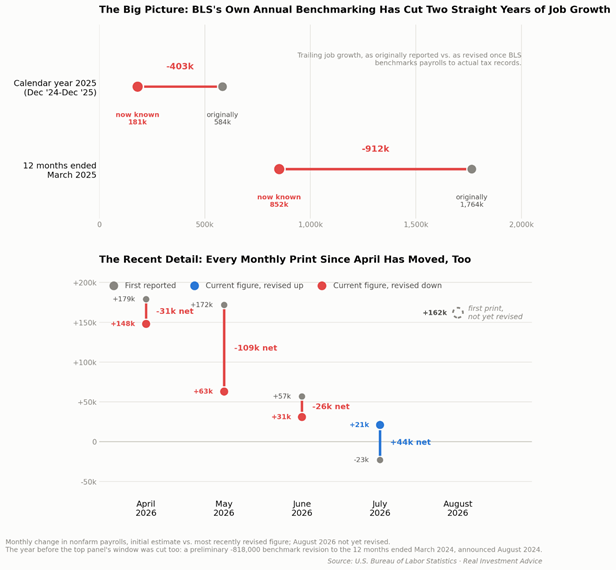
Twice a year, BLS benchmarks and revises the payroll survey against actual unemployment-insurance tax records. The preliminary 2025 benchmark knocked 911,000 jobs off the year ended March 2025, cutting average monthly growth in half from a reported 147,000 to 71,000. When it was finalized in January, calendar-year 2025 growth got cut again, from a reported 584,000 down to just 181,000. The year before that, the preliminary 2024 benchmark had already cut 818,000 jobs from the year ended March 2024.
More recently, April’s initial 179,000 gain is now 148,000, and May’s initial 172,000 gain is now just 63,000. July was reported as an outright loss of 23,000 jobs but has since been revised up to a positive 21,000. An economic data series that has been grossly overstated in two straight annual benchmarks and then turned a reported loss into a gain within a month is data that we must be dubious of. Last week’s gain of 162,000 jobs has not yet been revised.
Richmond Fed President Tom Barkin’s read on the underlying labor market is as follows: “It’s not loose, it’s not tight, it’s sort of been a weak balance,” he said, describing employers who are neither firing employees aggressively nor expanding their payrolls.

Inflation And Other Risks
On inflation, the defense will note that the July CPI report was benign. Headline CPI rose just 0.1% month-over-month, and core CPI rose 0.2%, but year-over-year rates of 3.4% headline and 2.5% core are above the Fed’s 2% target. The recent trend, not the dated annual comparison, is what should matter most for a forward-looking rate decision, and the monthly trend is cooling.
It’s worth adding that the Dallas Fed Trimmed Mean PCE, which ignores the most volatile components of PCE, sits at 2.28%, close to the Fed’s 2% target. At his Senate confirmation, Warsh cited the trimmed mean as a valuable inflation gauge. Furthermore, five-year inflation expectations, another tool many Fed members rely on, sit at 2.4%, slightly below where they were before the Iranian conflict.
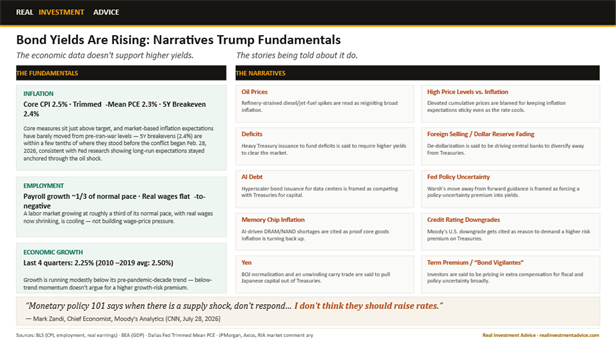
The defense’s strongest proponent may be Governor Waller, who argues against rate hikes. He believes that the forces pushing yields higher are largely outside the Fed’s price stability and full employment mandate. The forces include deficits, dollar concerns, AI-related capital needs, and the oil shock tied to shipping disruptions rather than domestic demand. Hiking to fight yield narratives risks a policy error.
The table below shows the fundamentals and narratives impacting the Fed’s decision.
The Evidence
To assess both sides, let’s review recent trends in the Fed’s two mandates: employment and prices.
Labor Markets
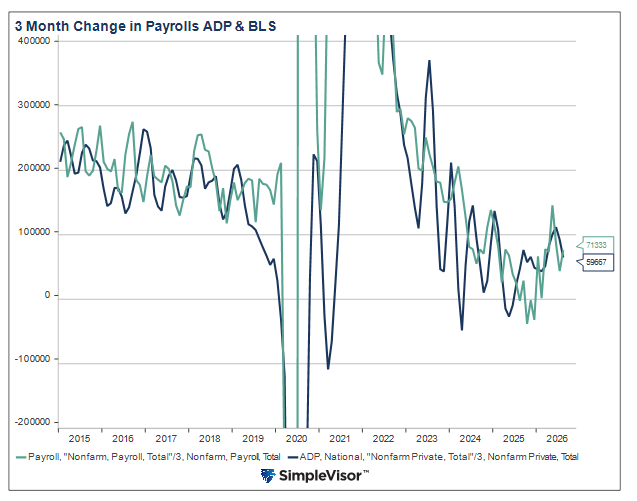
While the most recent labor data from the BLS was strong, we are highly skeptical, as negative revisions have plagued BLS data. Furthermore, recent ADP and JOLTS data offer little confirmation of a sharp pickup in hiring. The graph below showing the 3-month moving average of BLS and ADP highlights that 60k to 70k jobs are being added monthly, which is well below the 150k to 250k range preceding the pandemic. The labor force has grown by 8 million people since 2018, making recent data even worse in comparison.
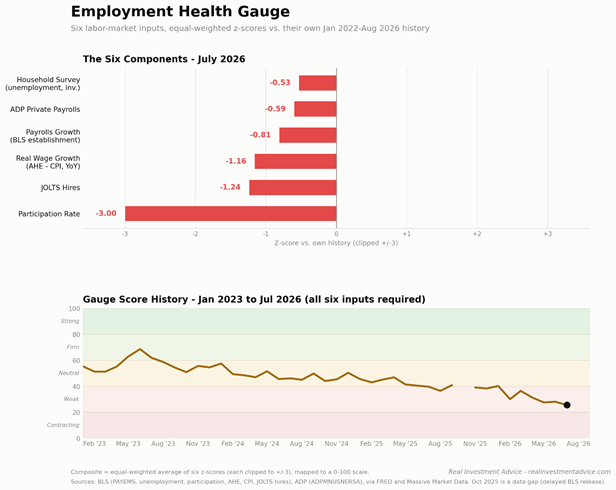
To better assess the labor market and its recent trend, we created a model using the following six factors:
- BLS household employment – survey of individuals
- BLS establishment employment – business survey and payroll records
- BLS labor participation rate
- ADP private payrolls
- Real wage growth
- JOLTS hires index
Our model expresses each of the six factors as a z-score against its own history since January 2022. This model doesn’t provide a historical reading on employment but shows that the weakening trend of the last few years has worsened over the last six months.

Inflation
The graph below shows that year-over-year Core CPI sits near 2.5%, almost exactly where it stood before the Iranian conflict started. Moreover, the slow trend toward 2% still appears intact. That said, headline CPI remains elevated at 3.4%.

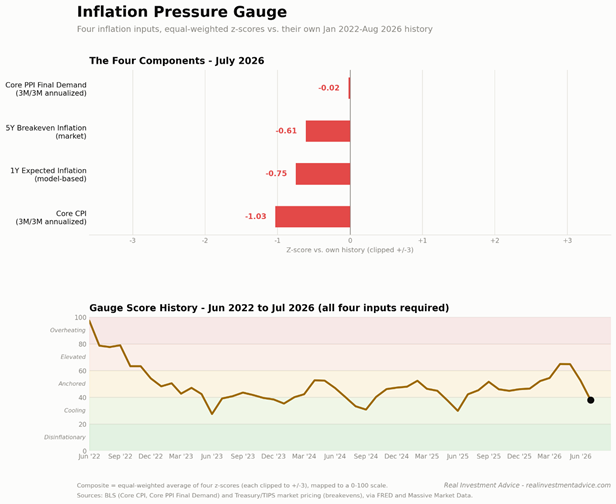
As we did with labor, we created an inflation trend model. This four-factor model compares the most recent three months of inflation data to the prior three months to detect trends.
Per the model shown below, inflation has been “anchored” since January 2023, albeit with a short spike coinciding with the Iranian conflict. Since then, the gauge has receded back toward 2025 levels and is now edging into the “cooling” zone. Like the employment gauge, all factors have a negative z-score, indicating the recent trend is softening.
Summary: Our Verdict
We are sympathetic to both sides. The prosecutor is 100% correct that we need to get inflation back to 2% as soon as possible. It has been above target for too long, and the Fed risks consumer and corporate spending behaviors changing in a pro-inflationary way. The debate at the Fed seems to come down to whether they let that occur naturally or force the issue.
The prosecuting side wants to raise rates to force inflation lower. The defense wants to wait, claiming the disinflationary trends that existed before the Iranian conflict are reasserting themselves and that higher rates could worsen an already weak labor market.
Some Fed members, including Warsh, claim that the recent spike in yields across the yield curve makes borrowing more restrictive for consumers and corporations, effectively doing the job for them.
We come down on the side of the defense, though the August employment number, assuming it holds up through revisions and similar strength persists, does weaken our case. Inflation should be hotly debated as it is. We are comfortable with recent trends and somewhat comfortable that, assuming oil prices don’t spike, price trends continue lower.
The credibility argument supporting a rate hike concerns us most. The idea is that the Fed needs to raise rates to address rising bond yields and reassert “credibility,” rather than respond to a confirmed breakdown in either of the Fed’s dual mandates.
Yields have risen largely because of an oil-driven supply shock and concerns about swelling fiscal deficits. The Fed’s short-term policy rate is poorly suited to address them.