



Momentum investing can give you an edge to earn better returns. That was the conclusion of a recent article by Brett Arends for Marketwatch. To wit:
“Its success “is a well-established empirical fact,” and can be demonstrated across multiple assets and over 212 years of stock market data argues money manager Cliff Asness and his colleagues. It is “the premier market anomaly,” writes analyst Gary Antonacci. It trounces a simple “buy and hold” stock market strategy going back almost 100 hundred years, estimates money manager Meb Faber.”
While the idea of momentum investing is appealing in a liquidity-driven bull market, is it always the best strategy? As noted in the “Best Way To Invest:”
The last decade has been a boon for the index ETF industry, financial applications, and media websites promoting “buy and hold” investing and diversification strategies.
But is the “best way to invest” during a bull market also the best way to invest during a bear market? Or, do different times call for different strategies?
That is the question we will explore further.

Momentum Investing Isn’t Passive
In Brett’s discussion, he compares several ETF funds over the past 5-years. To simply our analysis, we will use the following 3-ETF’s from 2014 to the present. (2014 is the earliest date that all 3-ETFs have performance data.)
- SPDR S&P 500 ETF (SPY) as the “buy and hold” proxy,
- IShares Momentum ETF (MTUM) as the “momentum” proxy; and,
- IShares Value ETF (IVE) as the “value” proxy.
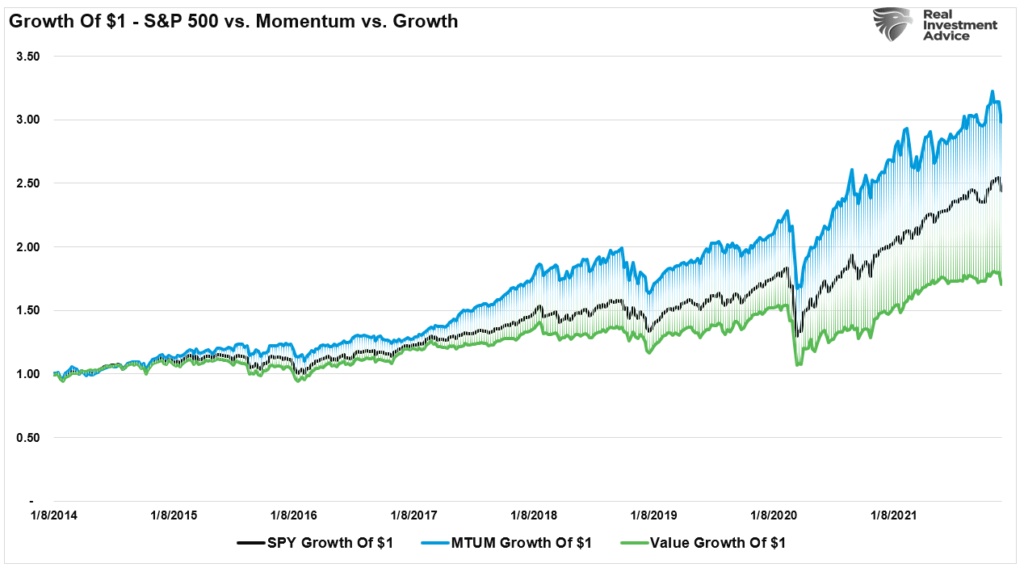
For the purposes of our analysis, we calculated the growth of $1 invested in each ETF from January 2014 on a nominal capital appreciation basis only.
At first blush, the clearly obvious choice for investors was momentum when compare to the S&P 500 or value.
So is that it? Just buy a “momentum” fund and forget about it?
As Brett says: “Not so fast.”
However, while I agree with Brett, it is for a different reason.
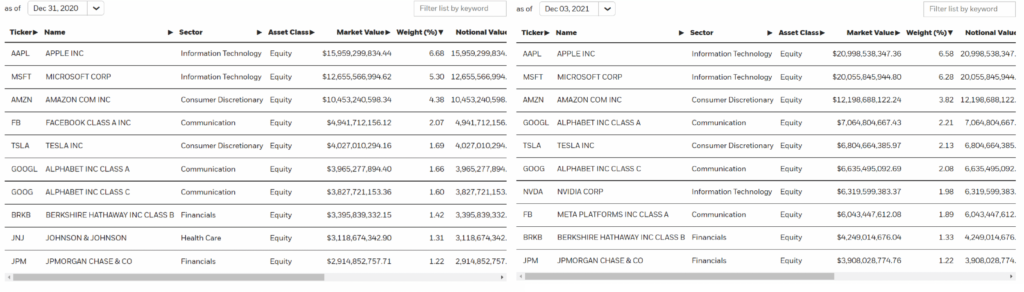
The problem with “Momentum investing,” is it is not a passive strategy. For example, if we look at the top-10 holdings of MTUM we see the changes being made to the ETF as momentum changes in the market.

For example, at the end of 2020, Danaher Corp (DHR) and Thermo Fisher (TMO) were in the top 10-holdings as the market was chasing heathcare related stocks due to the pandemic. However, by September 2021, as vaccines, bitcoin, and the yield curve was steepening, Paypal (PYPL,) Moderna (MRNA,) and major banks dominated the top-10. Just a couple of months later, Paypal is gone, Nvidia (NVDA), Costco (COST) and accounting stocks have been added.
However, if you hold SPY, there were no changes over the last year. In fact, the only difference in top-10 holdings is Nvidia (NVDA) due to its sharp ascent pushing its market capitalization into the top-10.
Again, momentum seems to be the obvious choice.
But it isn’t.

Momentum Investing Doesn’t Always Win
Brett makes a very important point about momentum investing.
Researchers say investing in so-called “momentum” stocks, is the best documented and most durable “edge” in the market.
Critically, that applies to owning individual equities in a portfolio. Not passivly holding an ETF.
There is a difference.
Yes, on a passive basis since 2014, momentum clearly outperformed both the benchmark and value indicies. However, passively holding an ETF negates the value of momentum investing.
“And there is an inbuilt cautious bias to this portfolio as well, because it only holds stocks that have positive trailing returns. In a bear market you may be invested in nothing whatsoever. As Meb Faber and others have pointed out, momentum strategies can help you avoid the worst market turmoil.” – Brett Arends
Read that again.
Momentum investing, as a strategy, raises cash when momentum of holdings turn negative. Such is not the case for an ETF which must remain invested at all times. If we break the comparative performance down into specific periods, the value of the momentum strategy gets lost.
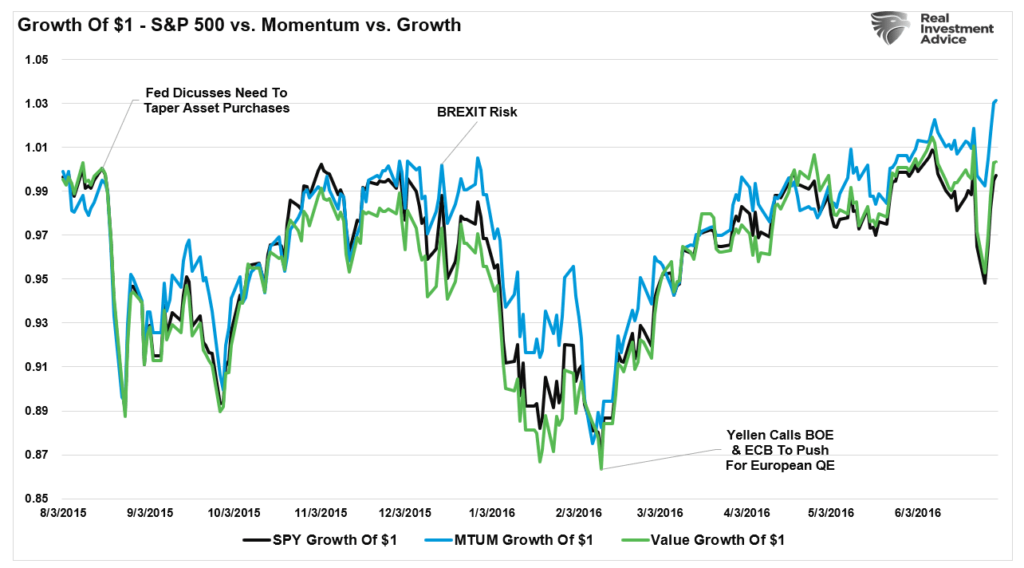
In 2105 and 2016, momentum provide no hedge agaisnt the Fed’s “taper” and Brexit.
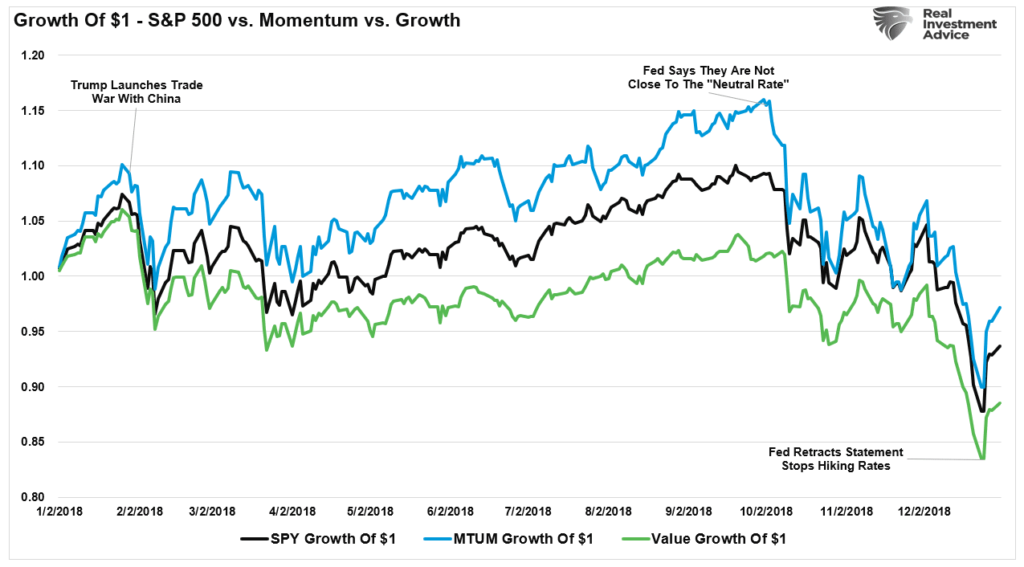
Similarly, in 2018, relative performance was worse than the benchmark during the Fed’s “taper tantrum.”
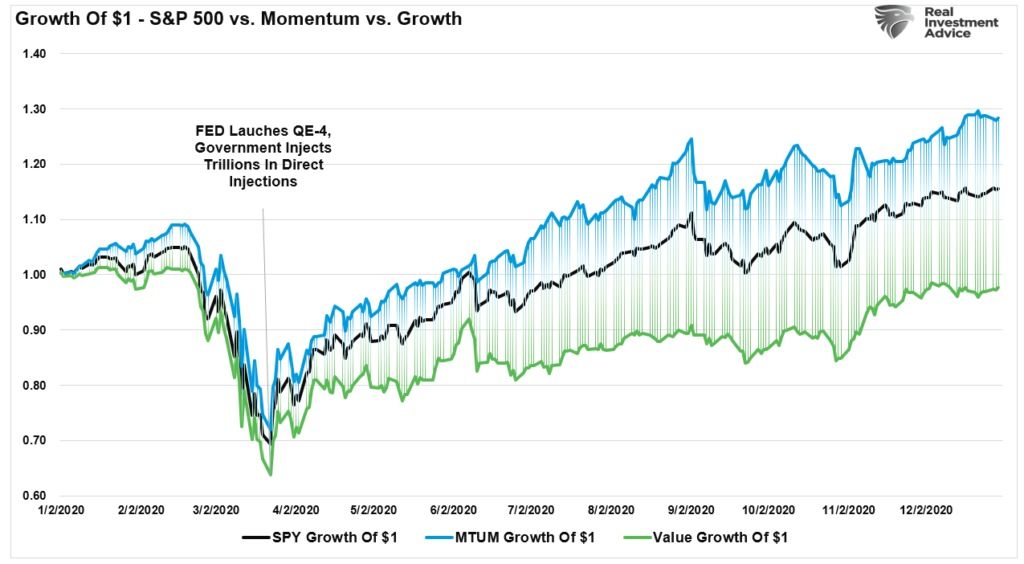
Holding a momentum ETF in early 2020 did little to shield you from the downturn. However, momentum clearly benefited from the recovery fueled by trillions in monetary and fiscal policies.
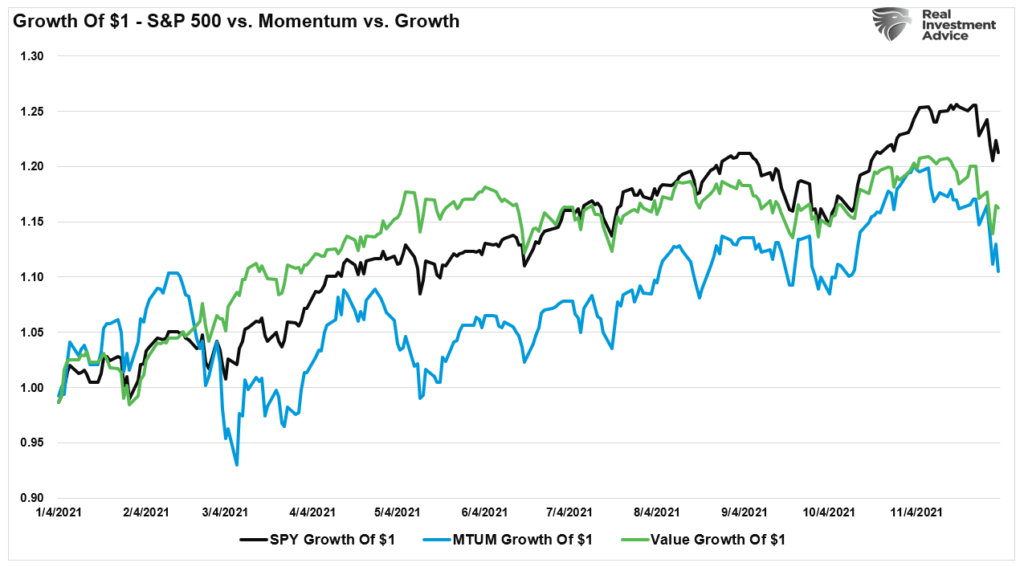
This year, holding a momentum ETF has significantly underpeformed the benchmarket index.
As Brett noted, the value of momentum investing, when applied to a portfolio of individual equities, is that it can help avoid significant capital destruction during market downturns.
However, the value of the momentum strategy gets lost when applying an active strategy into a passive holding.

Choosing The Right Strategy At The Right Time
Momentum investing, as a strategy, works very well when properly applied to a portfolio of individuals securities. Notably, as Brett points out:
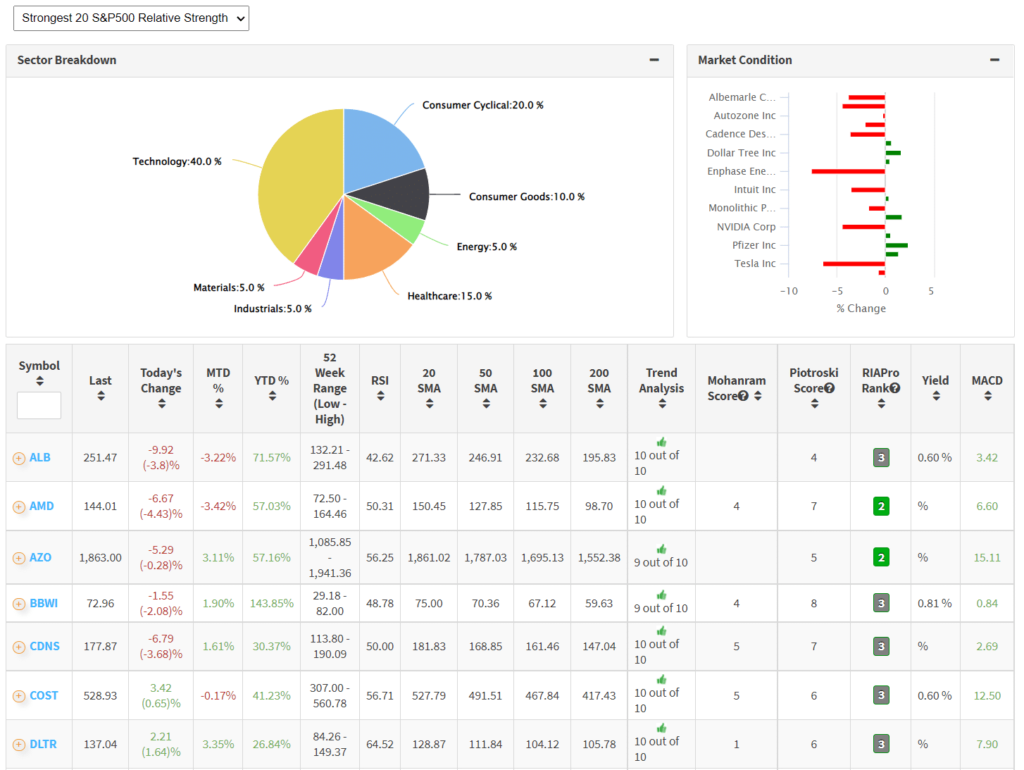
One of the most interesting aspects of this portfolio though is not only that it has a lot of hard numbers backing it up, but that it is in theory accessible to any ordinary investor who can screen stocks by monthly performance.
He is correct and is something that we provide at RIAPRO.NET on a daily basis as shown:
Momentum investing works exceptionally well during a strongly trending bull market. However, it is critical to remember that strategies change during a bear market. As shown below, market cycles then to lead economic cycles. As a result, investment strategies change with both economic and market cycles.
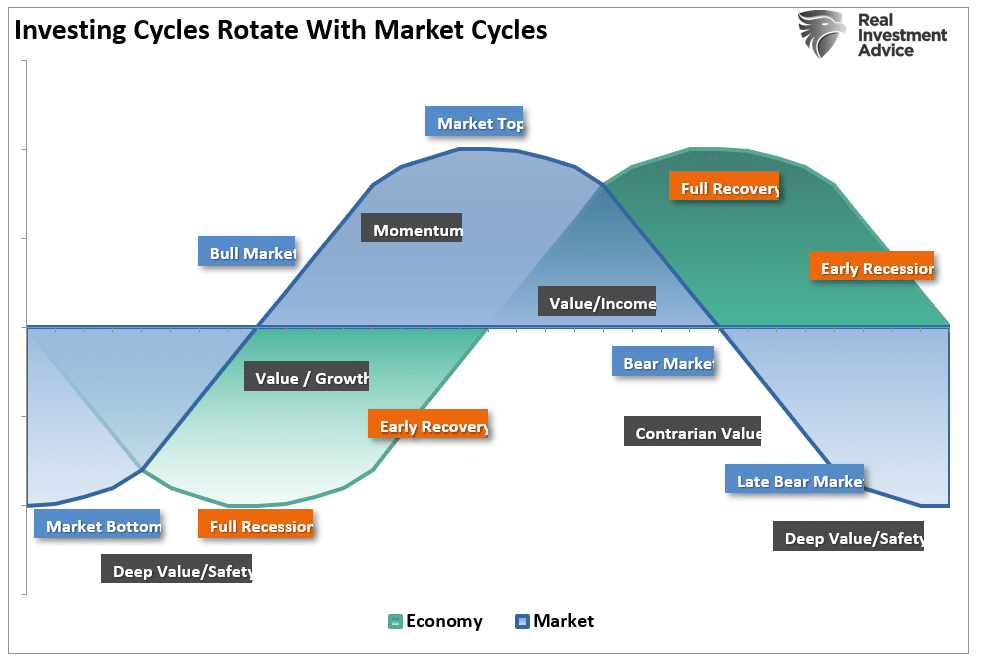
Such will be critically important when the next bear market begins.
The Return Of Value
As Brett aptly concludes:
My biggest problem with “momentum” as an investment strategy is that you are basically abandoning any attempt to do your own fundamental analysis whatsoever. It feels to me like the stock market equivalent of “social” media, jumping on the latest crowd mania regardless of any merits.
But maybe that’s why I should do it. If Rome is falling, and the Dark Ages are coming, shouldn’t I just give up and bet on the Vandals?”
I wouldn’t give up just yet.
The chart shows the difference in the performance of the “value vs growth” index. That index is compared to a pure growth index with each based on a $100 investment. Notable are the periods when “value investing” outperforms.
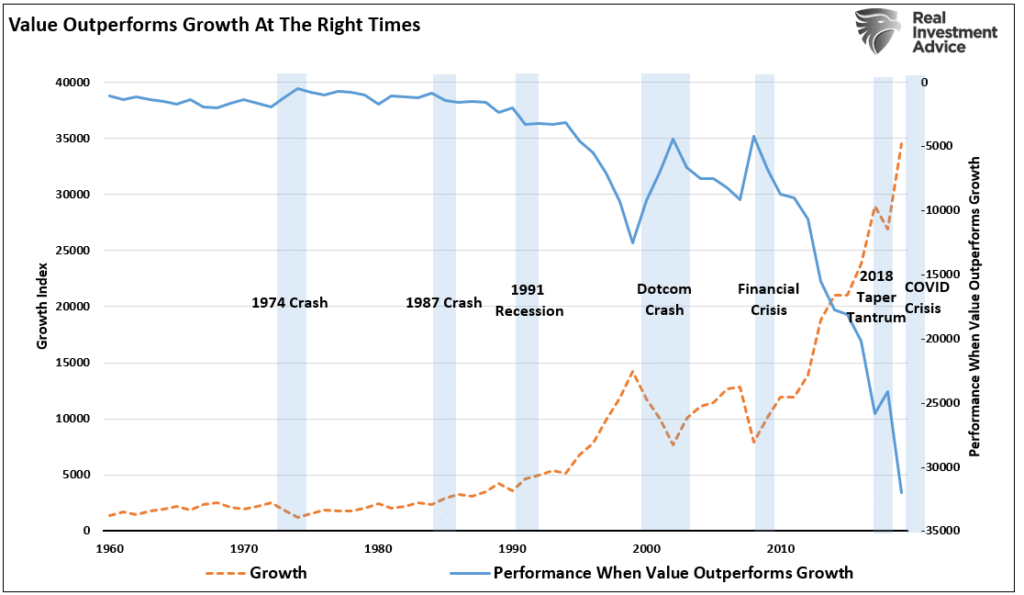
While it may seem like the current advance will never end, it would be unwise to abandon decades of investment history. As Howard Marks once stated:
“Rule No. 1: Most things will prove to be cyclical.
Rule No. 2: Some of the most exceptional opportunities for gain and loss come when other people forget Rule No. 1.”
The realization that nothing lasts forever is crucial to long term investing. To “buy low,” one must have first “sold high.” Understanding that all things are cyclical suggests investment strategies must change also.
The rotation from “momentum” to “value” is inevitable. It will occur against a backdrop of devastation for investors quietly lulled into the extreme sense of complacency following years of monetary interventions.
“Relative valuations are in the far tail of the historical distribution. If, as history suggests, there is any tendency for mean reversion, the expected future returns for value are elevated by almost any definition.” – Research Affiliates
The only question is whether you will be the buyer of “value” when everyone else is selling “momentum?”